. 2010 Dec 31;285(53):41455-62.
doi: 10.1074/jbc.M110.145466. Epub 2010 Nov 2.

Conserved residues within the putative S4-S5 region serve distinct functions among thermosensitive vanilloid transient receptor potential (TRPV) channels

Affiliations

Conserved residues within the putative S4-S5 region serve distinct functions among thermosensitive vanilloid transient receptor potential (TRPV) channels

Stepana Boukalova et al. J Biol Chem. .

Abstract

The vanilloid transient receptor potential channel TRPV1 is a tetrameric six-transmembrane segment (S1-S6) channel that can be synergistically activated by various proalgesic agents such as capsaicin, protons, heat, or highly depolarizing voltages, and also by 2-aminoethoxydiphenyl borate (2-APB), a common activator of the related thermally gated vanilloid TRP channels TRPV1, TRPV2, and TRPV3. In these channels, the conserved charged residues in the intracellular S4-S5 region have been proposed to constitute part of a voltage sensor that acts in concert with other stimuli to regulate channel activation. The molecular basis of this gating event is poorly understood. We mutated charged residues all along the S4 and the S4-S5 linker of TRPV1 and identified four potential voltage-sensing residues (Arg(557), Glu(570), Asp(576), and Arg(579)) that, when specifically mutated, altered the functionality of the channel with respect to voltage, capsaicin, heat, 2-APB, and/or their interactions in different ways. The nonfunctional charge-reversing mutations R557E and R579E were partially rescued by the charge-swapping mutations R557E/E570R and D576R/R579E, indicating that electrostatic interactions contribute to allosteric coupling between the voltage-, temperature- and capsaicin-dependent activation mechanisms. The mutant K571E was normal in all aspects of TRPV1 activation except for 2-APB, revealing the specific role of Lys(571) in chemical sensitivity. Surprisingly, substitutions at homologous residues in TRPV2 or TRPV3 had no effect on temperature- and 2-APB-induced activity. Thus, the charged residues in S4 and the S4-S5 linker contribute to voltage sensing in TRPV1 and, despite their highly conserved nature, regulate the temperature and chemical gating in the various TRPV channels in different ways.


Figures

FIGURE 1.
FIGURE 1.
Putative S4/S4–S5 segment of TRPV1. A, sequence comparison of the S4–S5 domain of rat TRPV1 (GenBank accession no. NM_031982) with that of hTRPV2 (NM_016113.3) and hTRPV3 (NP_659505.1). Protein sequences were aligned using MUSCLE multiple alignment software with Zappo score colors. B, homology model of the S4–S5 region of rTRPV1 taken from Ref. . C, residues described under “Results ” are indicated in bold type.
FIGURE 2.
FIGURE 2.
Voltage dependence of TRPV1 mutants. A, representative whole cell patch clamp current traces in response to a family of voltage steps in HEK293T cells transfected with wild-type and TRPV1 mutants in the absence (open symbols) or presence of 10 μm capsaicin (filled symbols). B, representative Boltzmann fits to conductances shown in A, obtained from steady-state currents at the end of the pulse (indicated by symbols in A), normalized to maximal conductance Gmax in 10 μm capsaicin. C, V1/2 for wild-type TRPV1 and indicated mutants in the absence (open bars) or presence of 10 μm capsaicin (filled bars). The asterisks indicate significance level. Under control conditions, some mutants did not reach half-maximal activation at voltages up to 200 mV. D, summary of voltage-independent component of capsaicin-induced gating (upward bars) and Gmax in 10 μm capsaicin (downward bars). Each bar is the mean ± S.E. (error bars); n > 4.
FIGURE 3.
FIGURE 3.
Mutations in S4 and the S4–S5 linker alter chemical sensitivity of TRPV1. A, sample recording of whole cell current responses to consecutive applications of capsaicin (1 μm) at −70 mV. B, averaged time constants obtained from monoexponential fit of the onset of first and second capsaicin response and deactivation times (T50) for all measurable mutants. The asterisks indicate significance level. C, whole cell currents in response to voltage protocol consisting of a 500-ms ramp from −70 mV to +100 mV applied every 2 s in the absence or presence of 10 μm capsaicin. D, averaged currents measured at 90 mV constructed from three to five independent recordings such as shown in C. The superimposed dotted line indicates wild type. Baseline was subtracted. E, 2-APB responses reduced by K571E mutation. Holding potential was −70 mV. F, mutation effects on 2-APB responses of TRPV1.
FIGURE 4.
FIGURE 4.
Mutations in S4 and the S4–S5 linker alter temperature sensitivity of TRPV1. A, representative recordings of whole cell current responses to application of 25–48 °C heat ramp (10 °C/s) at −70 mV. B, Arrhenius plot of whole cell currents obtained from representative cells shown in A, normalized at 25 °C (ordinate, log scale) and plotted against the reciprocal of absolute temperature (abscissa). Temperature coefficients Q10 were determined for each cell over the temperature range where the Arrhenius plot was linear (dashed lines). C, effects of mutations on Q10. Dotted line indicates the value at which the temperature dependence of the thermally induced currents is considered to be nonspecific, i.e. close to that of the aqueous diffusion limit (∼2). NT denotes nontransfected cells. Each bar is the mean ± S.E. (error bars); n = 33 for wild type and 3–15 for mutants.
FIGURE 5.
FIGURE 5.
Mutations homologous to those identified in TRPV1 do not alter temperature and chemical sensitivity in hTRPV2. A, representative recordings of whole cell current responses to application of 25–57 °C heat ramp (10–14 °C/s) recorded from cells expressing wild-type or mutant hTRPV2 in the absence or presence of 2-APB (300 μm) at −70 mV. B, Arrhenius plot of whole cell currents obtained from representative cells shown in A, normalized at 25 °C. Q10 was determined over the temperature range where the Arrhenius plot was linear (dashed lines). C, summary of Q10 determined for wild-type hTRPV2 and indicated mutants. Each bar is the mean ± S.E. (error bars); n = 10 for wild type and 3–6 for mutants.
FIGURE 6.
FIGURE 6.
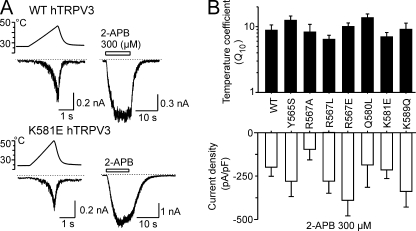
Mutations homologous to those identified in TRPV1 do not alter temperature and chemical sensitivity in hTRPV3. A, sample recording of whole cell current responses to consecutive application of 25–48 °C temperature ramp (10–14 °C/s) and 2-APB (300 μm) in hTRPV3 and K581E-hTRPV3. B, summary of Q10- and 2-APB-induced current densities determined for wild-type and mutant hTRPV3. Each bar is the mean ± S.E. (error bars); n = 9 for wild type and 3–7 for mutants. No significant changes were detected (p = 0.344).

References

    1. Caterina M. J., Schumacher M. A., Tominaga M., Rosen T. A., Levine J. D., Julius D. (1997) Nature 389, 816–824 - PubMed
    1. Voets T., Droogmans G., Wissenbach U., Janssens A., Flockerzi V., Nilius B. (2004) Nature 430, 748–754 - PubMed
    1. Tominaga M., Caterina M. J., Malmberg A. B., Rosen T. A., Gilbert H., Skinner K., Raumann B. E., Basbaum A. I., Julius D. (1998) Neuron 21, 531–543 - PubMed
    1. Matta J. A., Ahern G. P. (2007) J. Physiol. 585, 469–482 - PMC - PubMed
    1. Brauchi S., Orio P., Latorre R. (2004) Proc. Natl. Acad. Sci. U.S.A. 101, 15494–15499 - PMC - PubMed

Publication types

LinkOut - more resources