


Assessment of across-muscle coherence using multi-unit vs. single-unit recordings
- PMID: 21046368
- PMCID: PMC5706539
- DOI: 10.1007/s00221-010-2455-4
Assessment of across-muscle coherence using multi-unit vs. single-unit recordings
Abstract
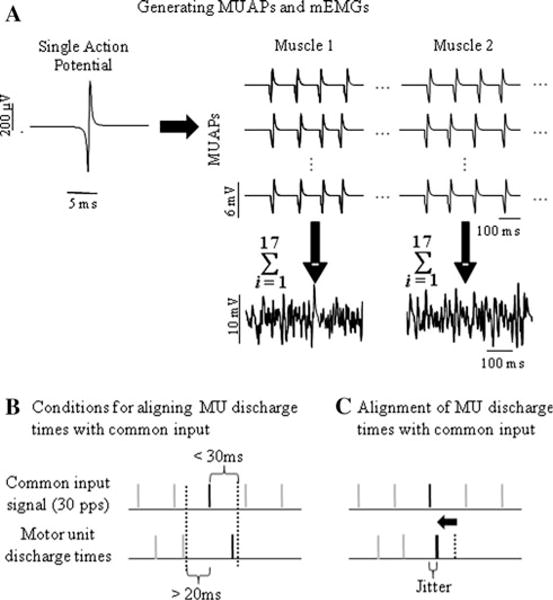
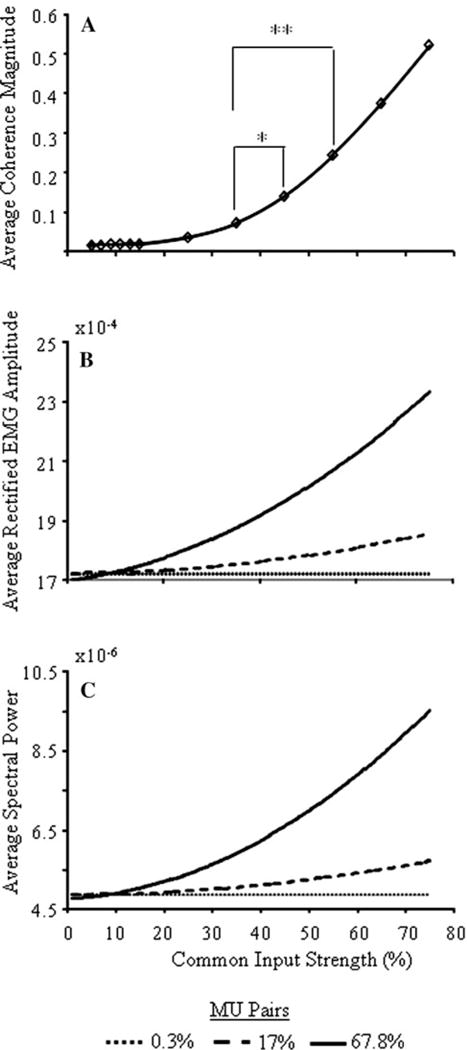
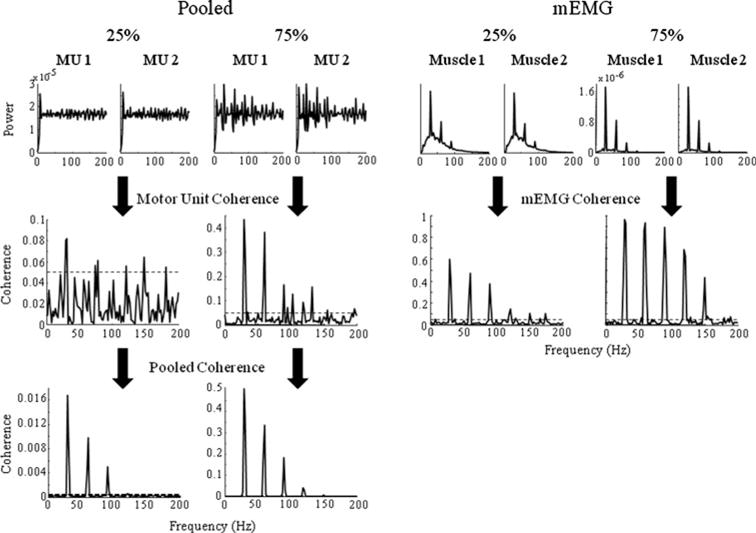
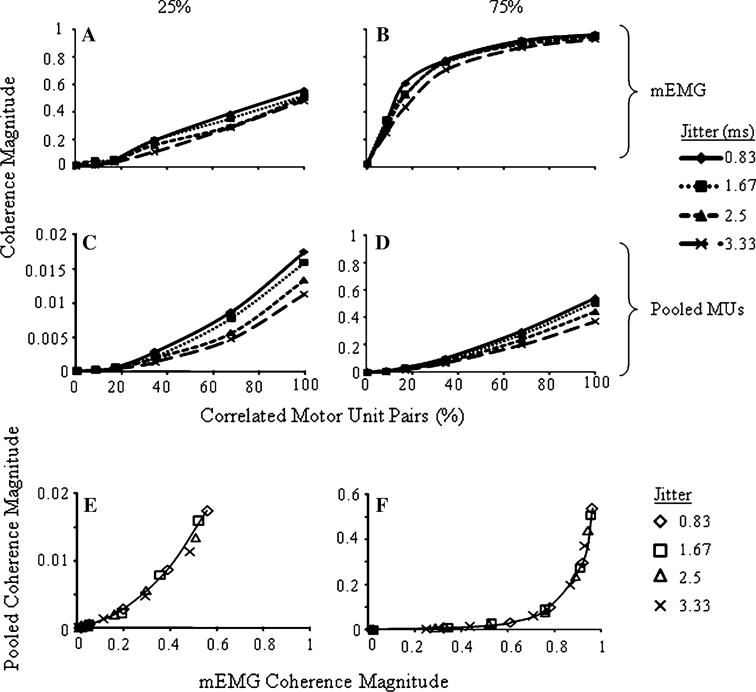
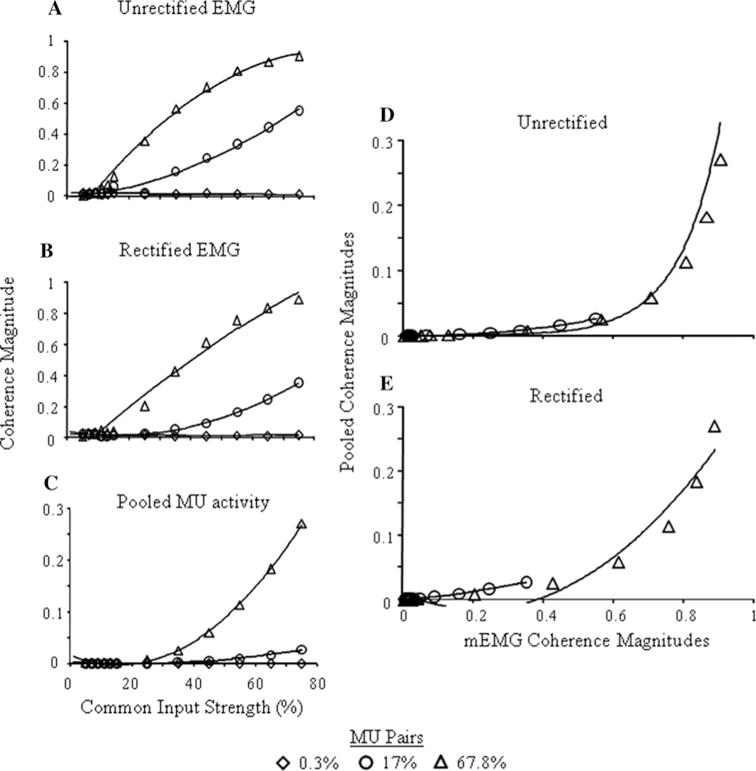
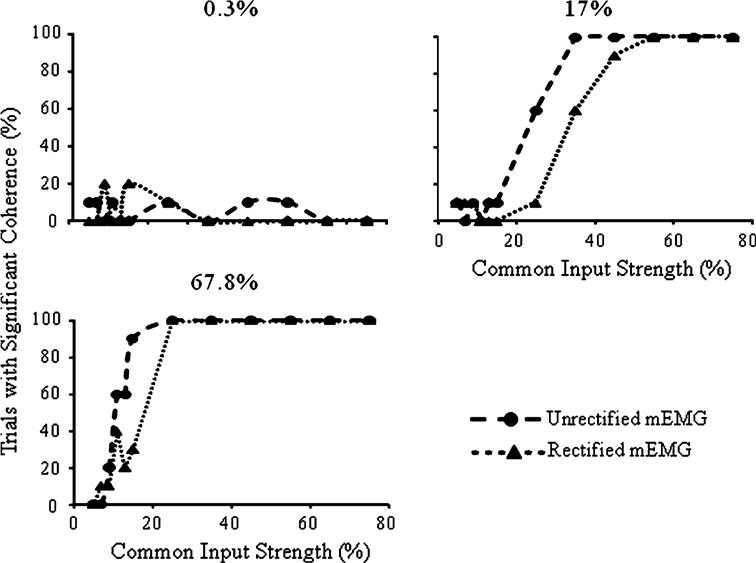
Coherence between electromyographic (EMG) signals has been used to identify correlated neural inputs to motor units (MUs) innervating different muscles. Simulations using a motor-unit model (Fuglevand et al. 1992) were performed to determine the ability of coherence between two multi-unit EMGs (mEMG) to detect correlated MU activity and the range of correlation strengths in which mEMG coherence can be usefully employed. Coherence between motor-unit and mEMG activities in two muscles was determined as we varied the strength of a 30-Hz periodic common input, the number of correlated MU pairs and variability of MU discharge relative to the common input. Pooled and mEMG coherence amplitudes positively and negatively accelerated, respectively, toward the strongest and most widespread correlating inputs. Furthermore, the relation between pooled and mEMG coherence was also nonlinear and was essentially the same whether correlation strength varied by changing common input strength or its distribution. However, the most important finding is that while the mEMG coherence saturates at the strongest common input strengths, this occurs at common input strengths greater than found in most physiological studies. Thus, we conclude that mEMG coherence would be a useful measure in many experimental conditions and our simulation results suggest further guidelines for using and interpreting coherence between mEMG signals.
Figures
References
-
- Amjad AM, Halliday DM, Rosenberg JR, Conway BA. An extended difference of coherence test for comparing and combining several independent coherence estimates: theory and application to the study of motor units and physiological tremor. J Neurosci Methods. 1997;73:69–79. - PubMed
-
- Ashby P, Zilm D. Relationship between EPSP shape and cross-correlation profile explored by computer simulation for studies on human motoneurons. Exp Brain Res. 1982;47:33–40. - PubMed
-
- Baker SN, Kilner JM, Pinches EM, Lemon RN. The role of synchrony and oscillations in the motor output. Exp Brain Res. 1999;128:109–117. - PubMed
-
- Binder MD, Powers RK. Relationship between simulated common synaptic input and discharge synchrony in cat spinal motoneurons. J Neurophysiol. 2001;86:2266–2275. - PubMed
-
- Christakos CN. Analysis of synchrony (correlations) in neural populations by means of unit-to-aggregate coherence computation. Neurosci. 1994;58:43–57. - PubMed
Publication types
MeSH terms
Grants and funding
LinkOut - more resources
Full Text Sources
Research Materials
