


Circulating microRNAs as blood-based markers for patients with primary and metastatic breast cancer
- PMID: 21047409
- PMCID: PMC3046429
- DOI: 10.1186/bcr2766
Circulating microRNAs as blood-based markers for patients with primary and metastatic breast cancer
Abstract
Introduction: MicroRNAs (miRs) are interesting new diagnostic targets that may provide important insights into the molecular pathogenesis of breast cancer. Here we evaluated, for the first time, the feasibility and clinical utility of circulating miRs as biomarkers for the detection and staging of breast cancer.
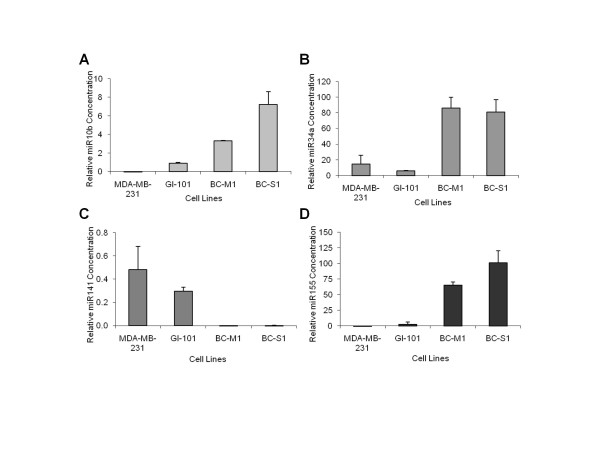
Methods: The relative concentrations of breast cancer-associated miR10b, miR34a, miR141 and miR155 were measured in the blood serum of 89 patients with primary breast cancer (M0, n = 59) and metastatic disease (M1, n = 30), and 29 healthy women by a TaqMan MicroRNA Assay.
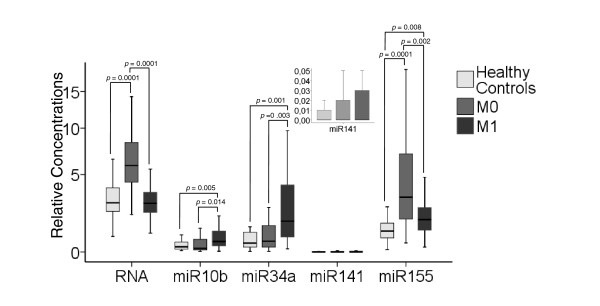
Results: The relative concentrations of total RNA (P = 0.0001) and miR155 (P = 0.0001) in serum significantly discriminated M0-patients from healthy women, whereas miR10b (P = 0.005), miR34a (P = 0.001) and miR155 (P = 0.008) discriminated M1-patients from healthy controls. In breast cancer patients, the changes in the levels of total RNA (P = 0.0001), miR10b (P = 0.01), miR34a (P = 0.003) and miR155 (P = 0.002) correlated with the presence of overt metastases. Within the M0-cohort, patients at advanced tumor stages (pT3 to 4) had significantly more total RNA (P = 0.0001) and miR34a (P = 0.01) in their blood than patients at early tumor stages (pT1 to 2).
Conclusions: This pilot study provides first evidence that tumor-associated circulating miRs are elevated in the blood of breast cancer patients and associated with tumor progression.
Figures
Comment in
-
Circulating microRNAs: promising breast cancer Biomarkers.Breast Cancer Res. 2011 Feb 4;13(1):402; author reply 403. doi: 10.1186/bcr2798. Breast Cancer Res. 2011. PMID: 21345257 Free PMC article. No abstract available.
References
Publication types
MeSH terms
Substances
LinkOut - more resources
Full Text Sources
Other Literature Sources
Medical
