Where does attention go when it moves? Spatial properties and locus of the attentional repulsion effect
- PMID: 21047765
- PMCID: PMC2998340
- DOI: 10.1167/10.12.33
Where does attention go when it moves? Spatial properties and locus of the attentional repulsion effect
Abstract
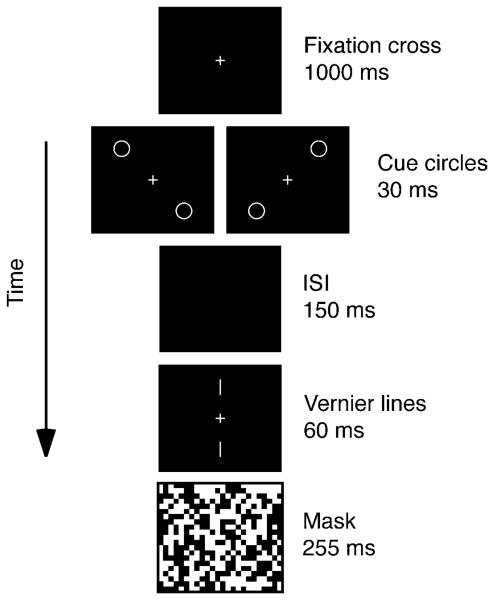
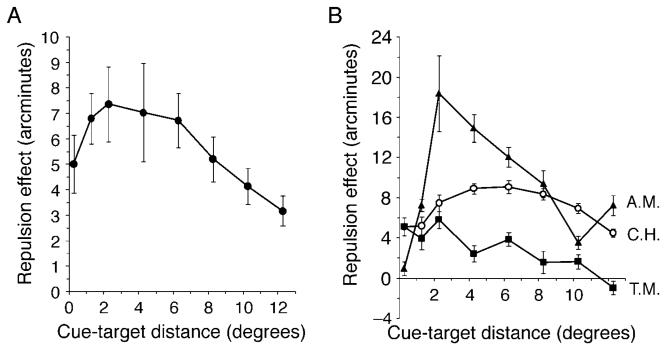
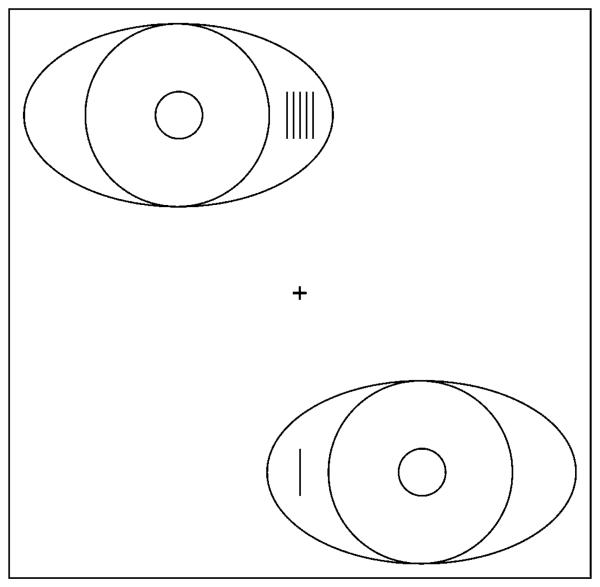
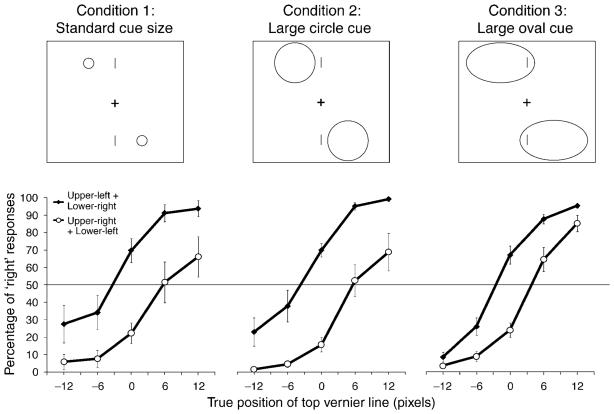
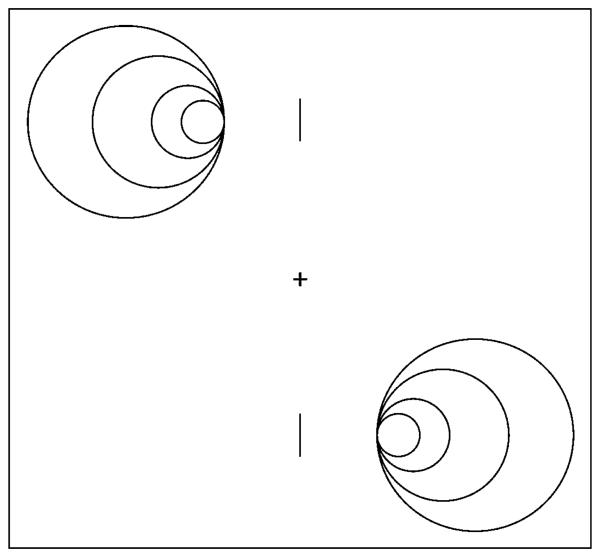
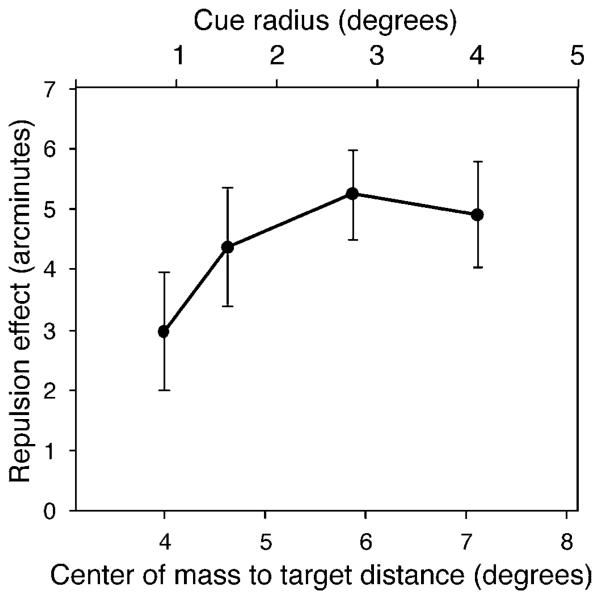
Reliable effects of spatial attention on perceptual measures have been well documented, yet little is known about how attention affects perception of space per se. The present study examined the effects of involuntary shifts of spatial attention on perceived location using a paradigm developed by S. Suzuki and P. Cavanagh (1997) that produces an attentional repulsion effect (ARE). The ARE refers to the illusory displacement of two vernier lines away from briefly presented cues. In Experiment 1, we show that the magnitude of the ARE depends on cue-target distance, indicating that the effects of attention on perceived location are not uniform across the visual field. Experiments 2 and 3 tested whether repulsion occurs away from cue center of mass or from cue contour. Perceived repulsion always occurred away from the cues' center of mass, regardless of the arrangement of the cue contours relative to the vernier lines. Moreover, the magnitude of the ARE varied with shifts in the position of the cues' center of mass. These experiments suggest that the onset of the cue produces a shift of attention to its center of mass rather than to the salient luminance contours that define it, and that this mechanism underlies the ARE.
Figures
References
-
- Adam JJ, Huys R, van Loon EM, Kingma H, Paas FG. Effects of spatial and symbolic precues on localization performance. Psychological Research. 2000;64:66–80. - PubMed
-
- Alvarez GA, Scholl BJ. How does attention select and track spatially extended objects? New effects of attentional concentration and amplification. Journal of Experimental Psychology: General. 2005;134:461–476. - PubMed
-
- Anton-Erxleben K, Henrich C, Treue S. Attention changes perceived size of moving visual patterns. Journal of Vision. 2007;7(11):5, 1–9. http://www.journalofvision.org/content/7/11/5, doi:10.1167/7.11.5. [PubMed][Article] - PubMed
Publication types
MeSH terms
Grants and funding
LinkOut - more resources
Full Text Sources