. 2011 May 22;278(1711):1489-97.
doi: 10.1098/rspb.2010.1747. Epub 2010 Nov 3.

Subretinal electronic chips allow blind patients to read letters and combine them to words

Affiliations

Subretinal electronic chips allow blind patients to read letters and combine them to words

Eberhart Zrenner et al. Proc Biol Sci. .

Abstract

A light-sensitive, externally powered microchip was surgically implanted subretinally near the macular region of volunteers blind from hereditary retinal dystrophy. The implant contains an array of 1500 active microphotodiodes ('chip'), each with its own amplifier and local stimulation electrode. At the implant's tip, another array of 16 wire-connected electrodes allows light-independent direct stimulation and testing of the neuron-electrode interface. Visual scenes are projected naturally through the eye's lens onto the chip under the transparent retina. The chip generates a corresponding pattern of 38 × 40 pixels, each releasing light-intensity-dependent electric stimulation pulses. Subsequently, three previously blind persons could locate bright objects on a dark table, two of whom could discern grating patterns. One of these patients was able to correctly describe and name objects like a fork or knife on a table, geometric patterns, different kinds of fruit and discern shades of grey with only 15 per cent contrast. Without a training period, the regained visual functions enabled him to localize and approach persons in a room freely and to read large letters as complete words after several years of blindness. These results demonstrate for the first time that subretinal micro-electrode arrays with 1500 photodiodes can create detailed meaningful visual perception in previously blind individuals.


Figures
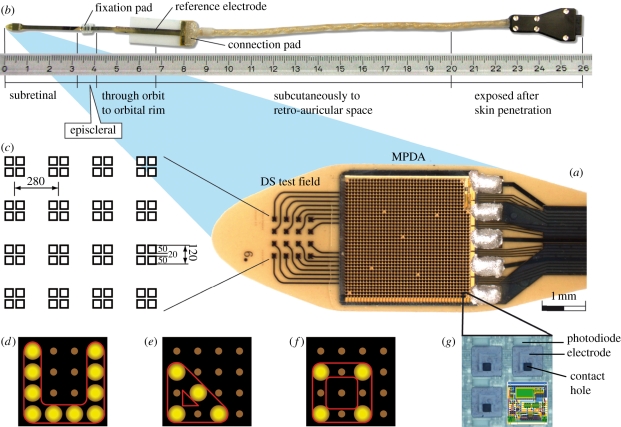
Figure 1.
Figure 1.
Subretinal implant. (a) The microphotodiode array (MPDA) is a light sensitive 3.0 × 3.1 mm CMOS-chip with 1500 pixel-generating elements on a 20 µm thick polyimide foil carrying an additional test field with 16 electrodes for direct electrical stimulation (DS test field). (b) The foil exits approximately 25 mm away from the tip at the equator of the eyeball and is attached to the sclera by means of a small fixation pad looping through the orbit to a subcutaneous silicone cable that connects via a plug behind the ear to a power control unit. (c) Magnification of the DS electrode array showing the 16 quadruple electrodes and their dimensions. (d) Pattern stimulation via DS array (e.g. ‘U’). (e,f) switching from a triangle to a square by shifting stimulation of a single electrode. (g) Magnification of four of the 1500 elements (‘pixels’), showing the rectangular photodiodes above each squared electrode and its contact hole that connects it to the amplifier circuit (overlaid sketch).
Figure 2.
Figure 2.
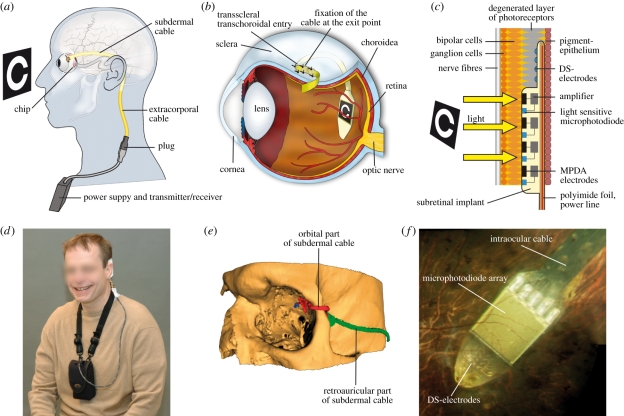
Implant position in the body. (a) The cable from the implanted chip in the eye leads under the temporal muscle to the exit behind the ear, and connects with a wirelessly operated power control unit. (b) Position of the implant under the transparent retina. (c) MPDA photodiodes, amplifiers and electrodes in relation to retinal neurons and pigment epithelium. (d) Patient with wireless control unit attached to a neckband. (e) Route of the polyimide foil (red) and cable (green) in the orbit in a three-dimensional reconstruction of CT scans. (f) Photograph of the subretinal implant's tip at the posterior eye pole through a patient's pupil.
Figure 3.
Figure 3.
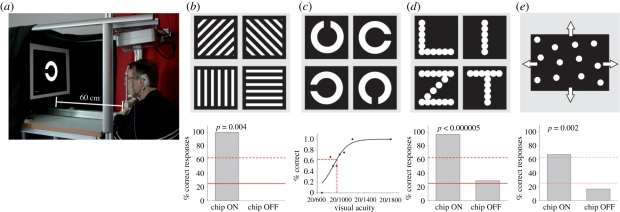
Recognition of projected targets (set up 1) (a) Set up for projecting targets on a screen. (b) Gratings of variable width, distance and luminance, presented individually in a ‘four-alternative forced choice’ mode (4AFC). (c) Landolt ‘C’ ring used in clinical tests of visual acuity. (d) Letters (8.5 cm high, 1.7 cm line width). (e) Random dot pattern moving in four different directions to assess spatio-temporal resolution. The inserts under each panel show the best results of patient 2 with the chip turned on and chip turned off. Solid line, chance rate; dashed line, psychometrically accepted recognition threshold; probability p as estimated from the binomial function.
Figure 4.
Figure 4.
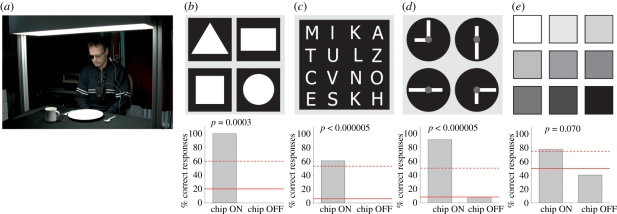
Recognition of objects (set up 2) (a) White items on a homogeneously illuminated black tablecloth. (b) Differentiation of four geometric objects with identical surface areas. (c) Differentiation of capital letters (height 5–8 cm). (d) Clock face for testing angle and size recognition. (e) Cards of different luminance presented in pairs to determine contrast vision. The respective inserts under each panel show the best results of patient 2 with the chip turned on and off. Solid line, chance rate; dashed line, psychometrically accepted recognition threshold; probability p as estimated from the binomial function (see electronic supplementary material, chapter 3b).

Similar articles

Cited by

References

    1. Congdon N., O'Colmain B., Klaver C. C., Klein R., Munoz B., Friedman D. S., Kempen J., Taylor H. R., Mitchell P. 2004. Causes and prevalence of visual impairment among adults in the United States. Arch. Ophthalmol. 122, 477–485 - PubMed
    1. Jones B. W., Marc R. E. 2005. Retinal remodeling during retinal degeneration. Exp. Eye Res. 81, 123–13710.1016/j.exer.2005.03.006 (doi:10.1016/j.exer.2005.03.006) - DOI - DOI - PubMed
    1. Zrenner E. 2002. Will retinal implants restore vision? Science 295, 1022–102510.1126/science.1067996 (doi:10.1126/science.1067996) - DOI - DOI - PubMed
    1. Rizzo J. F., 3rd, Wyatt J., Loewenstein J., Kelly S., Shire D. 2003. Perceptual efficacy of electrical stimulation of human retina with a microelectrode array during short-term surgical trials. Invest. Ophthalmol. Vis. Sci. 44, 5362–536910.1167/iovs.02-0817 (doi:10.1167/iovs.02-0817) - DOI - DOI - PubMed
    1. Dommel N. B., Wong Y. T., Lehmann T., Lovell N. H., Suaning G. J. 2009. A CMOS retinal neurostimulator capable of focussed, simultaneous stimulation. J. Neural Eng. 6, 035006.10.1088/1741-2560/6/3/035006 (doi:10.1088/1741-2560/6/3/035006) - DOI - DOI - PubMed

LinkOut - more resources