


Digit ratios predict polygyny in early apes, Ardipithecus, Neanderthals and early modern humans but not in Australopithecus
- PMID: 21047863
- PMCID: PMC3081742
- DOI: 10.1098/rspb.2010.1740
Digit ratios predict polygyny in early apes, Ardipithecus, Neanderthals and early modern humans but not in Australopithecus
Abstract
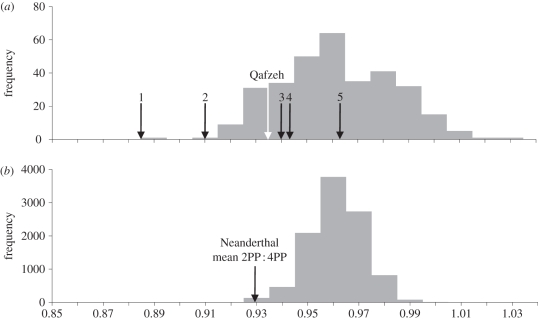
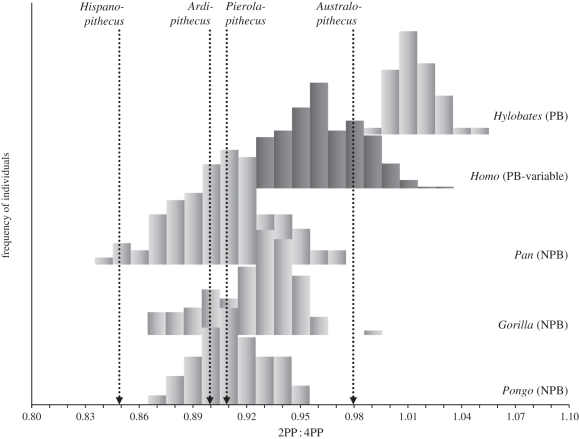
Social behaviour of fossil hominoid species is notoriously difficult to predict owing to difficulties in estimating body size dimorphism from fragmentary remains and, in hominins, low canine size dimorphism. Recent studies have shown that the second-to-fourth digit ratio (2D : 4D), a putative biomarker for prenatal androgen effects (PAEs), covaries with intra-sexual competition and social systems across haplorrhines; non-pair-bonded polygynous taxa have significantly lower 2D : 4D ratios (high PAE) than pair-bonded monogamous species. Here, we use proximal phalanx ratios of extant and fossil specimens to reconstruct the social systems of extinct hominoids. Pierolapithecus catalaunicus, Hispanopithecus laietanus and Ardipithecus ramidus have ratios consistent with polygynous extant species, whereas the ratio of Australopithecus afarensis is consistent with monogamous extant species. The early anatomically modern human Qafzeh 9 and Neanderthals have lower digit ratios than most contemporary human populations, indicating increased androgenization and possibly higher incidence of polygyny. Although speculative owing to small sample sizes, these results suggest that digit ratios represent a supplementary approach for elucidating the social systems of fossil hominins.
Figures
References
-
- Plavcan M. J., van Schaik C. P. 1992. Intrasexual competition and canine dimorphism in anthropoid primates. Am. J. Phys. Anthropol. 87, 461–477 10.1002/ajpa.1330870407 (doi:10.1002/ajpa.1330870407) - DOI - PubMed
-
- Lockwood C. A., Menter C. G., Moggie-Cecchi J., Keyser A. W. 2007. Extended male growth in a fossil hominin species. Science 318, 1443–1446 10.1126/science.1149211 (doi:10.1126/science.1149211) - DOI - PubMed
-
- Plavcan M. J. 2004. Sexual selection, measures of sexual selection, and sexual dimorphism in primates. In Sexual selection in primates: new and comparative perspectives on sexual selection, measures of sexual selection, and sexual dimorphism in primates (eds Kappeler P., van Schaik C.), pp. 230–353 Cambridge, UK: Cambridge University Press
-
- Reno P. L., Meindl R. S., McCollum M. A., Lovejoy C. O. 2003. Sexual dimorphism in Australopithecus afarensis was similar to that of modern humans. Proc. Natl Acad. Sci. USA 100, 9404–9409 10.1073/pnas.1133180100 (doi:10.1073/pnas.1133180100) - DOI - PMC - PubMed
-
- Plavcan M. J., Ward C. V., Paulus F. L. 2009. Estimating canine tooth crown height in early Australopithecus. J. Hum. Evol. 57, 2–10 10.1016/j.jhevol.2009.04.005 (doi:10.1016/j.jhevol.2009.04.005) - DOI - PubMed
Publication types
MeSH terms
LinkOut - more resources
Full Text Sources
