


Human LDL core cholesterol ester packing: three-dimensional image reconstruction and SAXS simulation studies
- PMID: 21047995
- PMCID: PMC3023545
- DOI: 10.1194/jlr.M011569
Human LDL core cholesterol ester packing: three-dimensional image reconstruction and SAXS simulation studies
Abstract
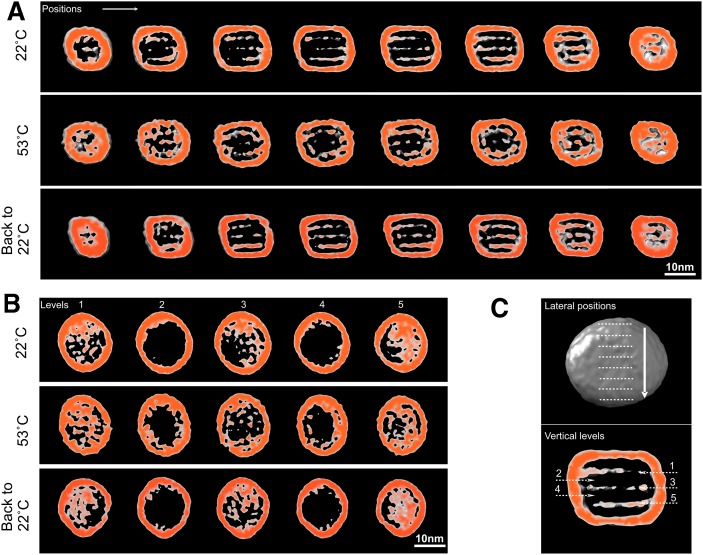
Human LDL undergoes a reversible thermal order-disorder phase transition associated with the cholesterol ester packing in the lipid core. Structural changes associated with this phase transition have been shown to affect the resistance of LDL to oxidation in vitro studies. Previous electron cryo-microscopy studies have provided image evidence that the cholesterol ester is packed in three flat layers in the core at temperatures below the phase transition. To study changes in lipid packing, overall structure and particle morphology in three dimensions (3D) subsequent to the phase transition, we cryo-preserved human LDL at a temperature above phase transition (53°C) and examined the sample by electron microscopy and image reconstruction. The LDL frozen from 53°C adopted a different morphology. The central density layer was disrupted and the outer two layers formed a "disrupted shell"-shaped density, located concentrically underneath the surface density of the LDL particle. Simulation of the small angle X-ray scattering curves and comparison with published data suggested that this disrupted shell organization represents an intermediate state in the transition from isotropic to layered packing of the lipid. Thus, the results revealed, with 3D images, the lipid packing in the dynamic process of the LDL lipid-core phase transition.
Figures




Comment in
-
Human low density lipoprotein: the mystery of core lipid packing.J Lipid Res. 2011 Feb;52(2):187-8. doi: 10.1194/jlr.E013417. Epub 2010 Dec 3. J Lipid Res. 2011. PMID: 21131533 Free PMC article. No abstract available.
References
-
- Hevonoja T., Pentikainen M. O., Hyvonen M. T., Kovanen P. T., Ala-Korpela M. 2000. Structure of low density lipoprotein (LDL) particles: basis for understanding molecular changes in modified LDL. Biochim. Biophys. Acta. 1488: 189–210. - PubMed
-
- Mahley R. W., Innerarity T. L., Rall S. C., Jr, Weisgraber K. H. 1984. Plasma lipoproteins: apolipoprotein structure and function. J. Lipid Res. 25: 1277–1294. - PubMed
-
- Goldstein J. L., Brown M. S. 1976. The LDL pathway in human fibroblasts: a receptor-mediated mechanism for the regulation of cholesterol metabolism. Curr. Top. Cell. Regul. 11: 147–181. - PubMed
Publication types
MeSH terms
Substances
Grants and funding
LinkOut - more resources
Full Text Sources
Medical
