


Variable dietary management of methylmalonic acidemia: metabolic and energetic correlations
- PMID: 21048060
- PMCID: PMC3001598
- DOI: 10.3945/ajcn.110.004341
Variable dietary management of methylmalonic acidemia: metabolic and energetic correlations
Abstract
Background: Isolated methylmalonic acidemia (MMA) is managed by dietary protein restriction and medical food supplementation. Resting energy expenditure (REE) can be depressed in affected individuals for undefined reasons.
Objective: The objective was to document the spectrum of nutritional approaches used to treat patients with MMA, measure REE, and analyze the dependence of REE on body composition, biochemical, and nutritional variables.
Design: Twenty-nine patients with isolated MMA (22 mut, 5 cblA, 2 cblB; 15 males, 14 females; age range: 2-35 y) underwent evaluation. REE was measured with open-circuit calorimetry and compared with predicted values by using age-appropriate equations.
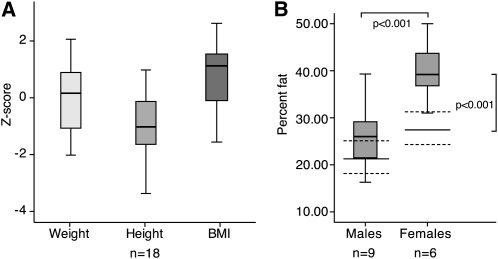
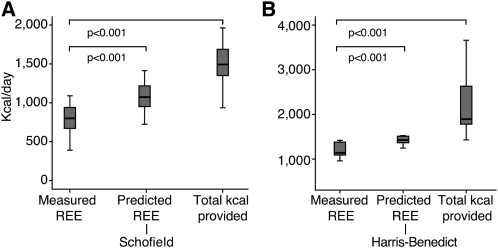
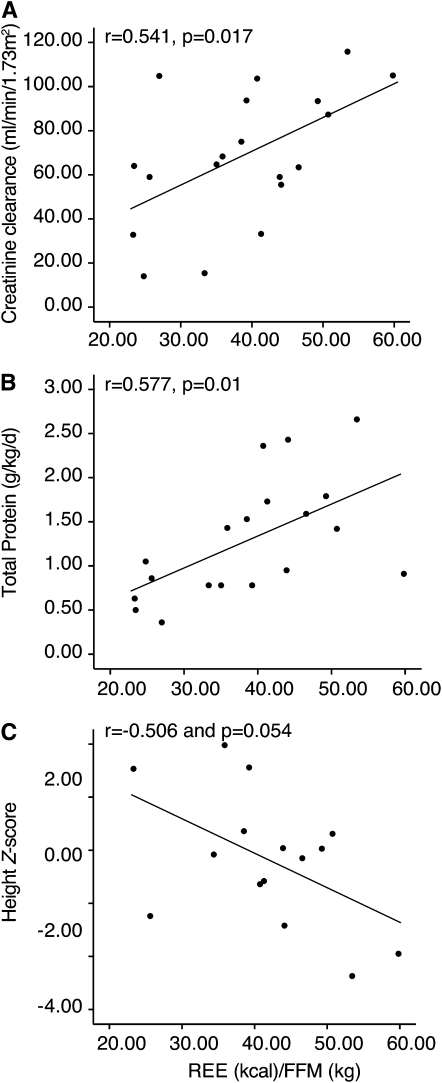
Results: Nutritional regimens were as follows: protein restriction with medical food (n = 17 of 29), protein restriction with medical food and supplemental isoleucine or valine (n = 5 of 29), or the use of natural protein alone for dietary needs (n = 7 of 29). Most mut patients had short stature and higher percentage fat mass compared with reference controls. Measured REE decreased to 74 ± 13.6% of predicted (P < 0.001) in the ≤ 18-y group (n = 22) and to 83 ± 11.1% (P = 0.004) in patients aged >18 y (n = 7). Linear regression modeling suggested that age (P = 0.001), creatinine clearance (P = 0.01), and height z score (P = 0.04) accounted for part of the variance of measured REE per kilogram of fat-free mass (model R² = 0.66, P < 0.0001).
Conclusions: There is wide variation in the dietary treatment of MMA. Standard predictive equations overestimate REE in this population primarily due to their altered body composition and decreased renal function. Defining actual energy needs will help optimize nutrition and protect individuals from overfeeding. This trial is registered at clinicaltrials.gov as NCT00078078.
Figures
References
-
- Manoli I, Venditti CP. Methylmalonic acidemia. GeneReviews at GeneTests: Medical Genetics Information Resource [database online]. 16 August 2005 (updated 28 September 2010). Seattle, WA: University of Washington, 2010.
-
- Horster F, Garbade SF, Zwickler T, et al. Prediction of outcome in isolated methylmalonic acidurias: combined use of clinical and biochemical parameters. J Inherit Metab Dis 2009;32:630–9 - PubMed
-
- Horster F, Baumgartner MR, Viardot C, et al. Long-term outcome in methylmalonic acidurias is influenced by the underlying defect (mut0, mut-, cblA, cblB). Pediatr Res 2007;62:225–30 - PubMed
-
- Shevell MI, Matiaszuk N, Ledley FD, Rosenblatt DS. Varying neurological phenotypes among muto and mut- patients with methylmalonylCoA mutase deficiency. Am J Med Genet 1993;45:619–24 - PubMed
-
- Wolff JA, Kelts DG, Algert S, Prodanos C, Nyhan WL. Alanine decreases the protein requirements of infants with inborn errors of amino acid metabolism. J Neurogenet 1985;2:41–9 - PubMed
Publication types
MeSH terms
Substances
Supplementary concepts
Associated data
Grants and funding
LinkOut - more resources
Full Text Sources
Other Literature Sources
Medical
