Comparative Study
. 2010 Nov 3;30(44):14817-23.
doi: 10.1523/JNEUROSCI.4160-10.2010.

A shared resource between declarative memory and motor memory

Affiliations
Comparative Study

A shared resource between declarative memory and motor memory

Aysha Keisler et al. J Neurosci. .

Abstract

The neural systems that support motor adaptation in humans are thought to be distinct from those that support the declarative system. Yet, during motor adaptation changes in motor commands are supported by a fast adaptive process that has important properties (rapid learning, fast decay) that are usually associated with the declarative system. The fast process can be contrasted to a slow adaptive process that also supports motor memory, but learns gradually and shows resistance to forgetting. Here we show that after people stop performing a motor task, the fast motor memory can be disrupted by a task that engages declarative memory, but the slow motor memory is immune from this interference. Furthermore, we find that the fast/declarative component plays a major role in the consolidation of the slow motor memory. Because of the competitive nature of declarative and nondeclarative memory during consolidation, impairment of the fast/declarative component leads to improvements in the slow/nondeclarative component. Therefore, the fast process that supports formation of motor memory is not only neurally distinct from the slow process, but it shares critical resources with the declarative memory system.


Figures
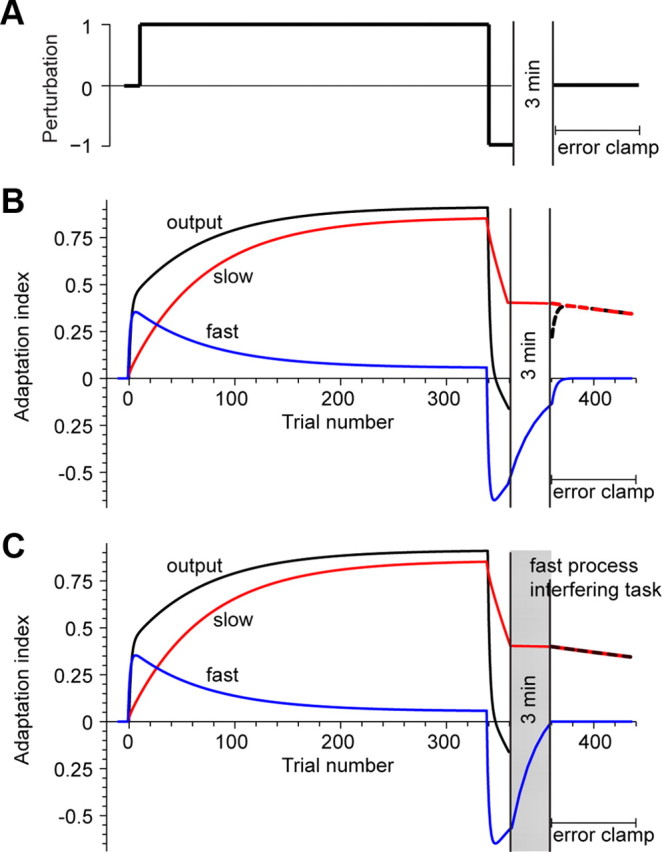
Figure 1.
Figure 1.
Model of fast and slow processes that support motor adaptation. A, Participants train on a null field, train for many trials in field A, then train briefly in field B (an opposing field). After performing an interfering task, participants complete error-clamp trials in which they make movements without error. B, If there is no interference, the motor output exhibits “spontaneous recovery” (dashed black line). C, Here, a declarative task occurs immediately after field B training. The task may interfere with the fast component, thereby altering the patterns of spontaneous recovery.
Figure 2.
Figure 2.
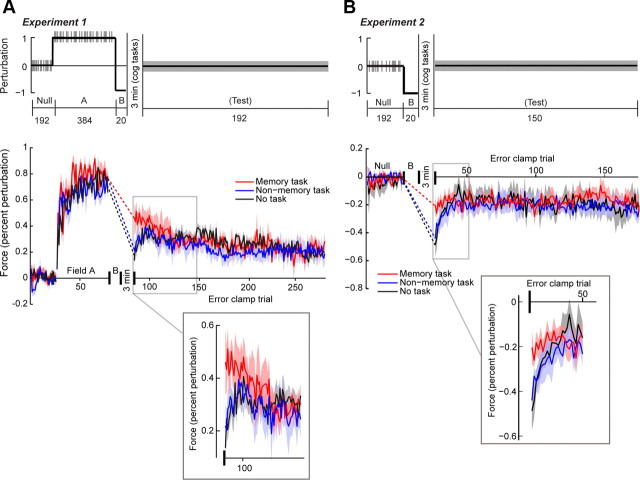
A, Experiment 1 experiment design (top) and performance (bottom). Participants train in a null block (no perturbation), followed by field A (positive perturbation), field B (negative perturbation), and a test block (100% error-clamp trials). Inset shows the initial trials of the test block. The “nonmemory task” and “no task” groups exhibit spontaneous recovery, but the “memory task” group does not. B, Experiment 2 design (top) and performance (bottom). Participants train in a null block (no perturbation), followed by field B (negative perturbation) and a test block (100% error-clamp trials). The memory task disrupts the memory of field B. Vertical tick marks indicate error-clamp trials in the experiment design subfigure. Shaded regions of the data indicate SEM.
Figure 3.
Figure 3.
Experiment 3 design (top) and performance (bottom). Participants train in a null block (no perturbation), followed by field A (positive perturbation) and a test block (100% error-clamp trials). The long period of training produced a motor memory that was not affected by the memory task. The memory task disrupts the memory of field B. Vertical tick marks indicate error-clamp trials in the experiment design subfigure. Shaded regions of the data indicate SEM.
Figure 4.
Figure 4.
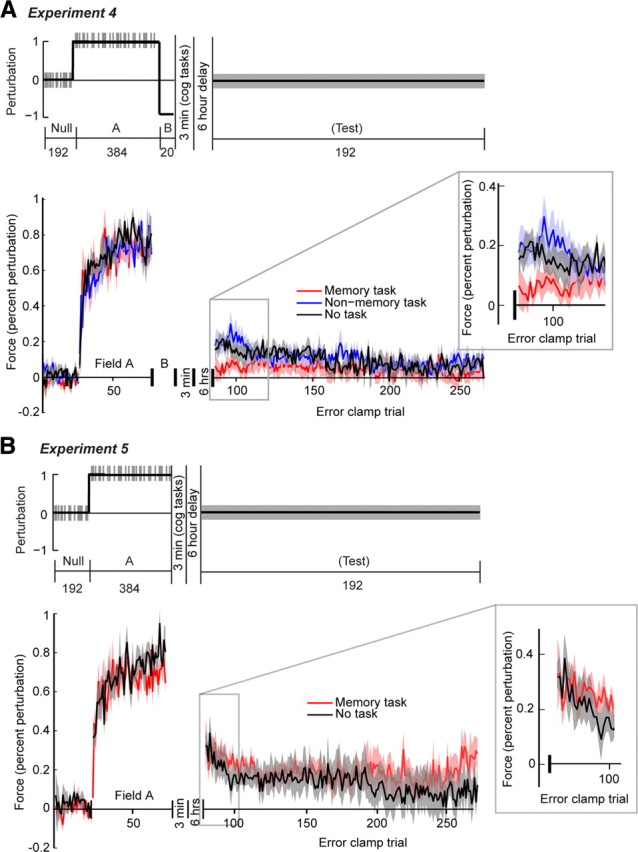
A, Experiment 4 design (top) and performance (bottom). Inset shows the initial trials of the test (error-clamp) block. Participants train in a null block (no perturbation), followed by field A (positive perturbation), field B (negative perturbation), a 6 h delay, and then a test block (100% error-clamp trials). B, Experiment 5 design (top) and performance (bottom). Participants train in a null block (no perturbation), followed by field A (positive perturbation), a 6 h delay, then a test block (100% error-clamp trials). The memory task disrupts the memory of field B. Vertical tick marks indicate error-clamp trials in the experiment design subfigure. Shaded regions indicate SEM.

References

    1. Anguera JA, Reuter-Lorenz PA, Willingham DT, Seidler RD. Contributions of spatial working memory to visuomotor learning. J Cogn Neurosci. 2010;22:1917–1930. - PubMed
    1. Baddeley AD. Essentials of human memory. Hove, UK: Psychology Press; 1999.
    1. Bonzano L, Tacchino A, Roccatagliata L, Abbruzzese G, Mancardi GL, Bove M. Callosal contributions to simultaneous bimanual finger movements. J Neurosci. 2008;28:3227–3233. - PMC - PubMed
    1. Brown RM, Robertson EM. Inducing motor skill improvements with a declarative task. Nat Neurosci. 2007a;10:148–149. - PMC - PubMed
    1. Brown RM, Robertson EM. Off-line processing: reciprocal interactions between declarative and procedural memories. J Neurosci. 2007b;27:10468–10475. - PMC - PubMed

Publication types