


NHERF1/EBP50 in Breast Cancer: Clinical Perspectives
- PMID: 21048827
- PMCID: PMC2931041
- DOI: 10.1159/000298962
NHERF1/EBP50 in Breast Cancer: Clinical Perspectives
Abstract
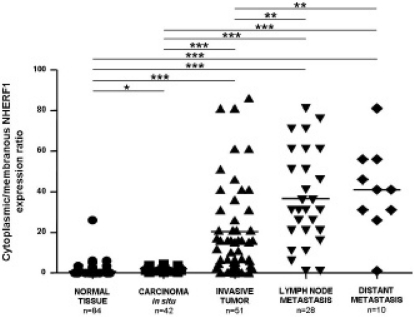
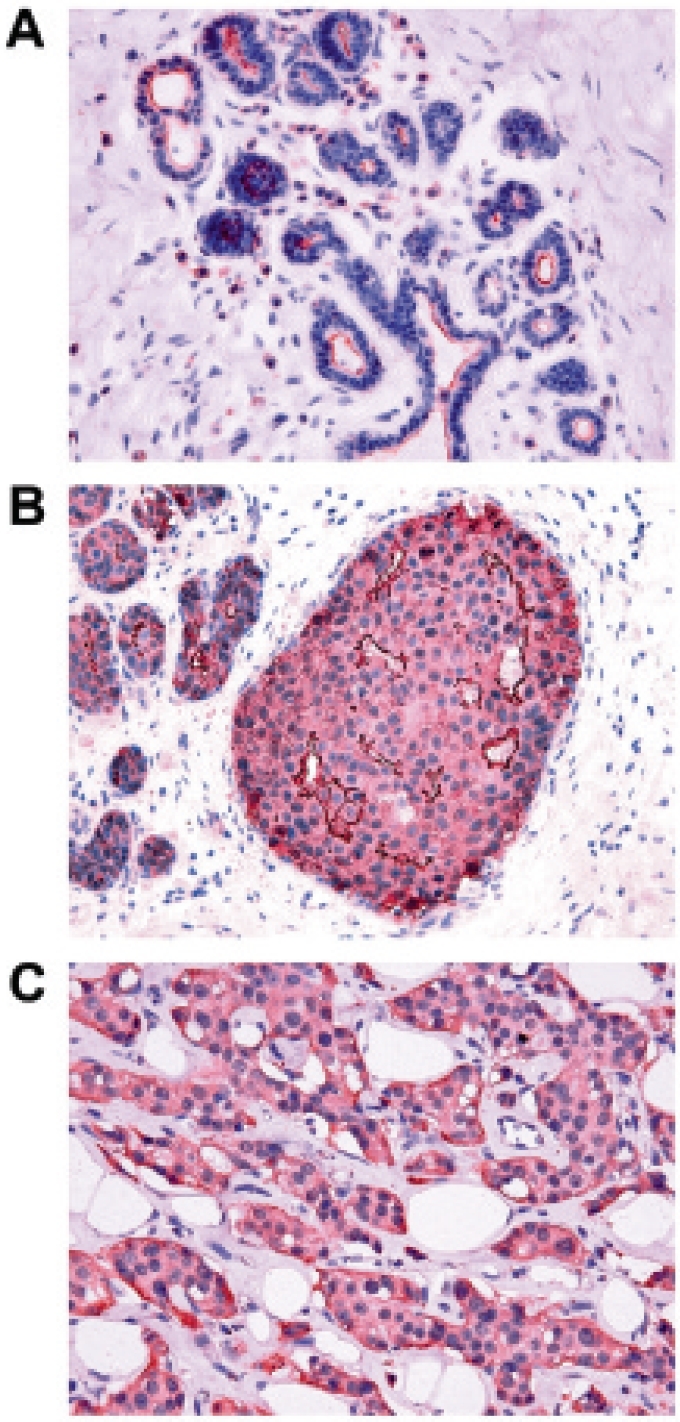
Na(+)/H(+) exchanger regulatory factor 1 (NHERF1) is a postsynaptic density 95/disc-large/zona occludens (PDZ) domain-containing protein that recruits membrane receptors/transporters and cytoplasmic signaling proteins into functional complexes. NHERF1 expression has been demonstrated to be altered in breast cancer, but its role in mammary cancerogenesis and progression remains still undefined. In this paper, we review what is known on the pathological role and the potential clinical application of NHERF1 protein in breast cancer. Recent evidence shows that an increased cytoplasmic expression of NHERF1 suggests a key role of its localization/compartmentalization in defining cancerogenesis, progression, and invasion. NHERF1 overexpression is associated with increasing tumor cytohistological grade, aggressive clinical behavior, unfavorable prognosis, and increased tumor hypoxia. Moreover, NHERF1 co-localizes with the oncogenic receptor HER2/neu in HER2/neu-overexpressing carcinoma and in distant metastases. These data make NHERF1 also a potential candidate of clinical relevance for anti-HER2/neu therapy.
Das NHERF1 (Na+/H+ exchanger regulatory factor D-Protein besitzt eine PDZ (postsynaptic density 95/disc-large/zona occludens)-Domäne und schließt Membranrezeptoren/Transporter und zytoplasmatische Signalproteine zu funktionellen Komplexen zusammen. Es ist gezeigt worden, dass bei Mammakarzinomen eine veränderte NHERFI-Expression vorliegt. Die Rolle des Proteins bei der Karzinogenese und Progression von Mammakarzinomen ist jedoch noch unklar. Im vorliegenden Artikel geben wir einen Überblick über das Wissen bezüglich der pathologischen Rolle und potentiellen klinischen Anwendung des NHERFI-Proteins beim Mammakarzinom. Neuesten Erkenntnissen zufolge deutet die erhöhte zytoplasmatische Expression von NHERF1 auf eine Schlüsselrolle seiner Lokalisation/Kompartimentierung bei der Festlegung der Karzinogenese, Progression und Invasion hin. NHERFI-Überexpression ist mit erhöhtem zytohistologi-schen Grad, aggressivem klinischen Verhalten, ungünstiger Prognose und verstärkter Tumorhypoxie assoziiert. Außerdem liegt eine Kolokalisation von NHERF1 mit dem onkogenen Rezeptor HER2/neu in HER2/neu-überexpre-mierenden Karzinomen und in Fernmetastasen vor. Diesen Daten zufolge ist NHERF1 ein klinisch relevanter, potentieller Kandidat für die Anti-HER2/neu-Therapie.
Figures
References
-
- Khatcheressian JL, Wolff AC, Smith TJ, Grunfeld E, Muss HB, Vogel VG, Halberg F, Somerfield MR, Davidson NE, American Society of Clinical Oncology American Society of Clinical Oncology 2006 update of the breast cancer follow-up and management guidelines in the adjuvant setting. J Clin Oncol. 2006;24:5091–5097. - PubMed
-
- Nourry C, Grant SG, Borg JP. PDZ domain proteins: plug and play! Sci STKE. 2003;2003:RE7. - PubMed
-
- Brône B, Eggermont J. PDZ proteins retain and regulate membrane transporters in polarized epithelial cell membranes. Am J Physiol Cell Physiol. 2005;288:C20–29. - PubMed
-
- Weinman EJ, Hall RA, Friedman PA, Liu-Chen LY, Shenolikar S. The association of NHERF adaptor proteins with g protein-coupled receptors and receptor tyrosine kinases. Annu Rev Physiol. 2006;68:491–505. - PubMed
-
- Song J, Bai J, Yang W, Gabrielson EW, Chan DW, Zhang Z. Expression and clinicopathological significance of oestrogen-responsive ezrin-radixin-moesin-binding phosphoprotein 50 in breast cancer. Histopathology. 2007;51:40–53. - PubMed
LinkOut - more resources
Full Text Sources
Research Materials
Miscellaneous
