


Differentiated thyroid cancer with extrathyroidal extension: prognosis and the role of external beam radiotherapy
- PMID: 21048835
- PMCID: PMC2956971
- DOI: 10.4061/2010/183461
Differentiated thyroid cancer with extrathyroidal extension: prognosis and the role of external beam radiotherapy
Abstract
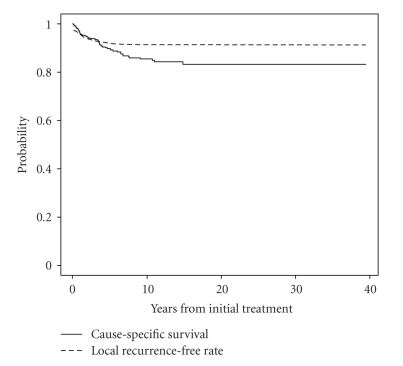
A study was performed to identify variables that affected cause-specific survival (CSS) and local relapse-free rate (LRFR) in patients with differentiated thyroid cancer (DTC) and extrathyroid extension (ETE) and to examine the role of external beam radiotherapy (XRT). Prognostic factors were similar to those found in studies of all patients with DTC. In patients with postoperative gross residual disease treated with radiotherapy, 10-year CSS and LRFR were 48% and 90%. For patients with no residual or microscopic disease, 10-year CSS and LRFR were 92% and 93%. In patients older than 60 years with T3 ETE but no gross residual disease postoperatively there was an improved LRFR at 5 years of 96%, compared to 87.5% without XRT (P = .02). Patients with gross ETE benefit from XRT and there may be a potential benefit in reducing locoregional failure in patients over 60 years with minimal extrathyroidal extension (T3).
Figures


References
-
- Lee N, Tuttle M. The role of external beam radiotherapy in the treatment of papillary thyroid cancer. Endocrine-Related Cancer. 2006;13(4):971–977. - PubMed
-
- British Thyroid Association. Guidelines for the Management of Thyroid Cancer in Adults. London, UK: Royal College of Physicians; 2006.
-
- Cooper DS, Doherty GM, Haugen BR, et al. Management guidelines for patients with thyroid nodules and differentiated thyroid cancer. Thyroid. 2006;16(2):109–141. - PubMed
-
- Brierley JD, Asa SL. Thyroid cancer. In: Gospodarowicz MK, O’Sullivan B, Sobin LH, editors. Prognostic Factors in Cancer. Hoboken, NJ, USA: John Wiley & Sons; 2006.
-
- Tsang RW, Brierley JD, Simpson WJ, Panzarella T, Gospodarowicz MK, Sutcliffe SB. The effects of surgery, radioiodine, and external radiation therapy on the clinical outcome of patients with differentiated thyroid carcinoma. Cancer. 1998;82(2):375–388. - PubMed
LinkOut - more resources
Full Text Sources
