


Retrospective seroepidemiology indicated that human enterovirus 71 and coxsackievirus A16 circulated wildly in central and southern China before large-scale outbreaks from 2008
- PMID: 21050463
- PMCID: PMC2989968
- DOI: 10.1186/1743-422X-7-300
Retrospective seroepidemiology indicated that human enterovirus 71 and coxsackievirus A16 circulated wildly in central and southern China before large-scale outbreaks from 2008
Abstract
Background: Large nationwide outbreaks of hand, foot, and mouth disease (HFMD) occurred in China from 2008; most of the cases were in children under 5 years. This study aims to identify the situation of natural human enterovirus 71 (HEV71) and coxsackievirus A16 (CVA16) infections in children before 2008 in China.
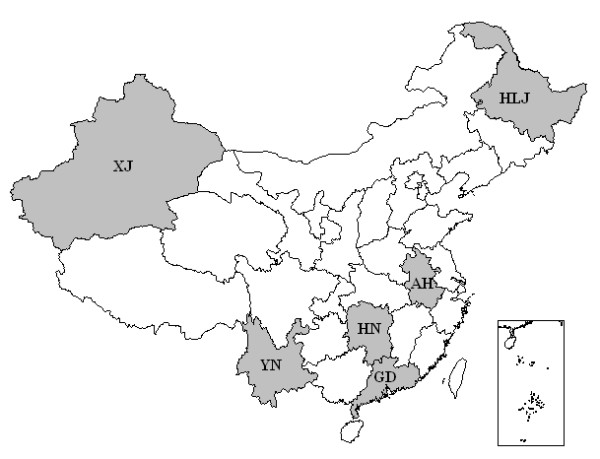
Results: Retrospective seroepidemiologic studies of HEV71 and CVA16 were performed with 900 serum samples collected from children ≤5 years of age in 2005. The samples were collected from 6 different geographical areas (Anhui, Guangdong, Hunan, Xinjiang, Yunnan, and Heilongjiang provinces) in mainland China. Of the 900 samples, 288 were positive for HEV71; the total positive rate was 32.0% and the geometric mean titer (GMT) was 1:8.5. Guangdong (43.7% and 1:10.8), Xinjiang (45.4% and 1:11.1), and Yunnan (43.4% and 1:12.0) provinces had relatively high rates of infection, while Heilongjiang province (8.1% and 1:4.9) had the lowest rate of infection. On the other hand, 390 samples were positive for CVA16; the total positive rate was 43.4% and the GMT was 1:9.5. Anhui (62.2% and 1:16.0) and Hunan (61.1% and 1:23.1) had relatively high rates, while Heilongjiang (8.0% and 1:4.6) had the lowest rate. Although there is a geographical difference in HEV71 and CVA16 infections, low neutralizing antibody positive rate and titer of both viruses were found in all 6 provinces.
Conclusions: This report confirmed that HEV71 and CVA16 had wildly circulated in a couple provinces in China before the large-scale outbreaks from 2008. This finding also suggests that public health measures to control the spread of HEV71 and CVA16 should be devised according to the different regional characteristics.
Figures


References
-
- Schmidt NJ, Lennette EH, Ho HH. An apparently new enterovirus isolated from patients with disease of the central nervous system. J Infect Dis. 1974;129:304–309. - PubMed
Publication types
MeSH terms
Substances
LinkOut - more resources
Full Text Sources
Other Literature Sources
