


Individual finger sensibility in carpal tunnel syndrome
- PMID: 21050964
- PMCID: PMC4410266
- DOI: 10.1016/j.jhsa.2010.08.013
Individual finger sensibility in carpal tunnel syndrome
Abstract
Purpose: Sensibility testing plays a role in the diagnosis of carpal tunnel syndrome (CTS). No single physical examination test has proven to be of critical value in the diagnosis, especially when compared with electrodiagnostic testing (EDX). The purpose of this study was to define which digits are most affected by CTS, both subjectively and with objective sensibility testing.
Methods: A prospective series of 35 patients (40 hands) with EDX-positive, isolated CTS were evaluated preoperatively using 2 objective sensibility tests: static 2-point discrimination (2PD) and abbreviated Semmes-Weinstein monofilament (SWMF) testing. Detailed surveys of subjective symptoms were also collected.
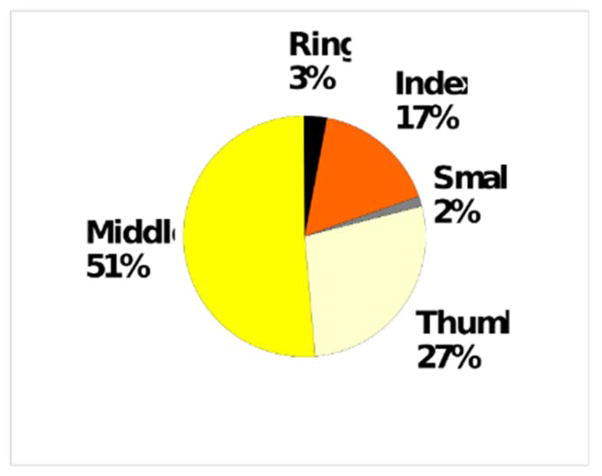
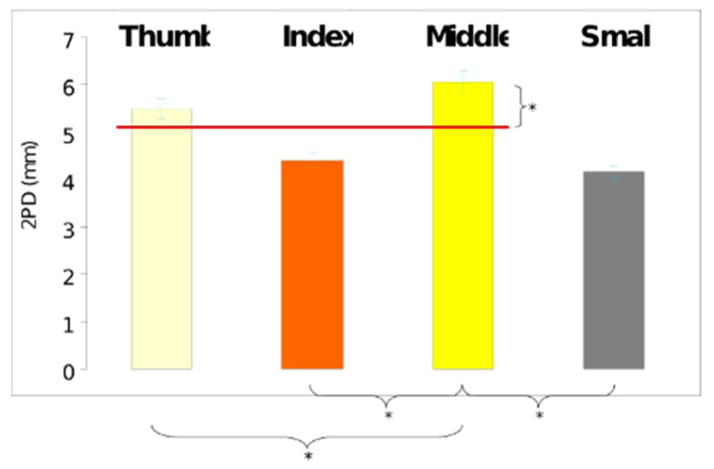
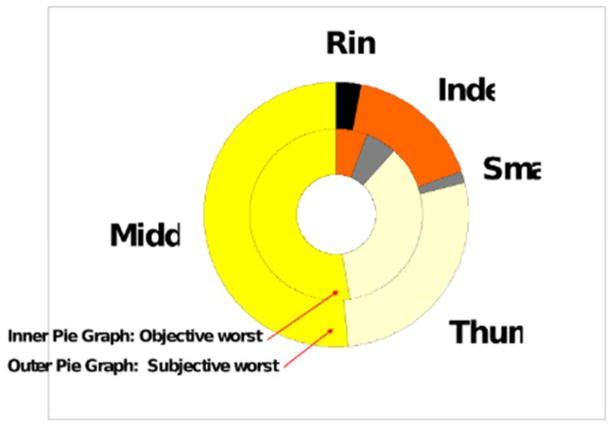
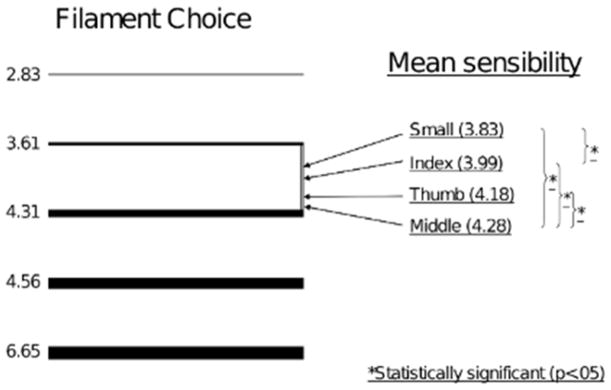
Results: Patients identified the middle finger as the most symptomatic over all others (51%). Objective 2PD results of each digit mirrored the subjective data, with higher values for the middle finger (mean 6.07 mm, (p < .0001). Values for the index finger failed to show a significant difference from the ulnar-innervated small finger. The most symptomatic finger matched 2PD results in over two thirds of patients. The SWMF testing showed similar, statistically significant results (middle > thumb > index > small). Correlations failed between EDX, symptoms, and SWMF results or 2PD in the index finger. Positive but weak correlation (p = .002, r = .42) was found between EDX and 2PD only in the middle fingers.
Conclusions: The middle finger is the most likely to show changes in 2PD in patients with positive EDX findings for CTS. Middle finger 2PD is best able to correlate with EDX when compared with 2PD of other digits. The SWMF testing also shows the middle digit testing as more sensitive, but this finding may be difficult to use clinically.
Type of study/level of evidence: Diagnostic I.
Copyright © 2010 American Society for Surgery of the Hand. Published by Elsevier Inc. All rights reserved.
Figures
References
-
- D’Arcy CA, McGee S. The rational clinical examination. Does this patient have carpal tunnel syndrome? JAMA. 2000;283:3110–7. - PubMed
-
- Palumbo CF, Szabo RM. Examination of patients for carpal tunnel syndrome sensibility, provocative, and motor testing. Hand Clin. 2002;18:269–77. - PubMed
-
- Atroshi I, Gummesson C, Johnsson R, Ornstein E, Ranstam J, Rosén I. Prevalence of carpal tunnel syndrome in a general population. JAMA. 1999;282:153–8. - PubMed
-
- Stevens JC, Smith BE, Weaver AL, Bosch EP, Deen HG, Jr, Wilkens JA. Symptoms of 100 patients with electromyographically verified carpal tunnel syndrome. Muscle Nerve. 1999;22:1448–56. - PubMed
-
- Gupta SK, Benstead TJ. Symptoms experienced by patients with carpal tunnel syndrome. Can J Neurol Sci. 1997;24:338–42. - PubMed
Publication types
MeSH terms
Grants and funding
LinkOut - more resources
Full Text Sources
Medical
Research Materials
