


Modes of Neuronal Calcium Entry and Homeostasis following Cerebral Ischemia
- PMID: 21052549
- PMCID: PMC2968719
- DOI: 10.4061/2010/316862
Modes of Neuronal Calcium Entry and Homeostasis following Cerebral Ischemia
Abstract
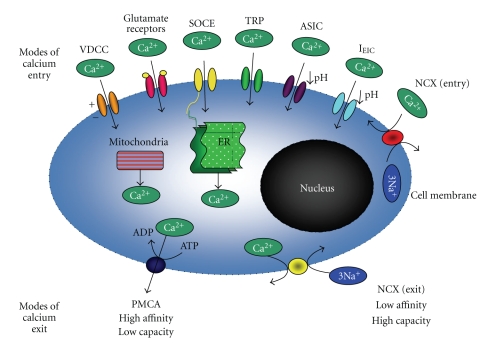
One of the major instigators leading to neuronal cell death and brain damage following cerebral ischemia is calcium dysregulation. The neuron's inability to maintain calcium homeostasis is believed to be a result of increased calcium influx and impaired calcium extrusion across the plasma membrane. The need to better understand the cellular and biochemical mechanisms of calcium dysregulation contributing to neuronal loss following stroke/cerebral ischemia is essential for the development of new treatments in order to reduce ischemic brain injury. The aim of this paper is to provide a concise overview of the various calcium influx pathways in response to ischemia and how neuronal cells attempts to overcome this calcium overload.
Figures
References
-
- Blaustein MP, Lederer WJ. Sodium/calcium exchange: its physiological implications. Physiological Reviews. 1999;79(3):763–854. - PubMed
-
- Hoyt KR, Arden SR, Aizenman E, Reynolds IJ. Reverse Na+/Ca2+ exchange contributes to glutamate-induced intracellular Ca2+ concentration increases in cultured rat forebrain neurons. Molecular Pharmacology. 1998;53(4):742–749. - PubMed
-
- Aarts M, Iihara K, Wei W-L, et al. A key role for TRPM7 channels in anoxic neuronal death. Cell. 2003;115(7):863–877. - PubMed
-
- Xiong Z-G, Chu X-P, Simon RP. Acid sensing ion channels—novel therapeutic targets for ischemic brain injury. Frontiers in Bioscience. 2007;12(4):1376–1386. - PubMed
LinkOut - more resources
Full Text Sources
