


A method to determine the available UV-C dose for the decontamination of filtering facepiece respirators
- PMID: 21054699
- PMCID: PMC9728109
- DOI: 10.1111/j.1365-2672.2010.04881.x
A method to determine the available UV-C dose for the decontamination of filtering facepiece respirators
Abstract
Aims: To develop a method to assess model-specific parameters for ultraviolet-C (UV-C, 254 nm) decontamination of filtering facepiece respirators (FFRs).
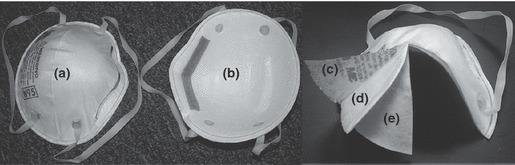
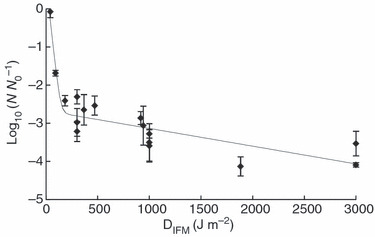
Methods and results: UV-C transmittance was quantified for the distinct composite layers of six N95 FFR models and used to calculate model-specific α-values, the percentage of the surface UV-C irradiance available for the internal filtering medium (IFM). Circular coupons, excised from the FFRs, were exposed to aerosolized particles containing MS2 coliphage and treated with IFM-specific UV-C doses ranging from 38 to 4707 J m(-2). Models exposed to a minimum IFM dose of 1000 J m(-2) demonstrated at least a 3 log reduction (LR) in viable MS2. Model-specific exposure times to achieve this IFM dose ranged from 2 to 266 min.
Conclusions: UV-C transmits into and through FFR materials. LR of MS2 was a function of model-specific IFM UV-C doses.
Significance and impact of the study: Filtering facepiece respirators are in high demand during infectious disease outbreaks, potentially leading to supply shortages. Reuse of disposable FFRs after decontamination has been discussed as a possible remediation strategy, but to date lacks supporting scientific evidence. The methods described here can be used to assess the likelihood that UV-C decontamination will be successful for specific FFR models.
Journal of Applied Microbiology © 2010 The Society for Applied Microbiology. No claim to US Government works.
Figures
References
-
- Andersen,B.M., Banrud,H., Boe,E., Bjordal,O. and Drangsholt,F. (2006) Comparison of UV C light and chemicals for disinfection of surfaces in hospital isolation units. Infect Control Hosp Epidemiol 27, 729–734. - PubMed
-
- Barrett,L.W. and Rousseau,A.D. (1998) Aerosol loading performance of electret filter media. Am Ind Hyg Assoc J 59, 532–539.
-
- Cerf,O. (1977) Tailing of survival curves of bacterial spores. J Appl Bacteriol 42, 1–19. - PubMed
-
- Duleba‐Majek,M. (2009) Transmission of UV radiation through woven fabrics in dependence on the inter‐thread spaces. Fibres Text East Eur 17, 34–38.
MeSH terms
LinkOut - more resources
Full Text Sources
Other Literature Sources
Research Materials
