


Blantyre Malaria Project Epilepsy Study (BMPES) of neurological outcomes in retinopathy-positive paediatric cerebral malaria survivors: a prospective cohort study
- PMID: 21056005
- PMCID: PMC2988225
- DOI: 10.1016/S1474-4422(10)70270-2
Blantyre Malaria Project Epilepsy Study (BMPES) of neurological outcomes in retinopathy-positive paediatric cerebral malaria survivors: a prospective cohort study
Abstract
Background: Cerebral malaria, a disorder characterised by coma, parasitaemia, and no other evident cause of coma, is challenging to diagnose definitively in endemic regions that have high rates of asymptomatic parasitaemia and limited neurodiagnostic facilities. A recently described malaria retinopathy improves diagnostic specificity. We aimed to establish whether retinopathy-positive cerebral malaria is a risk factor for epilepsy or other neurodisabilities.
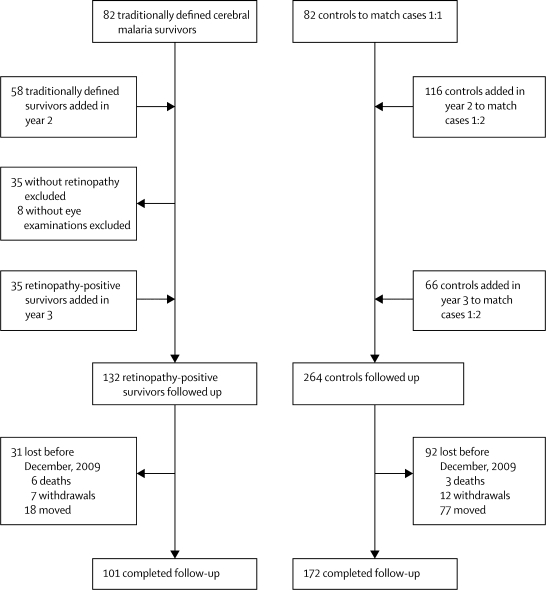
Methods: Between 2005 and 2007, we did a prospective cohort study of survivors of cerebral malaria with malaria retinopathy in Blantyre, Malawi. Children with cerebral malaria were identified at the time of their index admission and age-matched to concurrently admitted children without coma or nervous system infection. Initially matching of cases to controls was 1:1 but, in 2006, enrolment criteria for cerebral malaria survivors were revised to limit inclusion to children with cerebral malaria and retinopathy on the basis of indirect ophthalmoscopic examination; matching was then changed to 1:2 and the revised inclusion criteria were applied retrospectively for children enrolled previously. Clinical assessments at discharge and standardised nurse-led follow-up every 3 months thereafter were done to identify children with new seizure disorders or other neurodisabilities. A Kaplan-Meier survival analysis was done for incident epilepsy.
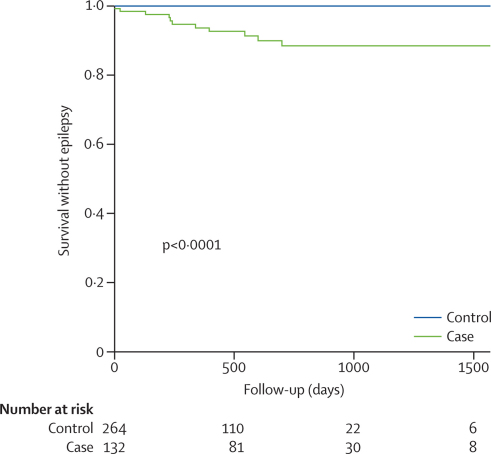
Findings: 132 children with retinopathy-positive cerebral malaria and 264 age-matched, non-comatose controls were followed up for a median of 495 days (IQR 195-819). 12 of 132 cerebral malaria survivors developed epilepsy versus none of 264 controls (odds ratio [OR] undefined; p<0·0001). 28 of 121 cerebral malaria survivors developed new neurodisabilities, characterised by gross motor, sensory, or language deficits, compared with two of 253 controls (OR 37·8, 95% CI 8·8-161·8; p<0·0001). The risk factors for epilepsy in children with cerebral malaria were a higher maximum temperature (39·4°C [SD 1·2] vs 38·5°C [1·1]; p=0·01) and acute seizures (11/12 vs 76/120; OR 6·37, 95% CI 1·02-141·2), and male sex was a risk factor for new neurodisabilities (20/28 vs 38/93; OR 3·62, 1·44-9·06).
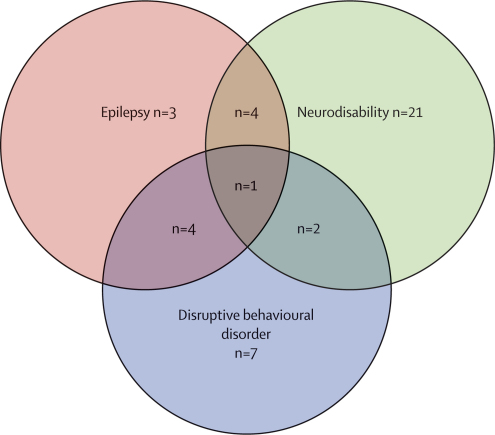
Interpretation: Almost a third of retinopathy-positive cerebral malaria survivors developed epilepsy or other neurobehavioural sequelae. Neuroprotective clinical trials aimed at managing hyperpyrexia and optimising seizure control are warranted.
Funding: US National Institutes of Health and Wellcome Trust.
Copyright © 2010 Elsevier Ltd. All rights reserved.
Figures
Comment in
-
Cerebral malaria and epilepsy.Lancet Neurol. 2010 Dec;9(12):1144-1145. doi: 10.1016/S1474-4422(10)70278-7. Epub 2010 Nov 4. Lancet Neurol. 2010. PMID: 21056006 No abstract available.
References
-
- Najera JA, Joahim J Hempel. The burden of malaria. World Health Organization; Geneva: 1999. http://www.rollbackmalaria.org/docs/burden.htm (accessed April 10, 2010).
-
- Roca-Feltrer A, Carneiro I, Schellenberg JR Armstrong. Estimates of the burden of malaria morbidity in Africa in children under the age of 5 years. Trop Med Int Health. 2008;13:771–783. - PubMed
-
- Carme B, Bouquety JC, Plassart H. Mortality and sequelae due to cerebral malaria in African children in Brazzaville, Congo. Am J Trop Med Hyg. 1993;48:216–221. - PubMed
-
- Molyneux ME, Taylor TE, Wirima JJ, Borgstein A. Clinical features and prognostic indicators in paediatric cerebral malaria: a study of 131 comatose Malawian children. Q J Med. 1989;71:441–459. - PubMed
-
- Crawley J, Smith S, Kirkham F, Muthinji P, Waruiru C, Marsh K. Seizures and status epilepticus in childhood cerebral malaria. QJM. 1996;89:591–597. - PubMed
Publication types
MeSH terms
Grants and funding
LinkOut - more resources
Full Text Sources
Other Literature Sources
Medical
