


NRF2, cancer and calorie restriction
- PMID: 21057541
- PMCID: PMC4684645
- DOI: 10.1038/onc.2010.492
NRF2, cancer and calorie restriction
Abstract
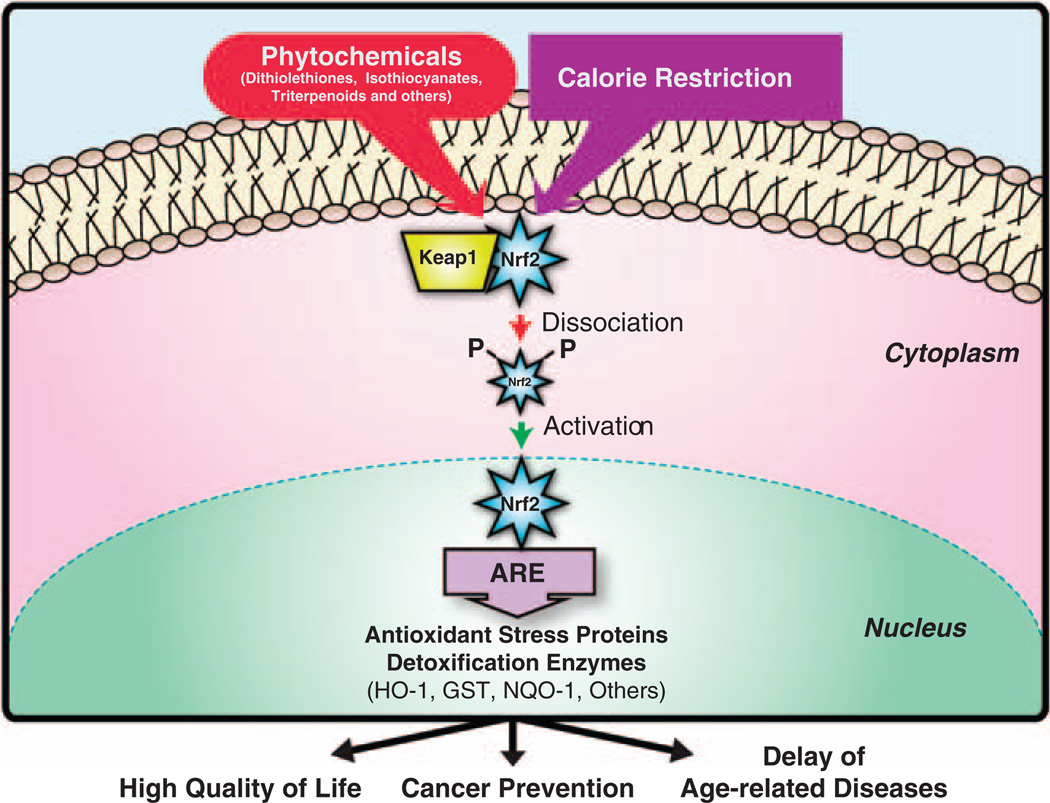
The transcription factor NF-E2-related factor (NRF2) is a key regulator of several enzymatic pathways, including cytoprotective enzymes in highly metabolic organs. In this review, we summarize the ongoing research related to NRF2 activity in cancer development, focusing on in vivo studies using NRF2 knockout (KO) mice, which have helped in defining the crucial role of NRF2 in chemoprevention. The lower cancer protection observed in NRF2 KO mice under calorie restriction (CR) suggests that most of the beneficial effects of CR on the carcinogenesis process are likely mediated by NRF2. We propose that future interventions in cancer treatment would be carried out through the activation of NRF2 in somatic cells, which will lead to a delay or prevention of the onset of some forms of human cancers, and subsequently an extension of health- and lifespan.
Conflict of interest statement
The authors declare no conflict of interest.
Figures
References
-
- Alam ZI, Daniel SE, Lees AJ, Marsden DC, Jenner P, Halliwell B. A generalised increase in protein carbonyls in the brain in Parkinson’s but not incidental Lewy body disease. J Neurochem. 1997a;69:1326–1329. - PubMed
-
- Alam ZI, Jenner A, Daniel SE, Lees AJ, Cairns N, Marsden CD, et al. Oxidative DNA damage in the parkinsonian brain: an apparent selective increase in 8-hydroxyguanine levels in substantia nigra. J Neurochem. 1997b;69:1196–1203. - PubMed
-
- Andreou KK, Morgan PR. Effect of dietary restriction on induced hamster cheek pouch carcinogenesis. Arch Oral Biol. 1981;26:525–531. - PubMed
-
- Ansher SS, Dolan P, Bueding E. Biochemical effects of dithiolthiones. Food Chem Toxicol. 1986;24:405–415. - PubMed
Publication types
MeSH terms
Substances
Grants and funding
LinkOut - more resources
Full Text Sources
Molecular Biology Databases
Research Materials
