


Characterizing age-related changes in remembering the past and imagining the future
- PMID: 21058863
- PMCID: PMC3062729
- DOI: 10.1037/a0021054
Characterizing age-related changes in remembering the past and imagining the future
Abstract
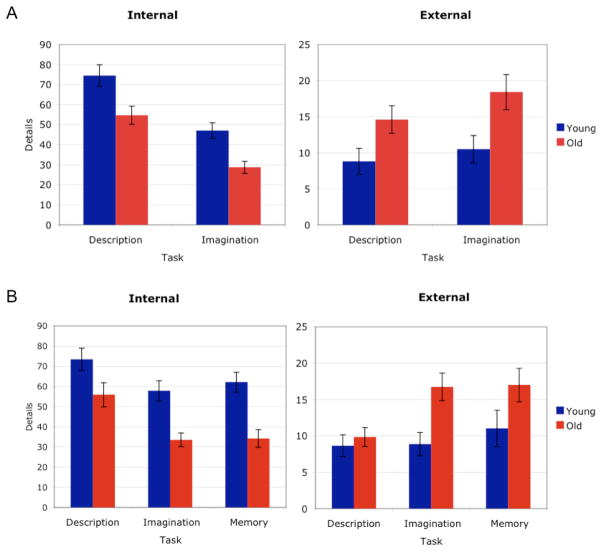
When remembering past events or imagining possible future events, older adults generate fewer episodic details than do younger adults. These results support the constructive episodic simulation hypothesis: deficits in retrieving episodic details underlie changes during memory and imagination. To examine the extent of this age-related reduction in specificity, we compared performance on memory and imagination tasks to a picture description task that does not require episodic memory. In two experiments, older adults exhibited comparable specificity reductions across all conditions. These findings emphasize the need to consider age-related changes in imagination and memory in a broader theoretical context.
(c) 2011 APA, all rights reserved.
Figures
References
-
- Addis DR, Wong AT, Schacter DL. Age-related changes in the episodic simulation of Future Events. Psychological Science. 2008;19:33–41. - PubMed
-
- Arbuckle TY, Gold DP. Aging, inhibition, and verbosity. Journal of Gerontology: Psychological Sciences. 1993;48:225–232. - PubMed
-
- Coupland N, Coupland J. Discourse, identity and aging. In: Nussbaum JF, Coupland J, editors. Handbook of communication and aging research. Hillsdale, NJ: Erlbaum; 1995. pp. 79–103.
Publication types
MeSH terms
Grants and funding
LinkOut - more resources
Full Text Sources
Medical
Miscellaneous
