


An approach for development of age-, gender-, and ethnicity-specific thyrotropin reference limits
- PMID: 21058882
- PMCID: PMC3012447
- DOI: 10.1089/thy.2010.0092
An approach for development of age-, gender-, and ethnicity-specific thyrotropin reference limits
Abstract
Background: The use of age- and ethnicity-specific thyrotropin (TSH) reference limits decreases misclassification of patients with thyroid dysfunction. Developing such limits requires TSH measurements in different subpopulations.
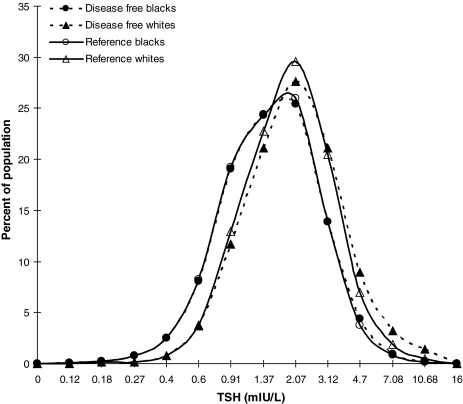
Methods: We determined, in the National Health and Nutrition Examination Survey III, the TSH median, 2.5th and 97.5th centiles as a function of age, and anti-thyroid antibodies (ABs) in specific racial/ethnic groups (REGs) designated as non-Hispanic Whites, non-Hispanic Blacks, and Mexican Americans, as classified by the U.S. Office of Management and Budget (OMB) Directive 15. We compared TSH limits of a thyroid disease-free population (n = 15,277) to a reference population (n = 13,344) formed by exclusion of AB+ subjects and TSH >10 mIU/L or <0.1 mIU/L. With quantile regression, we examined the effect of age, REG, gender, body weight, and urinary iodine concentration on TSH reference limits in the AB- population.
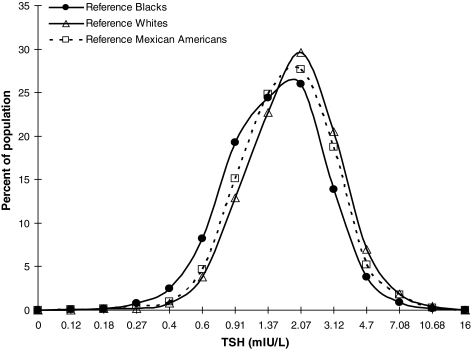
Results: AB status did not affect the 2.5th centile and median TSH in any REG or the 97.5th centile in Blacks. The average 97.5th centile of the disease-free Whites and Mexican Americans was 1.0 mIU/L higher than the reference population group. The TSH 2.5th, 50th, and 97.5th centiles increased with age and were lower in Blacks than in Whites or Mexican Americans. Women had lower 2.5th and 50th centiles than males. From these data, we developed equations to predict subpopulation-specific TSH reference limits.
Conclusions: Our study provides a method to determine TSH limits in individual patients of different ages, gender, and REG criteria whose AB status is uncertain and it will enable clinicians to better classify patients within their subpopulation-specific TSH reference range.
Figures
Comment in
-
Thyroid gland: TSH reference limits specific for age, sex and ethnicity.Nat Rev Endocrinol. 2011 Feb;7(2):61. doi: 10.1038/nrendo.2010.218. Nat Rev Endocrinol. 2011. PMID: 21332090 No abstract available.
References
-
- U.S., Census Bureau Directive No. 15 Race and Ethnic Standards for Federal Statistics and Administrative Reporting. http://wonder.cdc.gov/wonder/help/populations/bridged-race/Directive15.html. http://wonder.cdc.gov/wonder/help/populations/bridged-race/Directive15.html - PubMed
-
- Surks MI. Hollowell JG. Age-specific distribution of serum thyrotropin and antithyroid antibodies in the US population: implications for the prevalence of subclinical hypothyroidism. J Clin Endocrinol Metab. 2007;92:4575–4582. - PubMed
-
- Boucai L. Surks MI. Reference limits of serum TSH and free T4 are significantly influenced by race and age in an urban outpatient medical practice. Clin Endocrinol (Oxf) 2009;70:788–793. - PubMed
-
- Surks MI. Boucai L. Age- and race-based serum thyrotropin reference limits. J Clin Endocrinol Metab. 2010;95:496–502. - PubMed
Publication types
MeSH terms
Substances
Grants and funding
LinkOut - more resources
Full Text Sources
Medical
