


Long-term effects of wealth on mortality and self-rated health status
- PMID: 21059808
- PMCID: PMC3139960
- DOI: 10.1093/aje/kwq348
Long-term effects of wealth on mortality and self-rated health status
Abstract
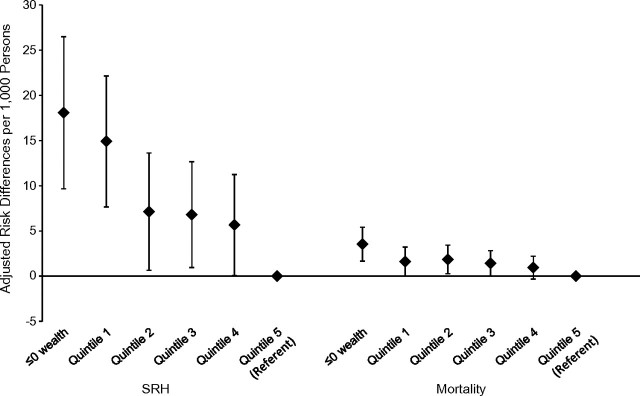
Epidemiologic studies seldom include wealth as a component of socioeconomic status. The authors investigated the associations between wealth and 2 broad outcome measures: mortality and self-rated general health status. Data from the longitudinal Panel Study of Income Dynamics, collected in a US population between 1984 and 2005, were used to fit marginal structural models and to estimate relative and absolute measures of effect. Wealth was specified as a 6-category variable: those with ≤0 wealth and quintiles of positive wealth. There were a 16%-44% higher risk and 6-18 excess cases of poor/fair health (per 1,000 persons) among the less wealthy relative to the wealthiest quintile. Less wealthy men, women, and whites had higher risk of poor/fair health relative to their wealthy counterparts. The overall wealth-mortality association revealed a 62% increased risk and 4 excess deaths (per 1,000 persons) among the least wealthy. Less wealthy women had between a 24% and a 90% higher risk of death, and the least wealthy men had 6 excess deaths compared with the wealthiest quintile. Overall, there was a strong inverse association between wealth and poor health status and between wealth and mortality.
Figures
References
-
- Keister LA. Wealth in America: Trends in Wealth Inequality. Cambridge, United Kingdom: Cambridge University Press; 2000.
-
- Mare RD. Socioeconomic careers and differential mortality among older men in the United States. In: Vallin J, D'Souza S, Palloni A, editors. Measurement and Analysis of Mortality: New Approaches. New York, NY: Oxford University Press; 1990. pp. 362–387.
-
- Menchik PL. Economic status as a determinant of mortality among black and white older men: does poverty kill? Popul Stud. 1993;47(3):427–436.
-
- Bond Huie SA, Krueger PM, Rogers RG, et al. Wealth, race, and mortality. Soc Sci Q. 2003;84(3):667–684.
-
- Attanasio OP, Hoynes HW. Differential mortality and wealth accumulation. J Hum Resour. 2000;35(1):1–29.
