


Corticosteroids and outcome in children undergoing congenital heart surgery: analysis of the Pediatric Health Information Systems database
- PMID: 21060075
- PMCID: PMC3013053
- DOI: 10.1161/CIRCULATIONAHA.110.948737
Corticosteroids and outcome in children undergoing congenital heart surgery: analysis of the Pediatric Health Information Systems database
Abstract
Background: Children undergoing congenital heart surgery often receive corticosteroids with the aim of reducing the inflammatory response after cardiopulmonary bypass; however, the value of this approach is unclear.
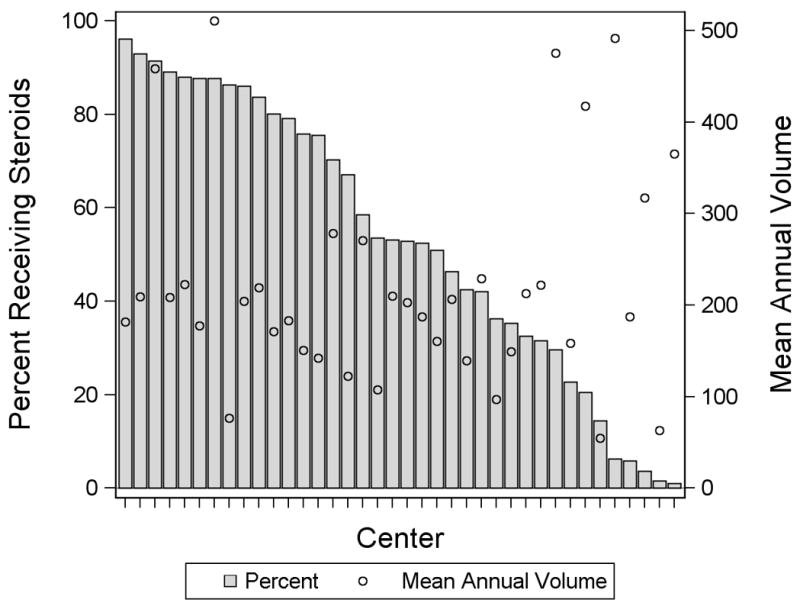
Methods and results: The Pediatric Health Information Systems Database was used to evaluate outcomes associated with corticosteroids in children (0 to 18 years of age) undergoing congenital heart surgery at 38 US centers from 2003 to 2008. Propensity scores were constructed to account for potential confounders: age, sex, race, prematurity, genetic syndrome, type of surgery (Risk Adjustment in Congenital Heart Surgery [RACHS-1] category), center, and center volume. Multivariable analysis, adjusting for propensity score and individual covariates, was performed to evaluate in-hospital mortality, postoperative length of stay, duration of ventilation, infection, and use of insulin. A total of 46 730 children were included; 54% received corticosteroids. In multivariable analysis, there was no difference in mortality among corticosteroid recipients and nonrecipients (odds ratio, 1.13; 95% confidence interval, 0.98 to 1.30). Corticosteroids were associated with longer length of stay (least square mean difference, 2.18 days; 95% confidence interval, 1.62 to 2.74 days), greater infection (odds ratio, 1.27; 95% confidence interval, 1.10 to 1.46), and greater use of insulin (odds ratio, 2.45; 95% confidence interval, 2.24 to 2.67). There was no difference in duration of ventilation. In analysis stratified by RACHS-1 category, no significant benefit was seen in any group, and the association of corticosteroids with increased morbidity was most prominent in RACHS-1 categories 1 through 3.
Conclusion: In this observational analysis of children undergoing congenital heart surgery, we were unable to demonstrate a significant benefit associated with corticosteroids and found that corticosteroids may be associated with increased morbidity, particularly in lower-risk patients.
Figures
References
-
- Checchia PA, Bronicki RA, Costello JM, Nelson DP. Steroid use before pediatric cardiac operations using cardiopulmonary bypass: An international survey of 36 centers. Pediatr Crit Care Med. 2005;6:441–4. - PubMed
-
- Lindberg L, Forsell C, Jogi P, Olsson K. Effects of dexamethasone on clinical course, C-reactive protein, S100B protein and von Willebrand factor antigen after pediatric cardiac surgery. Br J Anaesth. 2003;90:728–732. - PubMed
-
- Bronicki R, Backer C, Baden H, Mavroudis C, Crawford S, Green T. Dexamethasone reduces the inflammatory response to cardiopulmonary bypass in children. Ann Thorac Surg. 2000;69:1490–1495. - PubMed
-
- Schroeder V, Pearl JM, Schwartz SM, Shanley TP, Manning PB, Nelson DP. Combined steroid treatment for congenital heart surgery improves oxygen delivery and reduces postbypass inflammatory mediator expression. Circulation. 2003;107:2823–2828. - PubMed
-
- Varan B, Tokel K, Mercan S, Donmez A, Aslamaci S. Systemic inflammatory response related to cardiopulmonary bypass and its modification by methyl prednisolone: High dose versus low dose. Pediatr Cardiol. 2002;23:437–41. - PubMed
Publication types
MeSH terms
Substances
Grants and funding
LinkOut - more resources
Full Text Sources
Other Literature Sources
Medical
