


Neuroengineering tools/applications for bidirectional interfaces, brain-computer interfaces, and neuroprosthetic implants - a review of recent progress
- PMID: 21060801
- PMCID: PMC2972680
- DOI: 10.3389/fneng.2010.00112
Neuroengineering tools/applications for bidirectional interfaces, brain-computer interfaces, and neuroprosthetic implants - a review of recent progress
Abstract
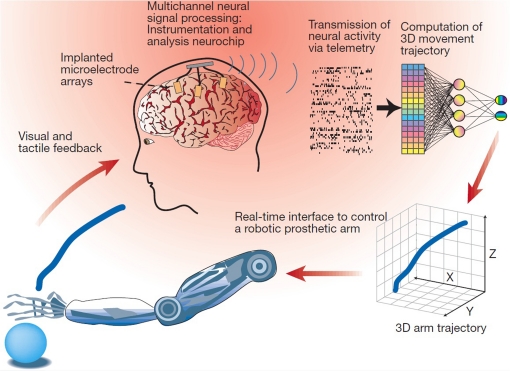
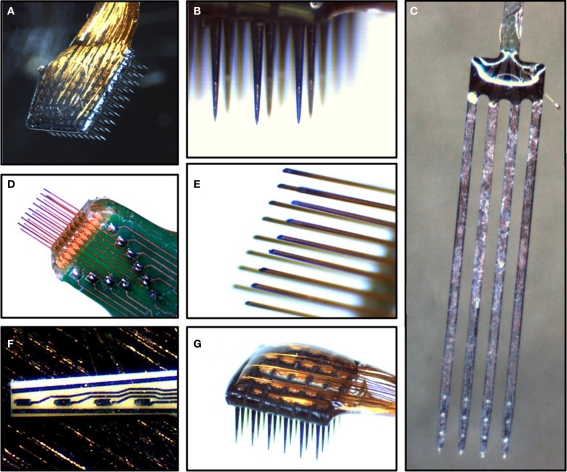
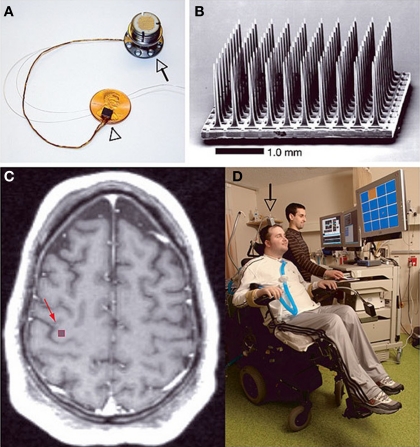
The main focus of this review is to provide a holistic amalgamated overview of the most recent human in vivo techniques for implementing brain-computer interfaces (BCIs), bidirectional interfaces, and neuroprosthetics. Neuroengineering is providing new methods for tackling current difficulties; however neuroprosthetics have been studied for decades. Recent progresses are permitting the design of better systems with higher accuracies, repeatability, and system robustness. Bidirectional interfaces integrate recording and the relaying of information from and to the brain for the development of BCIs. The concepts of non-invasive and invasive recording of brain activity are introduced. This includes classical and innovative techniques like electroencephalography and near-infrared spectroscopy. Then the problem of gliosis and solutions for (semi-) permanent implant biocompatibility such as innovative implant coatings, materials, and shapes are discussed. Implant power and the transmission of their data through implanted pulse generators and wireless telemetry are taken into account. How sensation can be relayed back to the brain to increase integration of the neuroengineered systems with the body by methods such as micro-stimulation and transcranial magnetic stimulation are then addressed. The neuroprosthetic section discusses some of the various types and how they operate. Visual prosthetics are discussed and the three types, dependant on implant location, are examined. Auditory prosthetics, being cochlear or cortical, are then addressed. Replacement hand and limb prosthetics are then considered. These are followed by sections concentrating on the control of wheelchairs, computers and robotics directly from brain activity as recorded by non-invasive and invasive techniques.
Keywords: bidirectional interface; biocompatibility; bioelectronics; brain–computer interface; brain–machine interface; multielectrode array; neuroengineering; neuroprosthetics.
Figures
References
-
- Abu-Nimeh F. T., Kamboh A., Aghagolzadeh M., Jow U. M., Mason A., Ghovanloo M., Oweiss K. (2009). “A highly modular, wireless, implantable interface to the cortex,” in International IEEE/EMBS Conference on Neural Engineering (NER), Antalya, Turkey, 375–37810.1109/NER.2009.5109311 - DOI
-
- Ahmed I., Liu H. Y., Mamiya P. C., Ponery A. S., Babu A. N., Weik T., Schindler M., Meiners S. (2006). Three-dimensional nanofibrillar surfaces covalently modified with tenascin-C-derived peptides enhance neuronal growth in vitro. J. Biomed. Mater. Res. A 76, 851–86010.1002/jbm.a.30587 - DOI - PubMed
-
- Avestruz A. T., Santa W., Carlson D., Jensen R., Stanslaski S., Helfenstine A., Denison T. (2008). A 5 μw/channel spectral analysis IC for chronic bidirectional brain–machine interfaces. IEEE J. Solid State Circuits 43, 3006–302410.1109/JSSC.2008.2006460 - DOI
LinkOut - more resources
Full Text Sources
Other Literature Sources
