


Evidence of a louse-borne outbreak involving typhus in Douai, 1710-1712 during the war of Spanish succession
- PMID: 21060879
- PMCID: PMC2965176
- DOI: 10.1371/journal.pone.0015405
Evidence of a louse-borne outbreak involving typhus in Douai, 1710-1712 during the war of Spanish succession
Abstract
Background: The new field of paleomicrobiology allows past outbreaks to be identified by testing dental pulp of human remains with PCR.
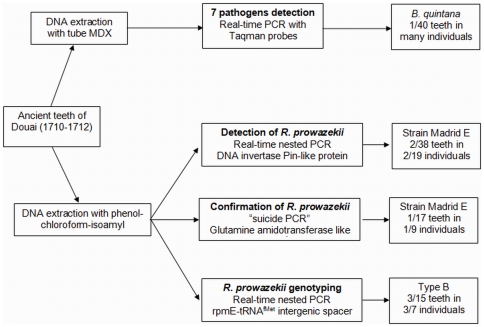
Methods: We identified a mass grave in Douai, France dating from the early XVIII(th) century. This city was besieged during the European war of Spanish succession. We tested dental pulp from 1192 teeth (including 40 from Douai) by quantitative PCR (qPCR) for R. prowazekii and B. quintana. We also used ultra-sensitive suicide PCR to detect R. prowazekii and genotyped positive samples.
Results and discussion: In the Douai remains, we identified one case of B. quintana infection (by qPCR) and R. prowazekii (by suicide PCR) in 6/21 individuals (29%). The R. prowazekii was genotype B, a genotype previously found in a Spanish isolate obtained in the first part of the XX(th) century.
Conclusion: Louse-borne outbreaks were raging during the XVIII(th) century; our results support the hypothesis that typhus was imported into Europe by Spanish soldiers from America.
Conflict of interest statement
Figures



References
-
- Zinsser H. Londres: Broadway House; 1935. Rats, lice, and history.301
-
- Drancourt M, Raoult D. Palaeomicrobiology: current issues and perspectives. Nat Rev Microbiol. 2005;3:23–35. - PubMed
-
- Drancourt M, Raoult D. Palaeomicrobiology: current issues and perspectives. Nat Rev Microbiol. 2005;3:23–35. - PubMed
-
- Drancourt M, Raoult D. Molecular detection of Yersinia pestis in dental pulp. Microbiology. 2004;150:263–264. - PubMed
Publication types
MeSH terms
LinkOut - more resources
Full Text Sources
Other Literature Sources
Miscellaneous
