


Normative data on the sleep habits of Australian children and adolescents
- PMID: 21061861
- PMCID: PMC2941425
- DOI: 10.1093/sleep/33.10.1381
Normative data on the sleep habits of Australian children and adolescents
Abstract
Study objective: To provide normative sleep data on 9-18 year old Australians.
Design: Cohort study.
Setting: Participants' homes.
Participants: 4032 Australians aged 9-18 years.
Interventions: N/A.
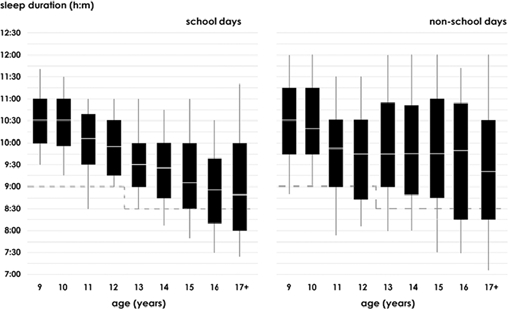
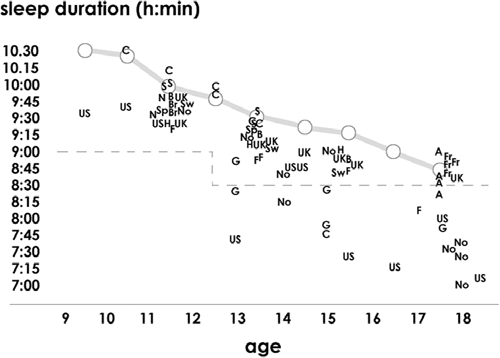
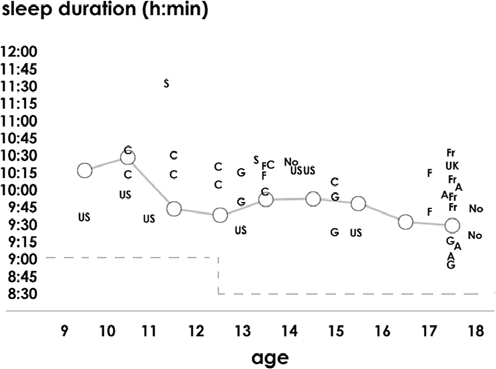
Measurements and results: Participants completed a 48h use of time recall, comprising sleep data for one complete night. Sleep duration, bedtime and wake time were compared across age groups, between genders, and between school and non-school days using ANOVA. Sleep duration declined with age (P < 0.0001) at the rate of 12 min/night per year of age on school days, and 4 min on non-school days. Girls slept slightly longer than boys (5 min/night; P = 0.03). Non-school day sleep was 16 min longer than school day sleep (P < 0.0001), with the difference increasing with age. Bedtimes got later with age (P < 0.0001), however there were no differences in bedtimes between boys and girls. Bedtimes occurred 34 min later on non-school days (P < 0.0001). Wake times were very similar across age groups on school days, but increased at the rate of 10 min/year of age on non-school days. Wake times were similar for boys and girls, and occurred on average 82 min later on non-school days (P < 0.0001). Overall, 17% of school days and 20% of non-school days failed to meet the American Centers for Disease Control and Prevention sleep duration guidelines.
Conclusions: Normative sleep data will provide a valuable yardstick for health and education professionals when dealing with sleep-related issues.
Figures
Comment in
-
Future directions for research on sleep durations in pediatric populations.Sleep. 2010 Oct;33(10):1281-2. doi: 10.1093/sleep/33.10.1281. Sleep. 2010. PMID: 21061849 Free PMC article. No abstract available.
References
-
- Gozal D, Kheirandish-Gozal L. Neurocognitive and behavioral morbidity in children with sleep disorders. Curr Opin Pulm Med. 2007;13:505–9. - PubMed
-
- O' Brien LM, Gozal D. Neurocognitive dysfunction and sleep in children: from human to rodent. Pediatr Clin North Am. 2004;51:187–202. - PubMed
-
- Blunden S, Hoban TF, Chervin RD. Sleepiness in children. Sleep Med Clin. 2006;1:105–18.
-
- Wong MM, Brower KJ, Fitzgerald HE, Zucker RA. Sleep problems in early childhood and early onset of alcohol and other drug use in adolescence. Alcohol Clin Exp Res. 2004;28:578–87. - PubMed
MeSH terms
LinkOut - more resources
Full Text Sources
Medical
