


Prevalence and clustering of metabolic risk factors for type 2 diabetes among Chinese adults in Shanghai, China
- PMID: 21062480
- PMCID: PMC2989965
- DOI: 10.1186/1471-2458-10-683
Prevalence and clustering of metabolic risk factors for type 2 diabetes among Chinese adults in Shanghai, China
Abstract
Background: Type 2 diabetes is becoming an epidemic in China. To evaluate the prevalence, clustering of metabolic risk factors and their impact on type 2 diabetes, we conducted a population-based study in Shanghai, China's largest metropolitan area.
Methods: From 2006 to 2007, 2,113 type 2 diabetes cases and 2,458 comparable controls of adults aged 40 to 79 years were enrolled. Demographic, lifestyle, and dietary factors were assessed via standardized questionnaires. Plasma, red and white blood cells were collected and stored for future studies. Anthropometric indices and biochemical intermediates (including blood pressure, fasting glucose, glycosylated hemoglobin, and blood lipids) were measured. The prevalence of metabolic syndrome were also compared following two criteria recommended by the Chinese Diabetes Society (CDS, 2004) and the National Cholesterol Education Program's Adult Treatment Panel III (ATP III, 2002).
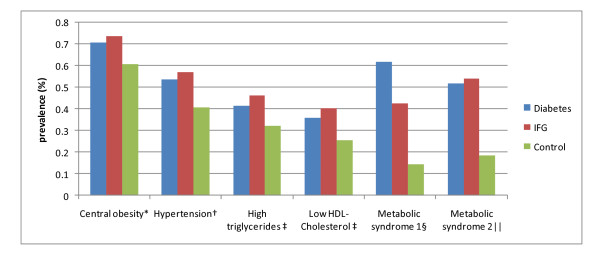
Results: Prevalence of metabolic syndrome (62% vs. 15% using CDS criteria) and its individual components, including obesity (51% vs. 42%), hypertension (54% vs. 41%), hypertriglyceridemia (42% vs. 32%), and low high-density lipoprotein-cholesterol (HDL) levels (36% vs. 25%) were higher in diabetes cases than controls. Regardless of criteria used, those with impaired fasting glucose (IFG) had similarly high prevalence of metabolic syndrome as did diabetes cases. In a multiple logistic regression model adjusted for demographics and lifestyle risk factors, the odds ratios of diabetes (95% CI) were 1.23 (1.04-1.45) for overweight (28 >= BMI >= 24), 1.81 (1.45-2.25) for obesity (BMI > 28), 1.53 (1.30-1.80) for central obesity (waist circumference > 80 cm for woman or waist circumference > 85 cm for man), 1.36 (1.17-1.59) for hypertension (sbp/dbp >= 140/90 mmHg), 1.55 (1.32-1.82) for high triglycerides (triglycerides > 1.70 mmol/l) and 1.52 (1.23-1.79) for low HDL-C (HDL-C < 1.04 mmol/L).
Conclusions: These data indicate that multiple metabolic risk factors--individually or jointly--were more prevalent in diabetes patients than in controls. Further research will examine hypotheses concerning the high prevalence of IFG, family history, and central obesity, aiding development of multifaceted preventive strategies specific to this population.
Figures
References
-
- Li R, Lu W, Jia WP, Li YY, Shi L, Liu MX, Geng GZ, Fu H, Shi R, Shi JH, Shi HL, Zhang SN. Cross-sectional investigation of prevalence of type 2 diabetes in Shanghai. Zhonghua Yi Xue Za Zhi. 2006;86(24):1675–1680. - PubMed
-
- Yang W, Lu J, Weng J, Jia W, Ji L, Xiao J, Shan Z, Liu J, Tian H, Ji Q, Zhu D, Ge J, Lin L, Chen L, Guo X, Zhao Z, Li Q, Zhou Z, Shan G, He J, China National Diabetes and Metabolic Disorders Study Group. Prevalence of diabetes among men and women in China. N Engl J Med. pp. 1090–1101. - DOI - PubMed
-
- Grarup N, Rose CS, Andersson EA, Andersen G, Nielsen AL, Albrechtsen A, Clausen JO, Rasmussen SS, Jorgensen T, Sandbaek A, Lauritzen T, Schmitz O, hansen T, Pedsersen O. Studies of association of variants near the HHEX, CDKN2A/B, and IGF2BP2 genes with type 2 diabetes and impaired insulin release in 10,705 Danish subjects: validation and extension of genome-wide association studies. Diabetes. 2007;56(12):3105–3111. doi: 10.2337/db07-0856. - DOI - PubMed
