. 2010 Nov 10:7:307.
doi: 10.1186/1743-422X-7-307.

In vitro inhibitory activity of Alpinia katsumadai extracts against influenza virus infection and hemagglutination

Affiliations

In vitro inhibitory activity of Alpinia katsumadai extracts against influenza virus infection and hemagglutination

Hyung-Jun Kwon et al. Virol J. .

Abstract

Background: Alpinia katsumadai (AK) extracts and fractions were tested for in vitro antiviral activities against influenza virus type A, specially human A/PR/8/34 (H1N1) and avian A/Chicken/Korea/MS96/96 (H9N2), by means of time-of-addition experiments; pre-treatment, simultaneous treatment, and post treatment.

Results: In pre-treatment assay, the AK extracts and AK fractions did not show significant antiviral activity. During the simultaneous treatment assay, one AK extract and five AK fractions designated as AK-1 to AK-3, AK-5, AK-10, and AK-11 showed complete inhibition of virus infectivity against A/PR/8/34 (H1N1) and A/Chicken/Korea/MS96/96 (H9N2). The 50% effective inhibitory concentrations (EC₅₀) of these one AK extracts and five AK fractions with exception of the AK-9 were from 0.8 ± 1.4 to 16.4 ± 4.5 μg/mL against A/PR/8/34 (H1N1). The two AK extracts and three AK fractions had EC₅₀ values ranging from <0.39 ± 0.4 to 2.3 ± 3.6 μg/mL against A/Chicken/Korea/MS96/96 (H9N2). By the hemagglutination inhibition (HI) assay, the two AK extracts and five AK fractions completely inhibited viral adsorption onto chicken RBCs at less than 100 μg/mL against both A/PR/8/34 (H1N1) and A/Chicken/Korea/MS96/96 (H9N2). Interestingly, only AK-3 was found with inhibition for both viral attachment and viral replication after showing extended antiviral activity during the post treatment assay and quantitative real-time PCR.

Conclusions: These results suggest that AK extracts and fractions had strong anti-influenza virus activity that can inhibit viral attachment and/or viral replication, and may be used as viral prophylaxis.


Figures
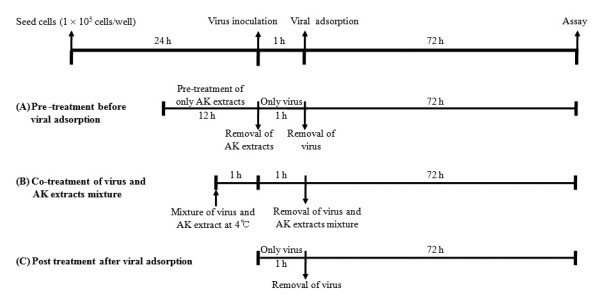
Figure 1
Figure 1
Antiviral assay strategies with AK extracts and AK fractions on different stages of virus infection. At 12 h prior to virus infection for pre-treatment assay (A), at the same time after virus incubation with AK extracts and AK fractions at 4°C for 1 h for simultaneous treatment assay (B), and at 1 h later of AK extracts after viral infection for post treatment assay (C).
Figure 2
Figure 2
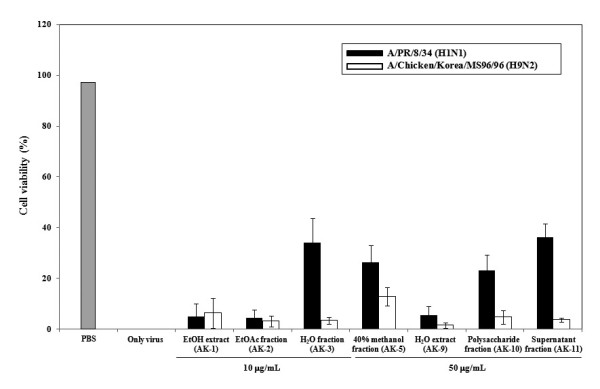
Antiviral activity of AK extracts and AK fractions before virus attachment in pre-treatment assay. MDCK cells were pre-incubated with AK extracts and AK fractions 12 h prior to infection of influenza virus (A/PR/8/34 [H1N1] and A/Chicken/Korea/MS96/96 [H9N2]). Antiviral effects were determined by formation of cytopathic effect and plotted as a percentage of cell control (uninfected) and virus control (untreated). AK-1: EtOH extract; AK-2: EtOAc fraction; AK-3: H2O fraction; AK-5: 40% methanol fraction; AK-9: H2O extract; AK-10: Polysaccharide fraction; AK-11: Supernatant fraction.
Figure 3
Figure 3
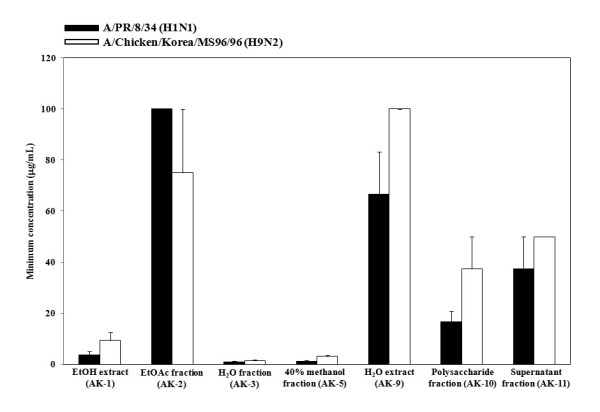
Inhibitory activity of AK extracts and AK fractions on agglutination with viral hemagglutinin and chichen RBC (cRBC). Four HAU of influenza virus (A/PR/8/34 [H1N1] and A/Chicken/Korea/MS96/96 [H9N2]) were mixed with an equal volume of 2-fold diluted two AK extracts and five AK fractions or PBS (negative control) and incubated for 1 h at 4°C. The hemagglutination activity was tested by incubation with 1% cRBC for 1 h at room temperature. We determined the minimum concentration of AK extracts and AK fractions inhibiting the viral hemagglutination completely.
Figure 4
Figure 4
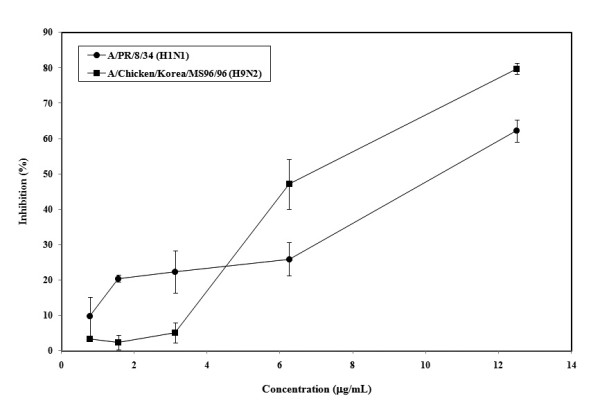
Antiviral effect of AK-3 after virus entry in post treatment assay. Influenza viruses at 100 TCID50 were inoculated in MDCK cells. After 1 h, viruses were removed and MDCK cells were treated with AK-3 at different concentration. The cultures were incubated for 72 h at 35°C under 5% CO2 atmosphere. Each concentration of AK-3 was assayed by two times in triplicate.
Figure 5
Figure 5
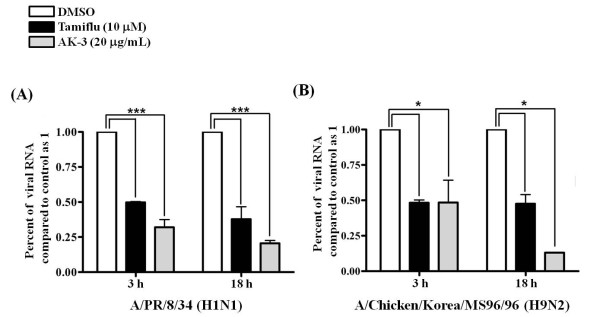
Quantitive real-time PCR of influenza viral RNA levels normalized to GAPDH. MDCK cells were infected with 0.01 MOI influenza viruses. After 1 h, viruses were removed. MDCK cells were treated with DMSO (0.5%), AK-3 (20 μg/mL) and Tamiflu (10 μM). Total RNA extraction was performed at 3 h and 18 h after influenza virus infection and the levels of intracellular influenza viral RNA were measured. Influenza viral RNA levles normalized to GAPDH. (A) A/PR/8/34 (H1N1) (*** p < 0.01), (B) A/Chicken/Korea/MS96/96 (H9N2) (* p < 0.05).

References

    1. Palese P. Influenza: old and new threats. Nature Medicine. 2004;10(Suppl 12):S82–S87. doi: 10.1038/nm1141. - DOI - PubMed
    1. Palese P, Shaw ML. In: Fields Virology. 5. Fields BN, Knipe DM, Howley PM, editor. Wolters Kluwer Health/Lippincott Williams & Wikins, Philadelphia; 2007. Orthomyxoviridae: the viruses and their replication; pp. 1647–1689.
    1. Hayden FG, Pavia AT. Antiviral management of seasonal and pandemic influenza. J Infect Dis. 2006;194(Suppl 2):S119–S126. doi: 10.1086/507552. - DOI - PubMed
    1. Memoli MJ, Morens DM, Taubenberger JK. Pandemic and seasonal influenza: therapeutic challenges. Drug Discovery Today. 2008;13:590–595. doi: 10.1016/j.drudis.2008.03.024. - DOI - PMC - PubMed
    1. Dawood FS, Jain S, Finelli L, Shaw MW, Lindstrom S, Garten RJ, Gubareva LV, Xu X, Bridges CB, Uyeki TM. Emergence of a novel swine-origin influenza A (H1N1) virus in humans. N Engl J Med. 2009;360:2605–2615. doi: 10.1056/NEJMoa0903810. - DOI - PubMed

Publication types

MeSH terms