


Ultraconserved cDNA segments in the human transcriptome exhibit resistance to folding and implicate function in translation and alternative splicing
- PMID: 21062826
- PMCID: PMC3064809
- DOI: 10.1093/nar/gkq949
Ultraconserved cDNA segments in the human transcriptome exhibit resistance to folding and implicate function in translation and alternative splicing
Abstract
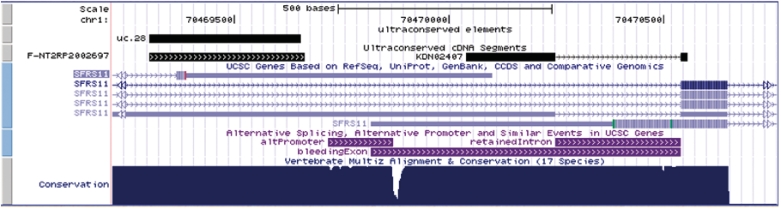
Ultraconservation, defined as perfect human-to-rodent sequence identity at least 200-bp long, is a strong indicator of evolutionary and functional importance and has been explored extensively at the genome level. However, it has not been investigated at the transcript level, where such extreme conservation might highlight loci with important post-transcriptional regulatory roles. We present 96 ultraconserved cDNA segments (UCSs), stretches of human mature mRNAs that match identically with orthologous regions in the mouse and rat genomes. UCSs can span multiple exons, a feature we leverage here to elucidate the role of ultraconservation in post-transcriptional regulation. UCS sites are implicated in functions at essentially every post-transcriptional stage: pre-mRNA splicing and degradation through alternative splicing and nonsense-mediated decay (AS-NMD), mature mRNA silencing by miRNA, fast mRNA decay rate and translational repression by upstream AUGs. We also found UCSs to exhibit resistance to formation of RNA secondary structure. These multiple layers of regulation underscore the importance of the UCS-containing genes as key global RNA processing regulators, including members of the serine/arginine-rich protein and heterogeneous nuclear ribonucleoprotein (hnRNP) families of essential splicing regulators. The discovery of UCSs shed new light on the multifaceted, fine-tuned and tight post-transcriptional regulation of gene families as conserved through the majority of the mammalian lineage.
Figures




References
-
- Boffelli D, Nobrega MA, Rubin EM. Comparative genomics at the vertebrate extremes. Nat. Rev. Genet. 2004;5:456–465. - PubMed
-
- Dermitzakis ET, Reymond A, Antonarakis SE. Conserved non-genic sequences - an unexpected feature of mammalian genomes. Nat. Rev. Genet. 2005;6:151–157. - PubMed
-
- Waterston RH, Lindblad-Toh K, Birney E, Rogers J, Abril JF, Agarwal P, Agarwala R, Ainscough R, Alexandersson M, An P, et al. Initial sequencing and comparative analysis of the mouse genome. Nature. 2002;420:520–562. - PubMed
-
- Bejerano G, Pheasant M, Makunin I, Stephen S, Kent WJ, Mattick JS, Haussler D. Ultraconserved elements in the human genome. Science. 2004;304:1321–1325. - PubMed
-
- Sakuraba Y, Kimura T, Masuya H, Noguchi H, Sezutsu H, Takahasi KR, Toyoda A, Fukumura R, Murata T, Sakaki Y, et al. Identification and characterization of new long conserved noncoding sequences in vertebrates. Mamm. Genome. 2008;19:703–712. - PubMed
Publication types
MeSH terms
Substances
LinkOut - more resources
Full Text Sources
Research Materials
