


Diminished antioxidant activity of high-density lipoprotein-associated proteins in systolic heart failure
- PMID: 21062973
- PMCID: PMC3023838
- DOI: 10.1161/CIRCHEARTFAILURE.110.958348
Diminished antioxidant activity of high-density lipoprotein-associated proteins in systolic heart failure
Abstract
Background: Diminished serum arylesterase activity, catalyzed by the high-density lipoprotein-associated paraoxonase-1, is associated with heightened systemic oxidative stress and atherosclerosis risk. In the present study, we sought to determine the prognostic role of serum arylesterase activity in subjects with systolic heart failure, particularly in relation to established cardiac biomarkers.
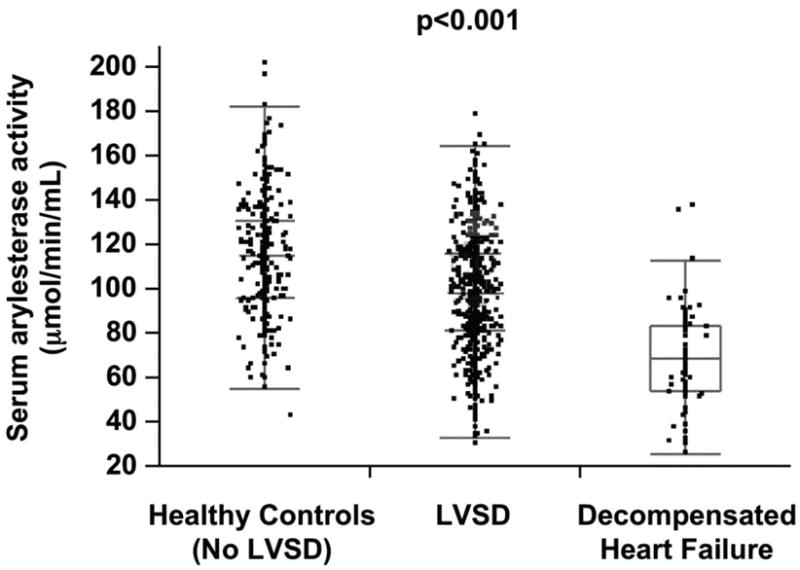
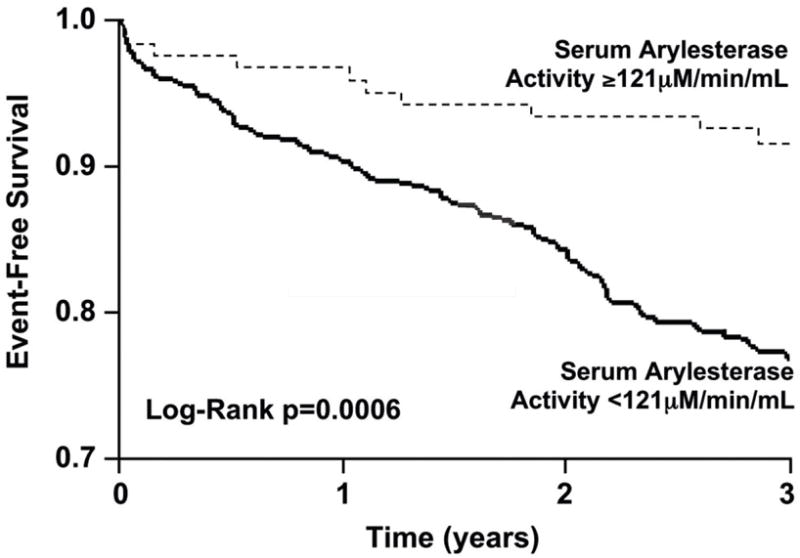
Methods and results: We measured serum arylesterase activity in 760 subjects with impaired left ventricular systolic function (left ventricular ejection fraction <50%), and prospectively followed major adverse cardiac events (including death, nonfatal myocardial infarction, and stroke) for 3 years. In our study cohort (mean age, 64±11 years; 74% men; median left ventricular ejection fraction, 35%; median creatinine clearance, 96 mg/dL), mean serum arylesterase activity (98±25 μmol/L/min/mL) was lower compared with that in healthy control subjects (mean, 115±26 μmol/L/min/mL, P<0.01) but higher compared with advanced decompensated heart failure subjects (mean, 69±22 μmol/L/min/mL, P<0.01). Within our cohort, there was modest correlation between serum arylesterase activity and high-density lipoprotein cholesterol (r=0.33, P<0.01) as well as B-type natriuretic peptide (r=-0.23, P<0.01). Lower serum arylesterase activity was a strong predictor of poorer outcomes (hazard ratio, 2.94; 95% confidence interval, 1.54, 5.62; P<0.001). After adjusting for traditional risk factors, medication use, B-type natriuretic peptide, and creatinine clearance, lower serum arylesterase still conferred an increased risk of major adverse cardiac events at 3 years (hazard ratio, 2.69; 95% confidence interval, 1.37 to 5.28; P=0.004).
Conclusions: In patients with systolic heart failure, decreased serum arylesterase activity, a measure of diminished antioxidant properties of high-density lipoprotein, predicts higher risk of incident long-term adverse cardiac event independent of established clinical and biochemical risk factors.
Figures
References
-
- George J, Wexler D, Roth A, Barak T, Sheps D, Keren G. Usefulness of anti-oxidized LDL antibody determination for assessment of clinical control in patients with heart failure. Eur J Heart Fail. 2006;8:58–62. - PubMed
-
- Diaz-Velez CR, Garcia-Castineiras S, Mendoza-Ramos E, Hernandez-Lopez E. Increased malondialdehyde in peripheral blood of patients with congestive heart failure. Am Heart J. 1996;131:146–152. - PubMed
-
- Hokamaki J, Kawano H, Yoshimura M, Soejima H, Miyamoto S, Kajiwara I, Kojima S, Sakamoto T, Sugiyama S, Hirai N, Shimomura H, Nagayoshi Y, Tsujita K, Shioji I, Sasaki S, Ogawa H. Urinary biopyrrins levels are elevated in relation to severity of heart failure. J Am Coll Cardiol. 2004;43:1880–1885. - PubMed
-
- Dieterich S, Bieligk U, Beulich K, Hasenfuss G, Prestle J. Gene expression of antioxidative enzymes in the human heart: increased expression of catalase in the end-stage failing heart. Circulation. 2000;101:33–39. - PubMed
Publication types
MeSH terms
Substances
Grants and funding
- 1R01 HL103931-01/HL/NHLBI NIH HHS/United States
- R01 HL103931/HL/NHLBI NIH HHS/United States
- 1P01 HL098055-01/HL/NHLBI NIH HHS/United States
- 1UL1RR024989/RR/NCRR NIH HHS/United States
- P01 HL076491/HL/NHLBI NIH HHS/United States
- R01 DK080732/DK/NIDDK NIH HHS/United States
- P01 HL0870180-20001/HL/NHLBI NIH HHS/United States
- P01 HL098055/HL/NHLBI NIH HHS/United States
- P01 HL076491-055328/HL/NHLBI NIH HHS/United States
- 1R01 DK080732-01A1/DK/NIDDK NIH HHS/United States
- P50 HL077107-050004/HL/NHLBI NIH HHS/United States
- UL1 RR024989/RR/NCRR NIH HHS/United States
LinkOut - more resources
Full Text Sources
Medical
