


Critical windows of fetal lead exposure: adverse impacts on length of gestation and risk of premature delivery
- PMID: 21063188
- PMCID: PMC3003442
- DOI: 10.1097/JOM.0b013e3181f86fee
Critical windows of fetal lead exposure: adverse impacts on length of gestation and risk of premature delivery
Abstract
Objective: Research on the role of environmental lead exposure in the complex etiology of premature birth has yielded inconsistent results. We assessed the trimester-specific effect of prenatal lead exposure on gestational age and risk of premature delivery.
Methods: We used linear and logistic regression to identify critical windows of susceptibility to lead exposure on gestational length.
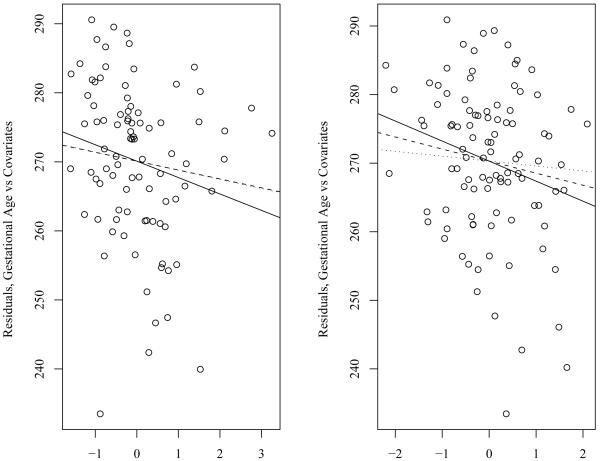
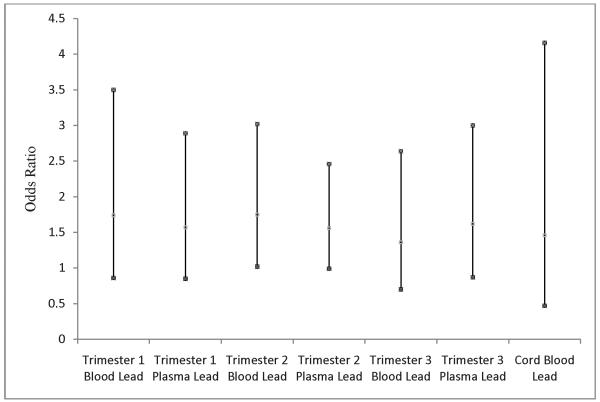
Results: In single-trimester models, decreases in gestational length were most strongly associated with first and second trimester blood lead. In adjusted logistic regression models, a one-standard deviation increase in second trimester blood lead was associated with an odds ratio of prematurity of 1.75 (95% CI: 1.02, 3.02).
Conclusions: Maternal whole blood lead levels measured during first and second trimesters yielded the most prominent inverse association with length of gestation and increased the risk of prematurity.
Figures
Similar articles
-
Very low maternal lead level in pregnancy and birth outcomes in an eastern Massachusetts population.Ann Epidemiol. 2014 Dec;24(12):915-9. doi: 10.1016/j.annepidem.2014.09.007. Epub 2014 Sep 28. Ann Epidemiol. 2014. PMID: 25444892 Free PMC article.
-
Prenatal lead exposure modifies the effect of shorter gestation on increased blood pressure in children.Environ Int. 2018 Nov;120:464-471. doi: 10.1016/j.envint.2018.08.038. Epub 2018 Aug 23. Environ Int. 2018. PMID: 30145310 Free PMC article.
-
Effects of trimester-specific exposure to vanadium on ultrasound measures of fetal growth and birth size: a longitudinal prospective prenatal cohort study.Lancet Planet Health. 2018 Oct;2(10):e427-e437. doi: 10.1016/S2542-5196(18)30210-9. Lancet Planet Health. 2018. PMID: 30318100
-
Association of BPA exposure during pregnancy with risk of preterm birth and changes in gestational age: A meta-analysis and systematic review.Ecotoxicol Environ Saf. 2021 Sep 1;220:112400. doi: 10.1016/j.ecoenv.2021.112400. Epub 2021 Jun 8. Ecotoxicol Environ Saf. 2021. PMID: 34116331
-
The effect of gestational period on the association between maternal prenatal salivary cortisol and birth weight: A systematic review and meta-analysis.Psychoneuroendocrinology. 2018 Aug;94:49-62. doi: 10.1016/j.psyneuen.2018.04.023. Epub 2018 Apr 24. Psychoneuroendocrinology. 2018. PMID: 29754005
Cited by
-
Longitudinal associations of age and prenatal lead exposure on cortisol secretion of 12-24 month-old infants from Mexico City.Environ Health. 2016 Feb 29;15:41. doi: 10.1186/s12940-016-0124-1. Environ Health. 2016. PMID: 26926653 Free PMC article.
-
Environmental contaminant exposures and preterm birth: a comprehensive review.J Toxicol Environ Health B Crit Rev. 2013;16(2):69-113. doi: 10.1080/10937404.2013.775048. J Toxicol Environ Health B Crit Rev. 2013. PMID: 23682677 Free PMC article. Review.
-
Prenatal Lead Exposure, Genetic Factors, and Cognitive Developmental Delay.JAMA Netw Open. 2023 Oct 2;6(10):e2339108. doi: 10.1001/jamanetworkopen.2023.39108. JAMA Netw Open. 2023. PMID: 37870833 Free PMC article.
-
Blood lead concentration and thyroid function during pregnancy: results from the Yugoslavia Prospective Study of Environmental Lead Exposure.Environ Health Perspect. 2014 Oct;122(10):1134-40. doi: 10.1289/ehp.1307669. Epub 2014 May 27. Environ Health Perspect. 2014. PMID: 24866691 Free PMC article.
-
Very low maternal lead level in pregnancy and birth outcomes in an eastern Massachusetts population.Ann Epidemiol. 2014 Dec;24(12):915-9. doi: 10.1016/j.annepidem.2014.09.007. Epub 2014 Sep 28. Ann Epidemiol. 2014. PMID: 25444892 Free PMC article.
References
-
- Lawn JE, Cousens S, Zupan J. 4 million neonatal deaths: when? Where? Why? Lancet. 2005;365:891–900. - PubMed
-
- Lawn JE, Wilczynska-Ketende K, Cousens SN. Estimating the causes of 4 million neonatal deaths in the year 2000. Int J Epidemiol. 2006;35:706–718. - PubMed
-
- Sesma HW, Georgieff MK. The effect of adverse intrauterine and newborn environments on cognitive development: the experiences of premature delivery and diabetes during pregnancy. Dev Psychopathol. 2003;15:991–1015. - PubMed
-
- Johnson S. Cognitive and behavioural outcomes following very preterm birth. Semin Fetal Neonatal Med. 2007;12:363–373. - PubMed
-
- Saigal SSB, Streiner DL, Burrows E. Physical growth and current health status of infants who were of extremely low birth weight and controls at adolescence. Pediatrics. 2001;108:407–415. - PubMed
Publication types
MeSH terms
Substances
Grants and funding
LinkOut - more resources
Full Text Sources
Medical
