. 2011 May;106(5):841-53.
doi: 10.1038/hdy.2010.127. Epub 2010 Nov 10.

Patterns of hybridization and asymmetrical gene flow in hybrid zones of the rare Eucalyptus aggregata and common E. rubida

Affiliations

Patterns of hybridization and asymmetrical gene flow in hybrid zones of the rare Eucalyptus aggregata and common E. rubida

D L Field et al. Heredity (Edinb). 2011 May.

Abstract

The patterns of hybridization and asymmetrical gene flow among species are important for understanding the processes that maintain distinct species. We examined the potential for asymmetrical gene flow in sympatric populations of Eucalyptus aggregata and Eucalyptus rubida, both long-lived trees of southern Australia. A total of 421 adults from three hybrid zones were genotyped with six microsatellite markers. We used genealogical assignments, admixture analysis and analyses of spatial genetic structure and spatial distribution of individuals, to assess patterns of interspecific gene flow within populations. A high number of admixed individuals were detected (13.9-40% of individuals), with hybrid populations consisting of F(1) and F(2) hybrids and backcrosses in both parental directions. Across the three sites, admixture proportions were skewed towards the E. aggregata genetic cluster (x=0.56-0.65), indicating that backcrossing towards E. aggregata is more frequent. Estimates of long-term migration rates also indicate asymmetric gene flow, with higher migration rates from E. aggregata to hybrids compared with E. rubida. Taken together, these results indicate a greater genetic input from E. aggregata into the hybrid populations. This asymmetry probably reflects differences in style lengths (E. rubida: ~7 mm, E. aggregata: ~4 mm), which can prevent pollen tubes of smaller-flowered species from fertilizing larger-flowered species. However, analyses of fine-scale genetic structure suggest that localized seed dispersal (<40 m) and greater clustering between hybrid and E. aggregata individuals may also contribute to directional gene flow. Our study highlights that floral traits and the spatial distributions of individuals can be useful predictors of the directionality of interspecific gene flow in plant populations.


Figures
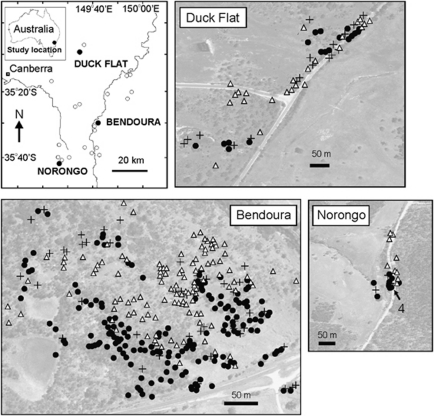
Figure 1
Figure 1
Map showing the location of three study sites, each consisting of populations of E. aggregata, E. rubida and their putative hybrids. Individual maps of each site indicate the location of adult E. aggregata (closed circles), E. rubida (open triangles), and hybrids (plus symbol). Arrow on Norongo map indicates the location of four hybrids.
Figure 2
Figure 2
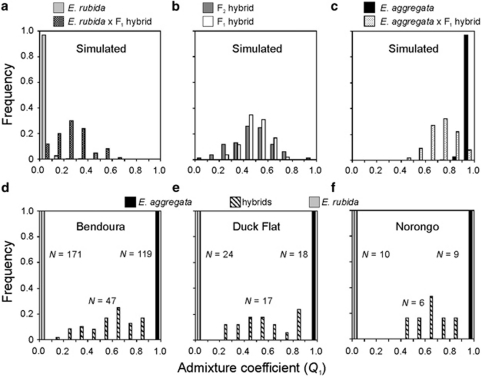
Frequency distribution of admixture coefficients (Q1) of multilocus genotypes of simulated parental and hybrid individuals (a–c), and adult plants at each of three sites: (d) Bendoura, (e) Duck Flat and (f) Norongo. Adult plant assignment based on the following thresholds: Q1>0.9 as E. aggregata, Q1<0.1 as E. rubida and 0.1 ⩽Q1 ⩽ 0.9 as hybrids.
Figure 3
Figure 3
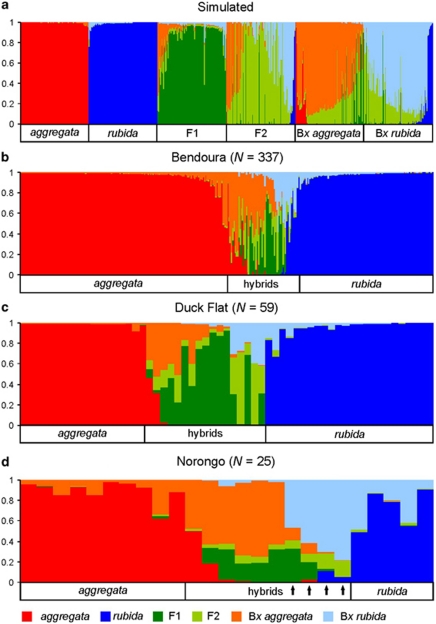
Bayesian assignment of multilocus genotypes of simulated purebred and hybrid individuals (a) and real adults (N=421) from three sympatric populations (b–d) using the software NEWHYBRIDS. Each line represents an individual's posterior probability of assignment (qi) to each of six genealogical classes including: purebred E. aggregata, purebred E. rubida and four hybrid classes (F1, F2, backcrosses towards each parent (Bx aggregata, Bx rubida)). Simulated individuals for each of the six classes were generated using reference genotypes and HYBRIDLAB. Arrows indicate individuals assigned as purebred E. rubida using the software STRUCTURE.
Figure 4
Figure 4
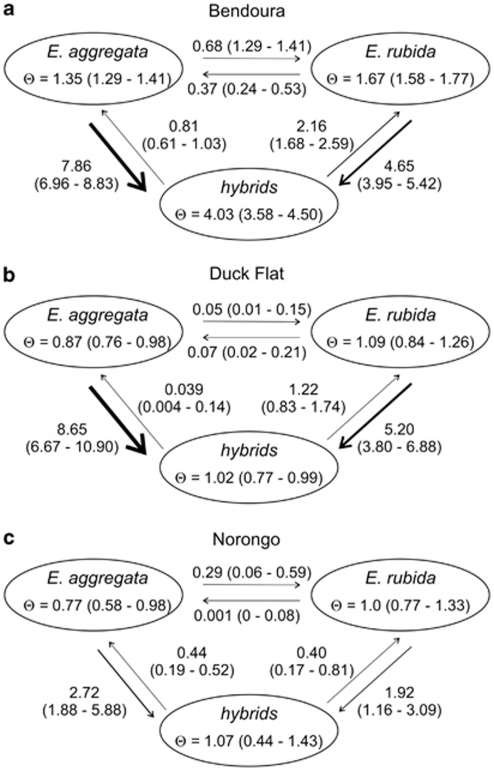
Maximum-likelihood estimates of the long-term migration rates (M) and the mutation-scaled effective population size (Θ) in each of three Eucalyptus hybrid zones (ac) using the methods of MIGRATE-N. Thickness of the arrows indicates the directional migration rate estimates (M=m/u, where m is the migration rate, and u is the mutation rate). Values in parenthesis indicate the 95% CIs.
Figure 5
Figure 5
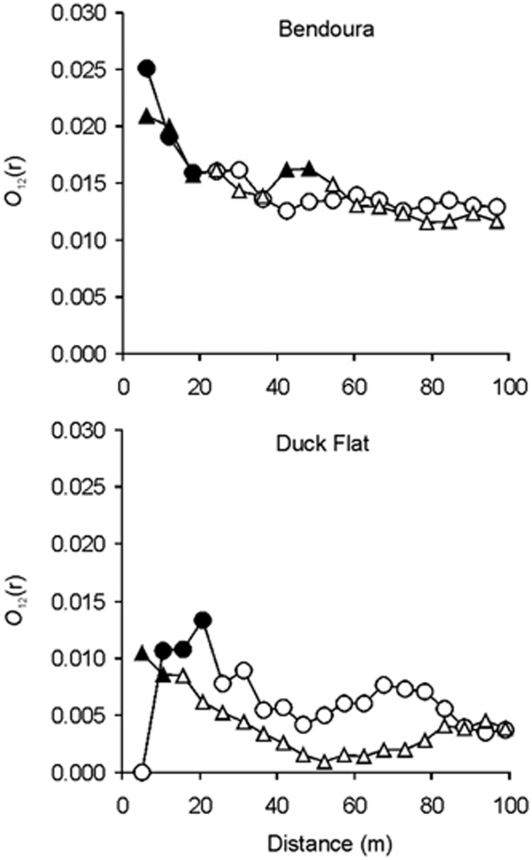
Wiegend and Moloney's O12 (r) statistics for bivariate analyses of adult populations of E. aggregata, E. rubida and hybrids at the continuous site Bendoura and remnant site Duck Flat. Circles and triangles represent bivariate analysis for E. aggregata vs hybrids and E. rubida vs hybrid individuals, respectively. Filled symbols indicate values significantly different from the null hypothesis as they lie outside the 95% CIs. The 95 % CIs were generated from 1000 Monte Carlo simulations of hybrid individuals randomly distributed around fixed E. aggregata and E. rubida distributions.
Figure 6
Figure 6
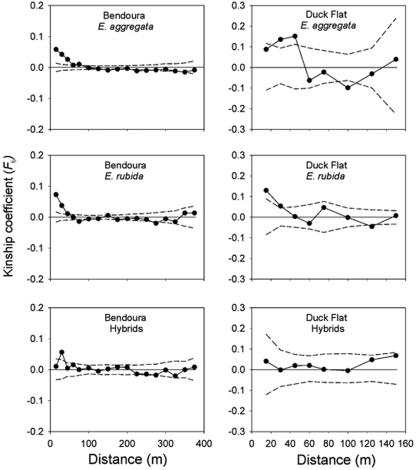
Spatial autocorrelation analyses of pair-wise co-ancestry (Fij) estimated from multi-locus genotypes of Eucalyptus aggregata, E. rubida and hybrids at each site (Bendoura and Duck Flat). Dashed lines indicate upper and lower 95% CIs around the null hypothesis of Fij=0.

References

    1. Anderson EC, Thompson EA. A model-based method for identifying species hybrids using multilocus genetic data. Genetics. 2002;160:1217–1229. - PMC - PubMed
    1. Bacilieri R, Ducousso A, Petit R, Kremer A. Mating system and asymmetric hybridization in a mixed stand of European oaks. Evolution. 1996;50:900–908. - PubMed
    1. Beerli P, Felsenstein J. Maximum-likelihood estimation of migration rates and effective population numbers in two populations using a coalescent approach. Genetics. 1999;152:763–773. - PMC - PubMed
    1. Beerli P, Felsenstein J. Maximum likelihood estimation of a migration matrix and effective population sizes in n subpopulations by using a coalescent approach. Proc Natl Acad Sci USA. 2001;98:4563–4568. - PMC - PubMed
    1. Brondani RPV, Brondani C, Tarchini R, Grattapaglia D. Development, characterization and mapping of microsatellite markers in Eucalyptus grandis and E urophylla. Theor Appl Genet. 1998;97:816–827.

Publication types