. 2010 Oct 12;1(4):e00208-10.
doi: 10.1128/mBio.00208-10.

Identification of a severe acute respiratory syndrome coronavirus-like virus in a leaf-nosed bat in Nigeria

Affiliations

Identification of a severe acute respiratory syndrome coronavirus-like virus in a leaf-nosed bat in Nigeria

Phenix-Lan Quan et al. mBio. .

Abstract

Bats are reservoirs for emerging zoonotic viruses that can have a profound impact on human and animal health, including lyssaviruses, filoviruses, paramyxoviruses, and severe acute respiratory syndrome coronaviruses (SARS-CoVs). In the course of a project focused on pathogen discovery in contexts where human-bat contact might facilitate more efficient interspecies transmission of viruses, we surveyed gastrointestinal tissue obtained from bats collected in caves in Nigeria that are frequented by humans. Coronavirus consensus PCR and unbiased high-throughput pyrosequencing revealed the presence of coronavirus sequences related to those of SARS-CoV in a Commerson's leaf-nosed bat (Hipposideros commersoni). Additional genomic sequencing indicated that this virus, unlike subgroup 2b CoVs, which includes SARS-CoV, is unique, comprising three overlapping open reading frames between the M and N genes and two conserved stem-loop II motifs. Phylogenetic analyses in conjunction with these features suggest that this virus represents a new subgroup within group 2 CoVs.


Figures
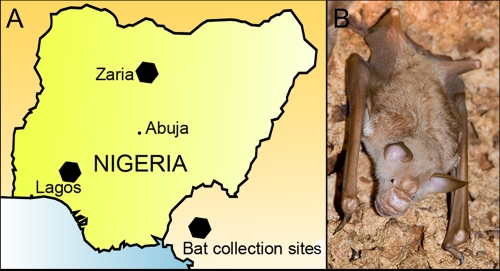
FIG 1
FIG 1
(A) Map of Nigeria showing the locations of bat collection sites. (B) Photograph of a male Commerson’s leaf-nosed bat (Hipposideros commersoni), courtesy of Ivan V. Kuzmin, reproduced with permission.
FIG 2
FIG 2
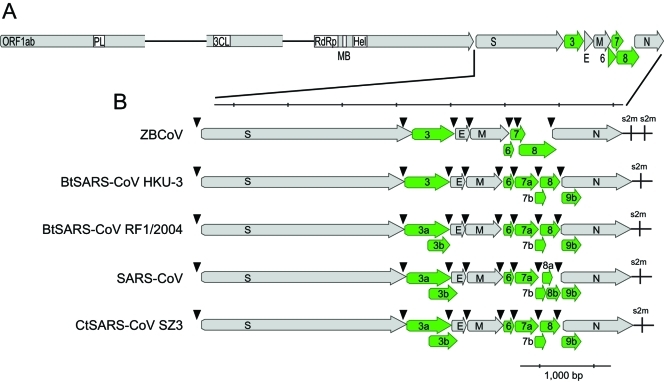
Genome organization of ZBCoV in comparison to that of representative coronaviruses from subgroup 2b. (A) Overall genome organization of ZBCoV. The ORF 1ab, spike (S), envelope (E), membrane (M), and nucleocapsid (N) genes are shown in gray arrows, whereas putative accessory genes ORF 3, ORF 6, ORF 7, and ORF 8 are indicated as 3, 6, 7, and 8 and illustrated by green arrows. The following conserved functional domains in ORF 1ab are represented in boxes: papain-like protease (PL), 3C-like protease (3CL), RNA-dependent RNA polymerase (RdRp), metal ion-binding domain (MB), and helicase (Hel). The two regions in ORF 1ab where sequences are incomplete are indicated by black lines. (B) Expanded diagram of the 3′ region of the ZBCoV genome in comparison to representative CoVs from subgroup 2b. TRS motifs and s2m are represented by black arrowheads and vertical lines, respectively.
FIG 3
FIG 3
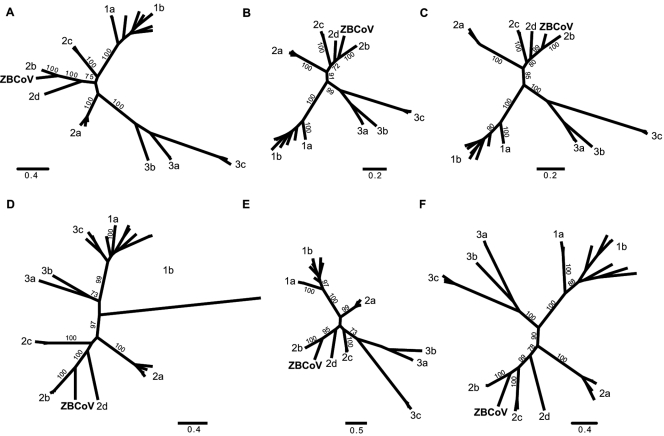
Phylogenetic analysis of the 3CLpro, RdRp, Hel, S, M, and N proteins of ZBCoV. Unrooted maximum likelihood phylogenies of the 3CLpro (A), RNA-dependent RNA polymerase (B), helicase (C), spike (D), membrane (E), and nucleocapsid (F) proteins. All phylogenies were constructed using the complete amino acid alignments of each protein, with the exception of RdRp (partial region available) and spike (only an 884-aa region could be reliably aligned). The scale bar indicates the number of substitutions per amino acid site. The numbers at each branch node represent the maximum likelihood bootstrap support; only major nodes where values exceed 70% are shown. The CoV subgroups are indicated as 1a and b, 2a to d, and 3a to c, and the following sequences obtained from GenBank were included, with the GenBank accession numbers given in parentheses: PRCV, porcine respiratory coronavirus (DQ811787); FIPV, feline infectious peritonitis virus (AY994055); HCoV-229E, human coronavirus 229E (NC_002645); HCoV-NL63, human coronavirus NL63 (NC_005831); BtCoV-512/2005, bat coronavirus 512/2005 (NC_009657); BtCoV-HKU2, bat coronavirus HKU2 (NC_009988); BtCoV-1B, bat coronavirus 1 B (NC_010436); BtCoV-1A, bat coronavirus 1A (NC_010437); BtCoV-HKU8, bat coronavirus HKU8 (NC_010438); BCoV, bovine coronavirus (NC_003045); HCoV-OC43, human coronavirus OC43 (NC_005147); HCoV-HKU1, human coronavirus HKU1 (NC_006577); MHV, mouse hepatitis virus (NC_006577); PHEV, porcine hemagglutinating encephalomyelitis virus (NC_007732); ECoV, equine coronavirus (NC_010327); BtSARS-CoV HKU3, bat SARS coronavirus HKU3 (NC_009694); CtSARS-CoV SZ3, civet SARS coronavirus SZ3 (AY304486); SARS-CoV, SARS coronavirus (NC_004718); BtSARS-CoV Rp3, bat coronavirus Rp3 (NC_009693); BtSARS-CoV Rf1/2004, bat coronavirus Rf1/2004 (NC_009695); BtSARS-CoV RM1, bat coronavirus RM1 (NC_009696); BtCoV-HKU4, bat coronavirus HKU4 (NC_009019); BtCoV HKU5, bat coronavirus HKU5 (NC_009020); BtCoV HKU9, bat coronavirus HKU9 (NC_009021); IBV, infectious bronchitis virus (NC_001451); TCoV, turkey coronavirus (NC_010800); SW1, beluga whale coronavirus (NC_010646); BuCoV HKU11, Bulbul coronavirus HKU11 (NC_011548); ThCoV HKU12, thrush coronavirus HKU12 (NC_011549); and MuCoV HKU13, Munia coronavirus HKU13 (NC_011550).
FIG 4
FIG 4
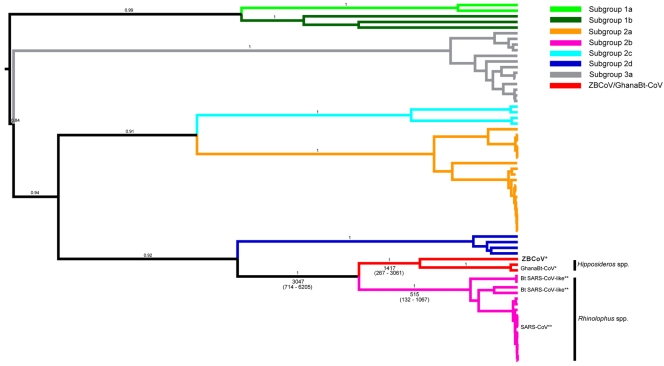
Estimation of the time of divergence between ZBCoV and representative coronaviruses. Bayesian MCMC phylogeny of a 659-nt region of the RNA-dependent RNA polymerase gene of ZBCoV and representative members of group 1, 2, and 3 coronaviruses. The host bat species and their geographic origins (*, Africa; **, Asia) are indicated for ZBCoV, GhanaBtCoV, and subgroup 2b CoVs. The times given at branch tips represent the dates of viral sampling, and the tree is rooted through the use of a relaxed molecular clock. Bayesian posterior probability values greater than 0.8 are shown above the branches leading to each major node. The mean TMRCAs for the taxa in subgroup 2b CoVs and ZBCoV are given below each branch, with the 95% highest probability densities indicated in parentheses. The following sequences from GenBank were included, with the GenBank accession numbers given in parentheses: for subgroup 1a CoVs, feline coronavirus (FJ938055) and canine coronavirus (GQ477367); for subgroup 1b CoVs, bat coronavirus HKU2 (DQ249213), bat coronavirus BtCoV/512/2005 (DQ648858), and human coronavirus NL63 (DQ445911); for subgroup 2a CoVs, murine hepatitis virus (AB551247), human coronavirus HKU1 (AY597011, DQ422731, DQ422728, DQ422732, DQ422737, and DQ422733), bovine respiratory coronavirus (AF220295, AF391541, AF391542, EF424615, EF424620, FJ938066, and U00735), equine coronavirus (EF446615), human enteric coronavirus 4408 (FJ415324), human coronavirus OC43 (AY391777 and AY903460), and waterbuck coronavirus (FJ425184); for subgroup 2b CoVs, bat SARS coronavirus Rf1 (DQ412042 and DQ648856), SARS coronavirus (AY313906, AY545914, AY559085, AY559097, AY595412, DQ071615, FJ882929, FJ882931, FJ882941, FJ882944, FJ882959, and FJ88686), bat SARS coronavirus HKU3 (DQ084199), and bat SARS coronavirus RM1 (DQ412043); for subgroup 2c CoVs, bat coronavirus HKU5 (DQ249217 and DQ249218), bat coronavirus HKU4 (DQ074652), and bat coronavirus BtCov/133/2005 (DQ648794); for subgroup 2d CoVs, bat coronavirus HKU9-1 (EF065513), bat coronavirus HKU9-2 (EF065514), bat coronavirus HKU9-3 (EF065515), and bat coronavirus HKU9-4 (EF065516); and for subgroup 3a CoVs, avian infectious bronchitis virus (AY514485, AY641576, AY646283, DQ001339, DQ646405, EU714029, FJ888351, FN430414, FN430415, HM245923, and HM245924) and turkey coronavirus (GQ427174, GQ427175, and GQ427176).

References

    1. Lai M., Perlman S., Anderson L. 2007. Coronaviridae, p. 1306–1335 In Knipe D. M., et al., Fields virology, 5th ed Lippincott Williams & Wilkins, Philadelphia, PA.
    1. Woo P. C., Lau S. K., Huang Y., Yuen K. Y. 2009. Coronavirus diversity, phylogeny and interspecies jumping. Exp. Biol. Med. (Maywood) 234:1117–1127 - PubMed
    1. Lai M. M., Cavanagh D. 1997. The molecular biology of coronaviruses. Adv. Virus Res. 48:1–100 - PMC - PubMed
    1. Carstens E. B. 2009. Ratification vote on taxonomic proposals to the International Committee on Taxonomy of Viruses. Arch. Virol. 155:133–146 - PMC - PubMed
    1. Lane T. E., Buchmeier M. J. 1997. Murine coronavirus infection: a paradigm for virus-induced demyelinating disease. Trends Microbiol. 5:9–14 - PMC - PubMed

Publication types

MeSH terms

Associated data

LinkOut - more resources