


Receiver operating characteristic (ROC) analysis of day 5 morphology grading and metabolomic Viability Score on predicting implantation outcome
- PMID: 21063765
- PMCID: PMC3059520
- DOI: 10.1007/s10815-010-9501-9
Receiver operating characteristic (ROC) analysis of day 5 morphology grading and metabolomic Viability Score on predicting implantation outcome
Abstract
Purpose: Assessment of embryo viability is a key component of in vitro fertilization (IVF) and currently relies largely on embryo morphology and cleavage rate. In this study, we used receiver operating characteristic (ROC) analysis to compare the Viability Score (generated by metabolomic profiling of spent embryo culture media using near infrared (NIR) spectroscopy) to morphologic grading for predicting pregnancy in women undergoing single embryo transfer (SET) on day 5.
Methods: A total of 198 spent embryo culture media samples were collected in four IVF centers located in the USA, Europe and Australia. First, 137 samples (training set) were analyzed by NIR to develop an algorithm that generates a Viability Score predictive of pregnancy for each sample. Next, 61 samples (validation set) were analyzed by observers blinded to embryo morphology and IVF outcome, using the Day 5 algorithm generated with the training set. Pregnancy was defined as fetal cardiac activity (FCA) at 12 weeks of gestation.
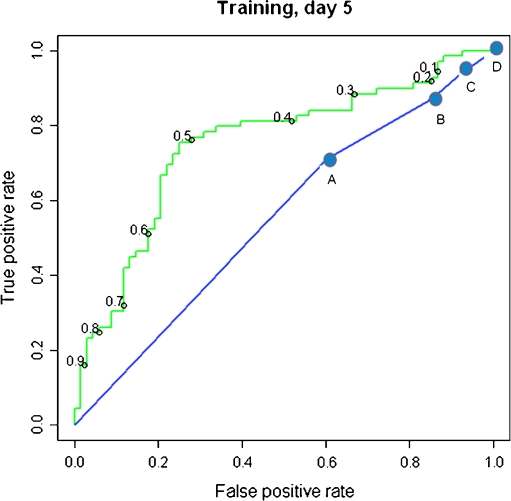
Results: The Area Under the Curve (AUC) was greater for the metabolomic Viability Score compared to Morphology [Training set: 0.75 versus 0.55, p = 0.0011; Validation set: 0.68 versus 0.50, P = 0.021], and for a Composite score (obtained using a model combining Viability Score with morphologic grading), compared to morphology alone [0.74 versus 0.50, p = 0.004].
Conclusions: Our findings suggest that Viability Score alone or in combination with morphologic grading has the potential to be a better classifier for pregnancy outcome than morphology alone in women undergoing SET on day 5.
Figures


References
-
- SART. Assisted reproductive technology success rates. National summary and fertility clinic reports. Centers for disease control, USA; 2007. - PubMed
-
- Ata B, Seli E. Economics of assisted reproductive technologies. Curr Opin Obstet Gynecol. 2010; epub Feb 1. - PubMed
-
- Edwards R, Fishel S, Cohen J. Factors influencing the success of in vitro fertilization for alleviating human infertility. J In Vitro Fertil Embryo Transf 1984:3–23. - PubMed
MeSH terms
LinkOut - more resources
Full Text Sources
Other Literature Sources
Miscellaneous
