


Parity, early menopause and the incidence of bladder cancer in women: a case-control study and meta-analysis
- PMID: 21067913
- PMCID: PMC3042804
- DOI: 10.1016/j.ejca.2010.10.007
Parity, early menopause and the incidence of bladder cancer in women: a case-control study and meta-analysis
Abstract
Introduction: Incidence rates of bladder cancer are notably higher in men than in women. While there is evidence that reproductive and hormonal risk factors may influence risk of bladder cancer, data are inconclusive.
Materials and methods: We examined reproductive, menstrual and hormonal use history in our population-based case-control study of bladder cancer in New Hampshire (NH), USA (n=207 women cases and n=463 women controls). Additionally, we performed a meta-analysis of the published literature. We used unconditional logistic regression analysis to compute adjusted odds ratios associated with each risk factor in the NH study. We combined these estimates with those from the published literature using inverse variance effects models.
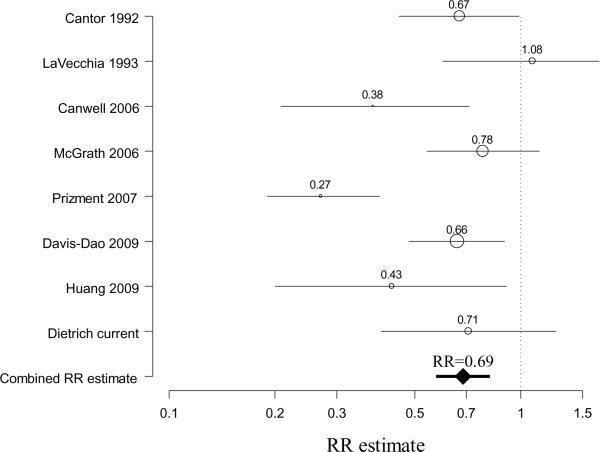
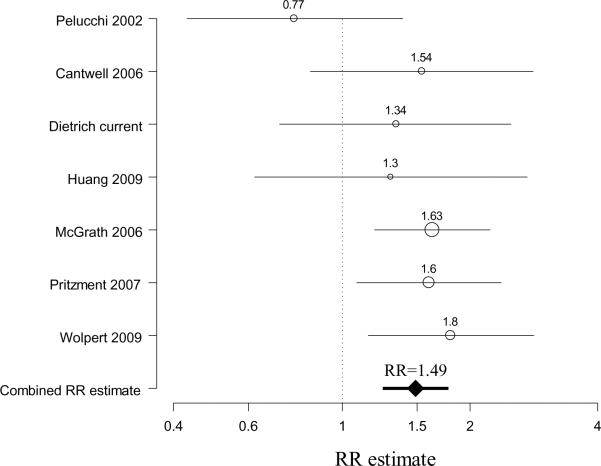
Results: In the NH study, a slightly decreased odds ratio was found among women who had ever had a birth compared to nulliparous women and an elevated odds ratio among women who underwent surgical menopause (bilateral oophorectomy), especially at an early age. No overall associations were found with oral contraceptive use or hormone replacement therapy. These findings were generally in agreement with the meta-analytic results for which the combined relative risk (RR) estimate was reduced among ever parous women (combined RR estimate for ever parous versus nulliparous=0.66, 95% confidence intervals [95% CI] 0.55-0.79) and elevated among those undergoing an early menopause (combined RR estimate for early versus late menopause=1.59, 95% CI 1.31-1.92). No consistent risk was observed for the other factors.
Discussion: Some reproductive and menstrual factors appear to be related to the incidence of bladder cancer among women; but whether effects are due to female hormones is uncertain.
Copyright © 2010 Elsevier Ltd. All rights reserved.
Figures
References
-
- Kogevinas M, Trichopoulos D. Urinary Bladder Cancer. In: Adami H-O, Hunter D, Trichopoulos D, editors. Textbook of Cancer Epidemiology. Oxford University Press; New York: 2008. pp. 446–466.
-
- McGrath M, Michaud D, Vivo ID. Hormonal and Reproductive Factors and the Risk of Bladder Cancer in Women. Am J Epidemiol. 2006;163(3):236–244. - PubMed
-
- Scosyrev E, Noyes K, Feng C, Messing E. Sex and Racial Differences in Bladder Cancer Presentation and Mortality in the US. Cancer. 2009;115:68–74. - PubMed
-
- Karim-Kos H, de Vries E, Soerjomataram I, Lemmens V, Siesling S, Coebergh J. Recent trends of cancer in Europe: A combined approach of incidence, survival and mortality for 17 cancer sites since the 1990s. Eur J Cancer. 2008;44:1345–1389. - PubMed
-
- Cantor K, Lynch C, Johnson D. Bladder cancer, parity, and age at first birth. Cancer Causes Control. 1992;3:57–62. - PubMed
Publication types
MeSH terms
Substances
Grants and funding
LinkOut - more resources
Full Text Sources
Medical
