


Comparison of conventional, nested, and real-time quantitative PCR for diagnosis of scrub typhus
- PMID: 21068287
- PMCID: PMC3043474
- DOI: 10.1128/JCM.01216-09
Comparison of conventional, nested, and real-time quantitative PCR for diagnosis of scrub typhus
Abstract
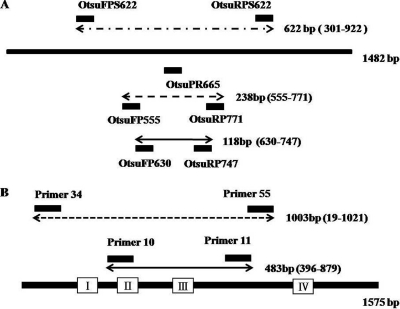
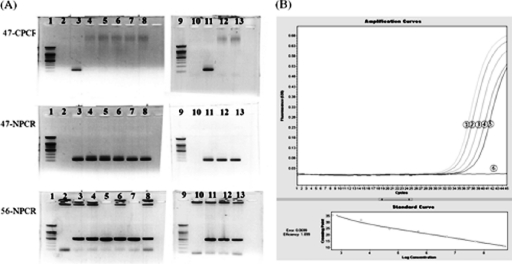
Orientia tsutsugamushi is the causative agent of scrub typhus. For the diagnosis of scrub typhus, we investigated the performances of conventional PCR (C-PCR), nested PCR (N-PCR), and real-time quantitative PCR (Q-PCR) targeting the O. tsutsugamushi-specific 47-kDa gene. To compare the detection sensitivities of the three techniques, we used two template systems that used plasmid DNA (plasmid detection sensitivity), including a partial region of the 47-kDa gene, and genomic DNA (genomic detection sensitivity) from a buffy coat sample of a single patient. The plasmid detection sensitivities of C-PCR, N-PCR, and Q-PCR were 5 × 10(4) copies/μl, 5 copies/μl, and 50 copies/μl, respectively. The results of C-PCR, N-PCR, and Q-PCR performed with undiluted genomic DNA were negative, positive, and positive, respectively. The genomic detection sensitivities of N-PCR and Q-PCR were 64-fold and 16-fold (crossing point [Cp], 37.7; 426 copies/μl), respectively. For relative quantification of O. tsutsugamushi bacteria per volume of whole blood, we performed real-time DNA PCR analysis of the human GAPDH gene, along with the O. tsutsugamushi 47-kDa gene. At a 16-fold dilution, the copy number and genomic equivalent (GE) of GAPDH were 1.1 × 10(5) copies/μl (Cp, 22.64) and 5.5 × 10(4) GEs/μl, respectively. Therefore, the relative concentration of O. tsutsugamushi at a 16-fold dilution was 0.0078 organism/one white blood cell (WBC) and 117 organisms/μl of whole blood, because the WBC count of the patient was 1.5 × 10(4) cells/μl of whole blood. The sensitivities of C-PCR, N-PCR, and Q-PCR performed with blood samples taken from patients within 4 weeks of onset of fever were 7.3% (95% confidence interval [CI], 1.6 to 19.9), 85.4% (95% CI, 70.8 to 94.4), and 82.9% (95% CI, 67.9 to 92.8), respectively. All evaluated assays were 100% specific for O. tsutsugamushi. In conclusion, given its combined sensitivity, specificity, and speed, Q-PCR is the preferred assay for the diagnosis of scrub typhus.
Figures
References
-
- Blacksell S. D., Bryant N. J., Paris D. H., Doust J. A., Sakoda Y., Day N. P. 2007. Scrub typhus serologic testing with the indirect immunofluorescence method as a diagnostic gold standard: a lack of consensus leads to a lot of confusion. Clin. Infect. Dis. 44:391–401 - PubMed
-
- Bozeman G. W., Elisberg B. L. 1963. Serological diagnosis of scrub typhus by indirect immunofluorescence. Proc. Soc. Exp. Biol. Med. 112:568–573 - PubMed
-
- Horinouchi H., Murai K., Okayama A., Nagatomo Y., Tachibana N., Tsubouchi H. 1996. Genotypic identification of Rickettsia tsutsugamushi by restriction fragment length polymorphism analysis of DNA amplified by the polymerase chain reaction. Am. J. Trop. Med. Hyg. 54:647–651 - PubMed
-
- Jiang J., Chan T. C., Temenak J. J., Dasch G. A., Ching W. M., Richards A. L. 2004. Development of a quantitative real-time polymerase chain reaction assay specific for Orientia tsutsugamushi. Am. J. Trop. Med. Hyg. 70:351–356 - PubMed
Publication types
MeSH terms
Substances
LinkOut - more resources
Full Text Sources
Other Literature Sources
Molecular Biology Databases
Research Materials
Miscellaneous
