


Perceptual learning increases the strength of the earliest signals in visual cortex
- PMID: 21068313
- PMCID: PMC3073503
- DOI: 10.1523/JNEUROSCI.5703-09.2010
Perceptual learning increases the strength of the earliest signals in visual cortex
Abstract
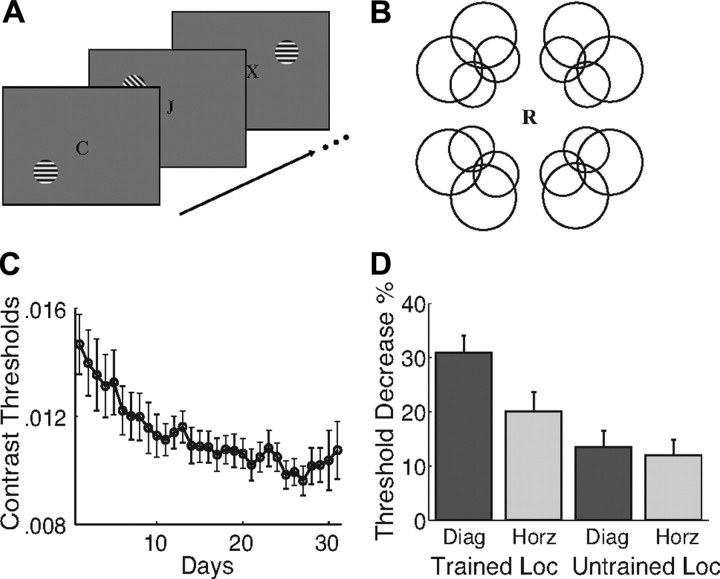
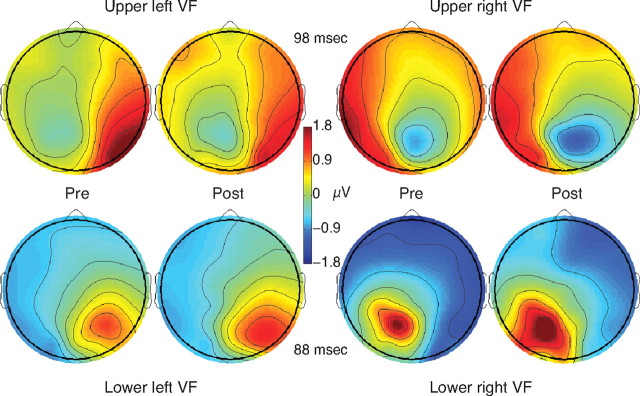
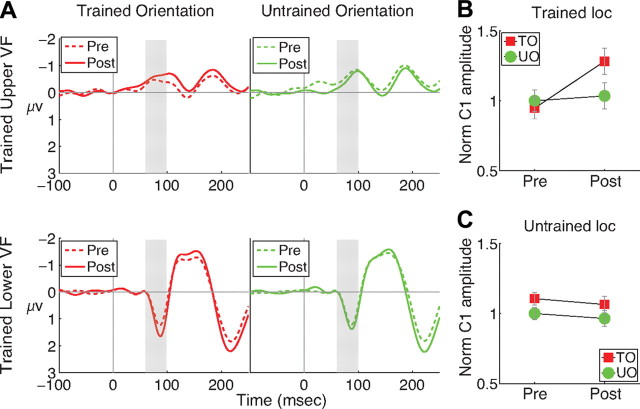
Training improves performance on most visual tasks. Such perceptual learning can modify how information is read out from, and represented in, later visual areas, but effects on early visual cortex are controversial. In particular, it remains unknown whether learning can reshape neural response properties in early visual areas independent from feedback arising in later cortical areas. Here, we tested whether learning can modify feedforward signals in early visual cortex as measured by the human electroencephalogram. Fourteen subjects were trained for >24 d to detect a diagonal grating pattern in one quadrant of the visual field. Training improved performance, reducing the contrast needed for reliable detection, and also reliably increased the amplitude of the earliest component of the visual evoked potential, the C1. Control orientations and locations showed smaller effects of training. Because the C1 arises rapidly and has a source in early visual cortex, our results suggest that learning can increase early visual area response through local receptive field changes without feedback from later areas.
Figures
References
-
- Ahissar M, Hochstein S. The reverse hierarchy theory of visual perceptual learning. Trends Cogn Sci. 2004;8:457–464. - PubMed
-
- Di Russo F, Martínez A, Hillyard SA. Source analysis of event-related cortical activity during visuo-spatial attention. Cereb Cortex. 2003;13:486–499. - PubMed
-
- Fahle M. Perceptual learning: a case for early selection. J Vis. 2004;4:879–890. - PubMed
Publication types
MeSH terms
Grants and funding
LinkOut - more resources
Full Text Sources
