


Paracetamol (acetaminophen) with or without an antiemetic for acute migraine headaches in adults
- PMID: 21069700
- PMCID: PMC4161111
- DOI: 10.1002/14651858.CD008040.pub2
Paracetamol (acetaminophen) with or without an antiemetic for acute migraine headaches in adults
Update in
-
Paracetamol (acetaminophen) with or without an antiemetic for acute migraine headaches in adults.Cochrane Database Syst Rev. 2013 Apr 30;2013(4):CD008040. doi: 10.1002/14651858.CD008040.pub3. Cochrane Database Syst Rev. 2013. PMID: 23633349 Free PMC article.
Abstract
Background: Migraine is a common, disabling condition and a burden for the individual, health services and society. Many sufferers choose not to, or are unable to, seek professional help and rely on over-the-counter analgesics. Co-therapy with an antiemetic should help to reduce nausea and vomiting commonly associated with migraine.
Objectives: To determine the efficacy and tolerability of paracetamol (acetaminophen), alone or in combination with an antiemetic, compared to placebo and other active interventions in the treatment of acute migraine in adults.
Search strategy: We searched Cochrane CENTRAL, MEDLINE, EMBASE and the Oxford Pain Relief Database for studies through 4 October 2010.
Selection criteria: We included randomised, double-blind, placebo- or active-controlled studies using self-administered paracetamol to treat a migraine headache episode, with at least 10 participants per treatment arm.
Data collection and analysis: Two review authors independently assessed trial quality and extracted data. Numbers of participants achieving each outcome were used to calculate relative risk and numbers needed to treat (NNT) or harm (NNH) compared to placebo or other active treatment.
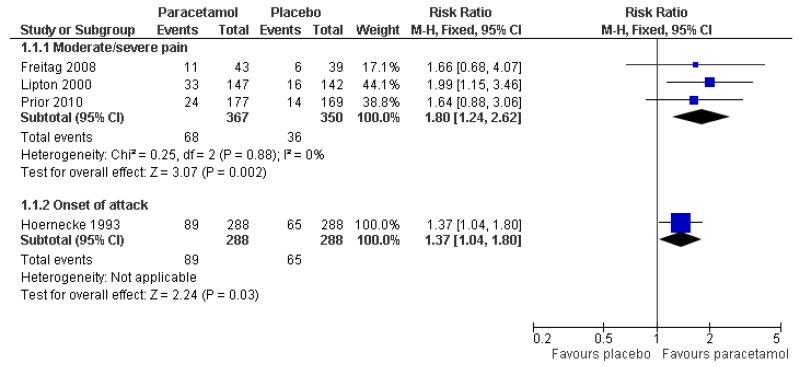
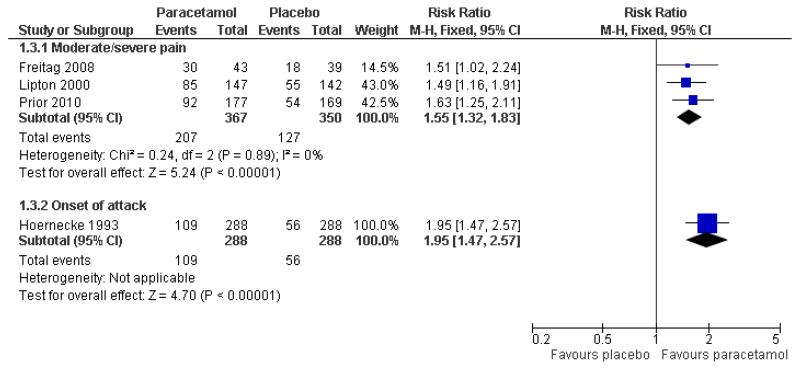
Main results: Ten studies (2769 participants, 4062 attacks) compared paracetamol 1000 mg, alone or in combination with an antiemetic, with placebo or other active comparators, mainly sumatriptan 100 mg. For all efficacy outcomes paracetamol was superior to placebo, with NNTs of 12, 5.2 and 5.0 for 2-hour pain-free and 1- and 2-hour headache relief, respectively, when medication was taken for moderate to severe pain. Nausea, photophobia and phonophobia were reduced more with paracetamol than with placebo at 2 hours (NNTs of 7 to 11); more individuals were free of any functional disability at 2 hours with paracetamol (NNT 10); and fewer participants needed rescue medication over 6 hours (NNT 6).Paracetamol 1000 mg plus metoclopramide 10 mg was not significantly different from oral sumatriptan 100 mg for 2-hour headache relief; there were no 2-hour pain-free data. There was no significant difference between the paracetamol plus metoclopramide combination and sumatriptan for relief of "light/noise sensitivity" at 2 hours, but slightly more individuals needed rescue medication over 24 hours with the combination therapy (NNT 17).Adverse event rates were similar between paracetamol and placebo, and between paracetamol plus metoclopramide and sumatriptan. No serious adverse events occurred with paracetamol alone, but more "major" adverse events occurred with sumatriptan than with the combination therapy (NNH 32).
Authors' conclusions: Paracetamol 1000 mg alone is an effective treatment for acute migraine headaches, and the addition of 10 mg metoclopramide gives short-term efficacy equivalent to oral sumatriptan 100 mg. Adverse events with paracetamol did not differ from placebo; "major" adverse events were slightly more common with sumatriptan than with paracetamol plus metoclopramide.
Figures
References
References to studies included in this review
-
- Dexter SL, Graham AN, Johnston ES, Ratcliffe DM, Wilkinson MI, Rose AJ. Double-blind controlled study of paramax in the acute treatment of common and classical migraine. British Journal of Clinical Practice. 1985;39(10):388–92. - PubMed
-
- Dowson A, Ball K, Haworth D. Comparison of a fixed combination of domperidone and paracetamol (Domperamol) with sumatriptan 50 mg in moderate to severe migraine: a randomised UK primary care study. Current Medical Research and Opinion. 2000;16(3):190–7. - PubMed
-
- Freitag F, Diamond M, Diamond S, Janssen I, Rodgers A, Skobieranda F. Efficacy and tolerability of coadministration of rizatriptan and acetaminophen vs rizatriptan or acetaminophen alone for acute migraine treatment. Headache. 2008;48(6):921–30. DOI: 10.1111/j.1526-4610.2007.01053.x. - PubMed
-
- A double-blind, general practice study to compare GR43175 with paracetamol and metoclopramide in the acute treatment of migraine (Original protocol) 1992 Available at: www.gsk-clinicalstudyregister.com/
-
- A double-blind, general practice study to compare GR43175 with paracetamol and metoclopramide in the acute treatment of migraine (Amended protocol) 1992 Available at: www.gsk-clinicalstudyregister.com/
References to studies excluded from this review
-
- Diamond S. Treatment of migraine with isometheptene, acetaminophen, and dichloralphenazone combination: a double-blind, crossover trial. Headache. 1976;15(4):282–7. - PubMed
-
- Diener HC, Pfaffenrath V, Pageler L, Peil H, Aicher B. The fixed combination of acetylsalicylic acid, paracetamol and caffeine is more effective than single substances and dual combination for the treatment of headache: a multicentre, randomized, double-blind, single-dose, placebo-controlled parallel group study. Cephalalgia. 2005;25(10):776–87. DOI: 10.1111/j.1468-2982.2005.00948.x. - PubMed
-
- Larsen BH, Christiansen LV, Andersen B, Olesen J. Randomized double-blind comparison of tolfenamic acid and paracetamol in migraine. Acta Neurologica Scandinavica. 1990;81(5):464–7. - PubMed
Additional references
-
- Ad Hoc Committee on the Classification of Headache National Institute of Neurological Diseases and Blindness. Classification of headache. JAMA. 1962;179(9):717–8.
-
- Bigal ME, Serrano D, Reed M, Lipton RB. Chronic migraine in the population: burden, diagnosis, and satisfaction with treatment. Neurology. 2008;71(8):559–66. DOI: 10.1212/01.wnl.0000323925.29520.e7. - PubMed
-
- Botting RM. Mechanism of action of acetaminophen: is there a cyclooxygenase 3? Clinical Infectious Diseases. 2000;31(5):S203–S210. - PubMed
-
- Clarke CE, MacMillan L, Sondhi S, Wells NEJ. Economic and social impact of migraine. The Quarterly Journal of Medicine. 1996;89(1):77–84. - PubMed
Publication types
MeSH terms
Substances
LinkOut - more resources
Full Text Sources
Other Literature Sources
Medical
