


Predicting cardiovascular risk in young adulthood from the metabolic syndrome, its component risk factors, and a cluster score in childhood
- PMID: 21070100
- PMCID: PMC3684392
- DOI: 10.3109/17477166.2010.528765
Predicting cardiovascular risk in young adulthood from the metabolic syndrome, its component risk factors, and a cluster score in childhood
Abstract
Objective: The value of metabolic syndrome (MetS) in childhood and adolescence and its stability into young adulthood have been questioned. This study compared the MetS in late childhood (mean age 13) versus a cluster score of the MetS components as predictors of young adult (mean age 22) cardiovascular risk.
Methods: Anthropometrics, blood pressure, lipid profile, and insulin resistance (insulin clamp) were obtained in 265 individuals at mean ages 13 and 22. The MetS was defined dichotomously by current pediatric and adult criteria. The MetS cluster score used the average of deviates of the MetS components standardized to their means and standard deviations at mean age 13.
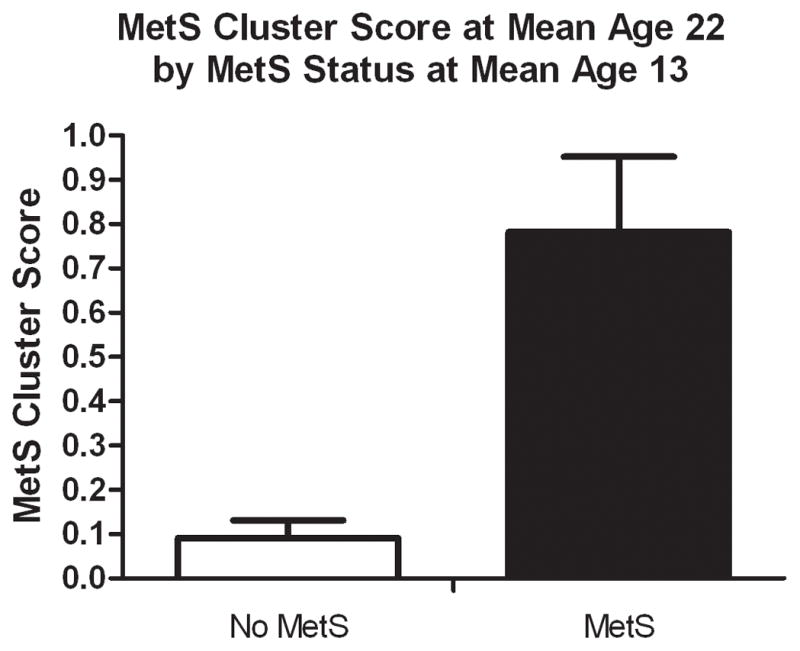
Results: The MetS was rarely present at mean age 13 and did not predict MetS at mean age 22 but identified individuals who continued to have adverse levels of risk factors at mean age 22. In contrast to the standard MetS definition, the MetS cluster score tracked strongly and at mean age 22 was significantly higher in the individuals with MetS at mean age 13 (0.78 ± 0.71) than those without MetS at mean age 13 (0.09 ± 0.70, p <0.0001).
Conclusions: Although the MetS at mean age 13, using the conventional definition, is not a reliable method for predicting the MetS at mean age 22, it does predict adverse levels of cardiovascular risk factors. A cluster score, using the MetS components as continuous variables, is more reliable in predicting young adult risk from late childhood.
Conflict of interest statement
Figures
References
-
- Cook S, Weitzman M, Auinger P, Nguyen M, Dietz WH. Prevalence of a metabolic syndrome phenotype in adolescents: findings from the third National Health and Nutrition Examination Survey, 1988–1994. Arch Pediatr Adolesc Med. 2003 Aug;157(8):821–7. - PubMed
-
- Zimmet P, Alberti G, Kaufman F, et al. The metabolic syndrome in children and adolescents. Lancet. 2007 Jun 23;369(9579):2059–61. - PubMed
-
- Grundy SM, Brewer HB, Jr, Cleeman JI, Smith SC, Jr, Lenfant C. Definition of metabolic syndrome: Report of the National Heart, Lung, and Blood Institute/American Heart Association conference on scientific issues related to definition. Circulation. 2004 Jan 27;109(3):433–8. - PubMed
-
- Grundy SM, Cleeman JI, Daniels SR, et al. Diagnosis and management of the metabolic syndrome: an American Heart Association/National Heart, Lung, and Blood Institute Scientific Statement. Circulation. 2005 Oct 25;112(17):2735–52. - PubMed
-
- Lee S, Bacha F, Gungor N, Arslanian S. Comparison of different definitions of pediatric metabolic syndrome: relation to abdominal adiposity, insulin resistance, adiponectin, and inflammatory biomarkers. J Pediatr. 2008 Feb;152(2):177–84. - PubMed
Publication types
MeSH terms
Substances
Grants and funding
LinkOut - more resources
Full Text Sources
Medical