


Post-load hyperglycemia as an important predictor of long-term adverse cardiac events after acute myocardial infarction: a scientific study
- PMID: 21070650
- PMCID: PMC2996353
- DOI: 10.1186/1475-2840-9-75
Post-load hyperglycemia as an important predictor of long-term adverse cardiac events after acute myocardial infarction: a scientific study
Abstract
Background: Diabetes mellitus (DM) and impaired glucose tolerance (IGT) are risk factors for acute myocardial infarction (AMI). However, it is unknown whether hyperglycemic state is associated with increased major adverse cardiovascular events (MACE) after AMI. In this study, we evaluated the relationship between glucometabolic status and MACE in patients after AMI, and determined the critical level of 2 h post-load plasma glucose that may be used to predict MACE.
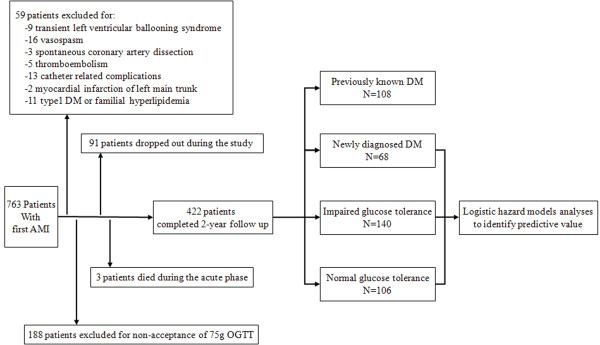
Methods: AMI patients (n = 422) were divided into 4 groups as follows: normal glucose tolerance (NGT) group, IGT group, newly diagnosed DM (NDM) group, and previously known DM (PDM) group. MACE of the 4 groups were compared for 2 years from AMI onset.
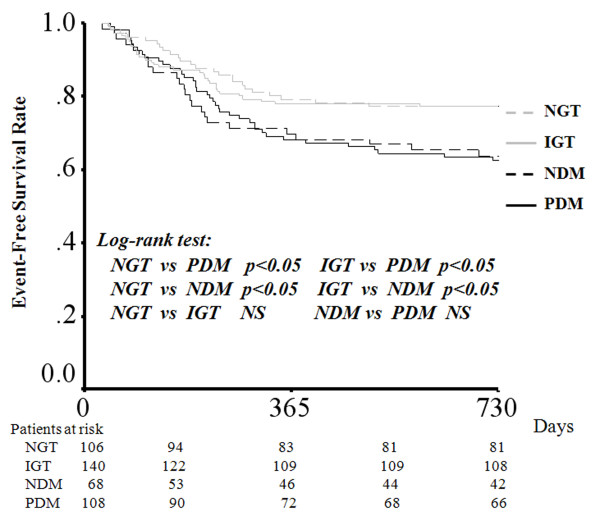
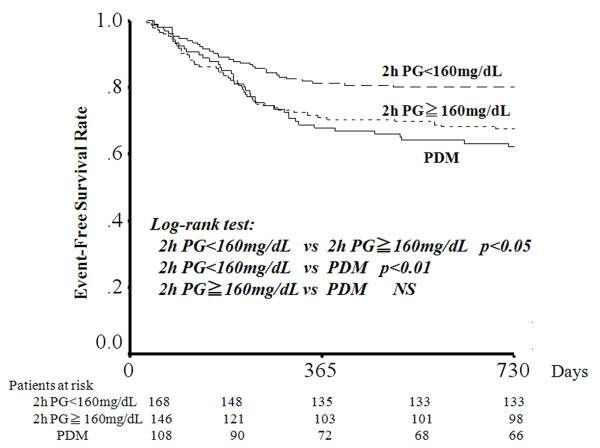
Results: The NDM group had a significantly higher event rate than the IGT and NGT groups and had a similar event rate curve to PDM group. The logistic models analyses revealed that 2 h post-load plasma glucose values of ≥160 mg/dL was the only independent predictor of long-term MACE after AMI (p = 0.028, OR: 1.85, 95% CI: 1.07-3.21). The 2-year cardiac event rate of patients with a 2 h post-load hyperglycemia of ≥160 mg/dL was significantly higher than that of patients with 2 h post-load glucose of <160 mg/dL (32.2% vs. 19.8%, p < 0.05) and was similar to that of PDM group (37.4%, p = 0.513).
Conclusions: NDM increases the risk of MACE after AMI as does PDM. Particularly, post-AMI patients with a 2 h post-load hyperglycemia ≥160 mg/dL may need adjunctive therapy after AMI.
Figures
Similar articles
-
Impaired Glucose Tolerance or Newly Diagnosed Diabetes Mellitus Diagnosed during Admission Adversely Affects Prognosis after Myocardial Infarction: An Observational Study.PLoS One. 2015 Nov 16;10(11):e0142045. doi: 10.1371/journal.pone.0142045. eCollection 2015. PLoS One. 2015. PMID: 26571120 Free PMC article.
-
The prognostic value of different glucose abnormalities in patients with acute myocardial infarction treated invasively.Cardiovasc Diabetol. 2012 Jun 28;11:78. doi: 10.1186/1475-2840-11-78. Cardiovasc Diabetol. 2012. PMID: 22741568 Free PMC article.
-
[Abnormal glucose tolerance and long-term prognosis in patients with acute myocardial infarction].Kardiologiia. 2013;53(9):15-20. Kardiologiia. 2013. PMID: 24090381 Russian.
-
Newly detected abnormal glucose regulation and long-term prognosis after acute myocardial infarction: Comparison of an oral glucose tolerance test and glycosylated haemoglobin A1c.Int J Cardiol. 2016 Jul 1;214:310-5. doi: 10.1016/j.ijcard.2016.03.199. Epub 2016 Mar 31. Int J Cardiol. 2016. PMID: 27085117 Review.
-
Proposal of a New Approach to Study and Categorize Stress Hyperglycemia in Acute Myocardial Infarction.J Emerg Med. 2016 Jul;51(1):31-6. doi: 10.1016/j.jemermed.2015.03.047. Epub 2016 Mar 31. J Emerg Med. 2016. PMID: 27041491 Review.
Cited by
-
The oral glucose tolerance test for the diagnosis of diabetes mellitus in patients during acute coronary syndrome hospitalization: a meta-analysis of diagnostic test accuracy.Cardiovasc Diabetol. 2012 Dec 27;11:155. doi: 10.1186/1475-2840-11-155. Cardiovasc Diabetol. 2012. PMID: 23270530 Free PMC article. Review.
-
An Overall Glance of Evidence Supportive of One-Hour and Two-Hour Postload Plasma Glucose Levels as Predictors of Long-Term Cardiovascular Events.Int J Endocrinol. 2019 Dec 18;2019:6048954. doi: 10.1155/2019/6048954. eCollection 2019. Int J Endocrinol. 2019. PMID: 31929794 Free PMC article. Review.
-
Long term prognostic implication of newly detected abnormal glucose tolerance among patients with stable cardiovascular disease: a population-based cohort study.J Transl Med. 2021 Jun 30;19(1):277. doi: 10.1186/s12967-021-02950-y. J Transl Med. 2021. PMID: 34193200 Free PMC article.
-
Glycosylated hemoglobin (HbA1c) levels and clinical outcomes in diabetic patients following coronary artery stenting.Cardiovasc Diabetol. 2012 Jul 17;11:82. doi: 10.1186/1475-2840-11-82. Cardiovasc Diabetol. 2012. PMID: 22805289 Free PMC article.
-
Serum adiponectin level is not only decreased in metabolic syndrome but also in borderline metabolic abnormalities.Nutr Diabetes. 2011 Oct 10;1(10):e18. doi: 10.1038/nutd.2011.13. Nutr Diabetes. 2011. PMID: 23455020 Free PMC article.
References
-
- Fujishima M, Kiyohara Y, Kato I, Ohmura T, Iwamoto H, Nakayama K, Ohmori S, Yoshitake T. Diabetes and cardiovascular disease in a prospective population survey in Japan: The Hisayama Study. Diabetes. 1996;45(Suppl 3):S14–16. - PubMed
MeSH terms
Substances
LinkOut - more resources
Full Text Sources
Medical
