. 2011 Jan;39(Database issue):D712-7.
doi: 10.1093/nar/gkq1156. Epub 2010 Nov 11.

ConsensusPathDB: toward a more complete picture of cell biology

Affiliations

ConsensusPathDB: toward a more complete picture of cell biology

Atanas Kamburov et al. Nucleic Acids Res. 2011 Jan.

Abstract

ConsensusPathDB is a meta-database that integrates different types of functional interactions from heterogeneous interaction data resources. Physical protein interactions, metabolic and signaling reactions and gene regulatory interactions are integrated in a seamless functional association network that simultaneously describes multiple functional aspects of genes, proteins, complexes, metabolites, etc. With 155,432 human, 194,480 yeast and 13,648 mouse complex functional interactions (originating from 18 databases on human and eight databases on yeast and mouse interactions each), ConsensusPathDB currently constitutes the most comprehensive publicly available interaction repository for these species. The Web interface at http://cpdb.molgen.mpg.de offers different ways of utilizing these integrated interaction data, in particular with tools for visualization, analysis and interpretation of high-throughput expression data in the light of functional interactions and biological pathways.


Figures
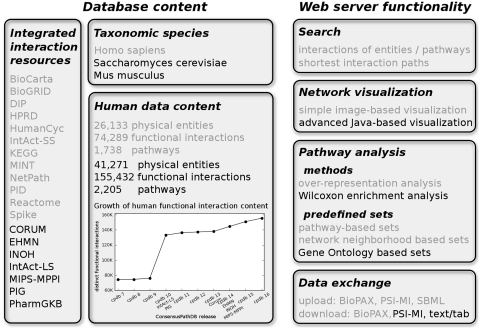
Figure 1.
Figure 1.
ConsensusPathDB content and Web interface functionality. Content and features that have been described in our previous database report (3) are displayed in gray font, new items in black. The plot in the left panel shows the growth of the human interaction data in ConsensusPathDB since the last database report (ConsensusPathDB release 7, 74 289 interactions) through the releases until present (release 16, 155 432 interactions). Source database additions that contribute interactions to ConsensusPathDB are listed under the corresponding release in the plot.
Figure 2.
Figure 2.
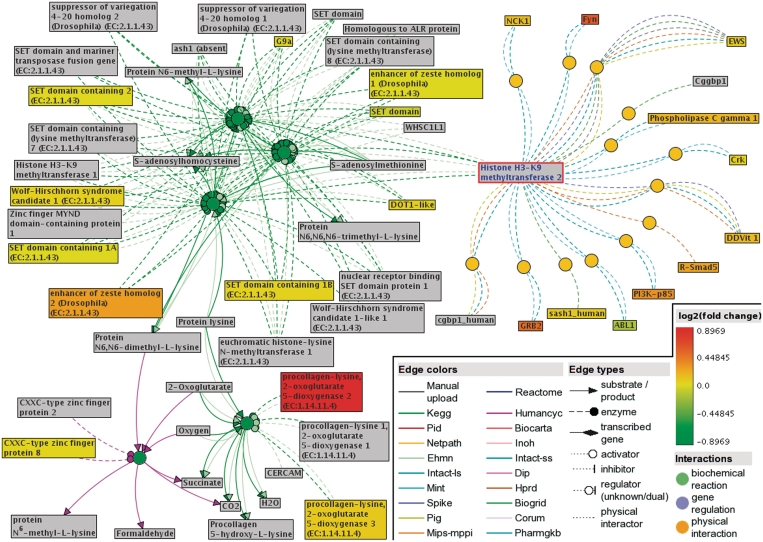
A functional interaction sub-network visualized by ConsensusPathDB’s new network visualization framework. This sub-network defines the neighborhood-based entity set centered by SUV39H2 (Histone H3-K9 methyltransferase 2, highlighted with red frame in the network) and containing its direct physical interactors, as well as enzymes of neighboring biochemical reactions. The network consists of 13 physical interactions (orange circles) and five biochemical reactions (green circles) from nine different databases (interaction origins are encoded as edge colors). Gene expression data by Yu et al. (20) are overlaid as log2(fold change) values on the physical entity nodes (rectangles). Protein products of measured genes are colored according to the fold expression change (see legend), the rest of the physical entities in the network are gray. Based on the Yu et al. data, the Wilcoxon enrichment analysis tool of ConsensusPathDB suggests that members of this neighborhood-based entity set show jointly significant increase in transcription levels in metastatic prostate cancer compared to primary prostate carcinoma.

References

    1. Ideker T, Sharan R. Protein networks in disease. Genome Res. 2008;18:644–652. - PMC - PubMed
    1. Bader GD, Cary MP, Sander C. Pathguide: a pathway resource list. Nucleic Acids Res. 2006;34:D504–D506. - PMC - PubMed
    1. Kamburov A, Wierling C, Lehrach H, Herwig R. ConsensusPathDB – a database for integrating human functional interaction networks. Nucleic Acids Res. 2009;37:D623–D628. - PMC - PubMed
    1. Ruepp A, Waegele B, Lechner M, Brauner B, Dunger-Kaltenbach I, Fobo G, Frishman G, Montrone C, Mewes H. CORUM: the comprehensive resource of mammalian protein complexes – 2009. Nucleic Acids Res. 2010;38:D497–D501. - PMC - PubMed
    1. Aranda B, Khadake J, Kerssemakers J, Leroy C, Menden M, Michaut M, Montecchi-Palazzi L, Neuhauser SN, Orchard S, Perreau V, et al. The IntAct molecular interaction database in 2010. Nucleic Acids Res. 2010;38:D525–D531. - PMC - PubMed

Publication types