


Proteomic identification of serum peptides predicting subsequent spontaneous preterm birth
- PMID: 21074133
- PMCID: PMC3103758
- DOI: 10.1016/j.ajog.2010.09.021
Proteomic identification of serum peptides predicting subsequent spontaneous preterm birth
Abstract
Objective: We sought to identify serum markers of subsequent spontaneous preterm birth (SPTB) in asymptomatic women prior to labor.
Study design: Serum proteomics was applied to sera from 80 pregnant women sampled at 24 weeks and an additional 80 pregnant women sampled at 28 weeks. Half had uncomplicated pregnancies and half had SPTB.
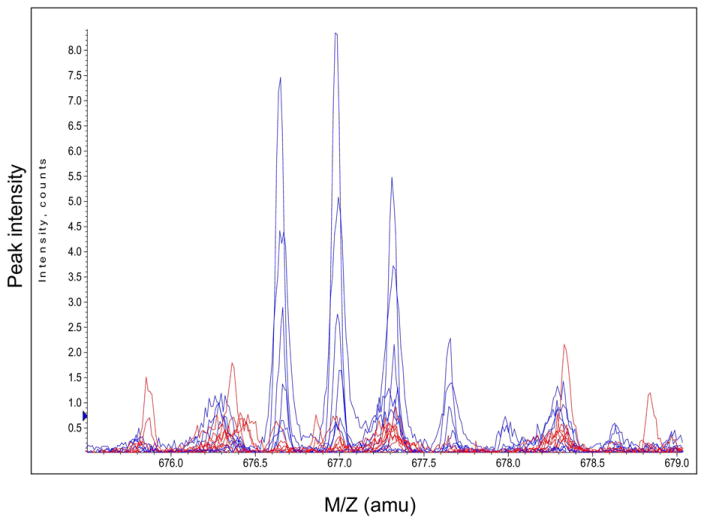
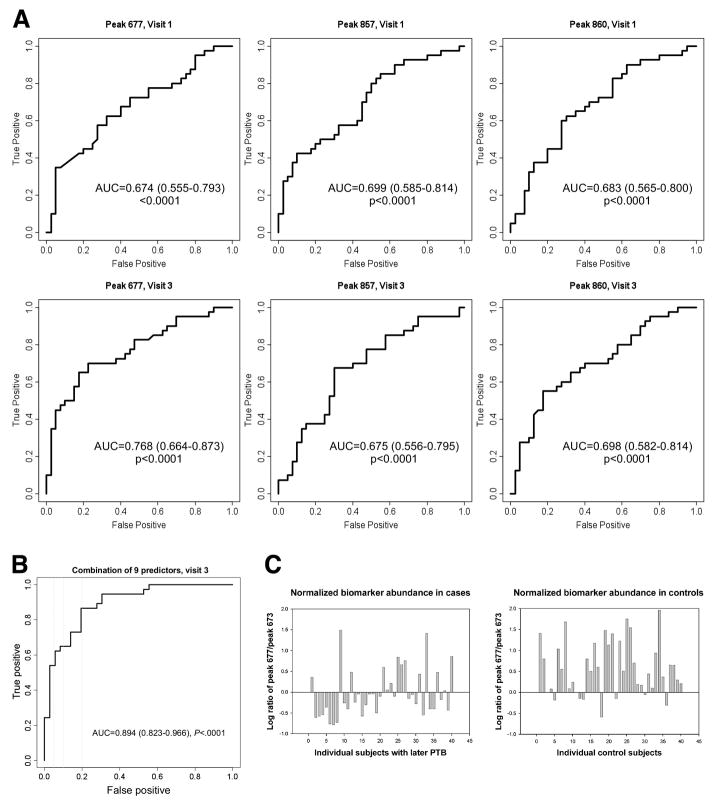
Results: Three specific peptides arising from inter-alpha-trypsin inhibitor heavy chain 4 protein were significantly reduced in women at 24 and 28 weeks having subsequent SPTB. The most discriminating peptide had a sensitivity of 65.0% and specificity of 82.5%; odds ratio, 8.8; and 95% confidence interval, 3.1-24.8. A combination of the 3 new biomarkers and 6 previously studied biomarkers increased sensitivity to 86.5%, with a specificity of 80.6% at 28 weeks.
Conclusion: Three novel serum markers of SPTB have been identified using serum proteomics. Using a combination of these new markers with additional markers, women at risk of SPTB can be identified weeks prior to SPTB.
Copyright © 2011 Mosby, Inc. All rights reserved.
Figures
Comment in
-
Discussion: 'Predicting spontaneous preterm birth' by Esplin et al.Am J Obstet Gynecol. 2011 May;204(5):e1-3. doi: 10.1016/j.ajog.2011.03.007. Epub 2011 Mar 10. Am J Obstet Gynecol. 2011. PMID: 21788164
-
Proteomic identification of serum peptides predicting subsequent spontaneous preterm birth.Am J Obstet Gynecol. 2012 Feb;206(2):e3; author reply e3-4. doi: 10.1016/j.ajog.2011.09.010. Epub 2011 Sep 21. Am J Obstet Gynecol. 2012. PMID: 22000671 No abstract available.
References
-
- Goldenberg R, Rouse DJ. Prevention of premature birth. N Engl J Med. 1998;339:313–320. - PubMed
-
- Hoyert DL, Mathews TJ, Menacker F, Stobino DM, Guyer B. Annual summary of vital statistics: 2004. Pediatrics. 2006;117:168–183. Erratum, Pediatrics 2006;117:2338. - PubMed
-
- Goldenberg RL, Iams JD, Mercer BM, Meis PJ, Moawad A, Das A, Miodovnik M, Vandorsten PJ, Caritis SN, Thurnau G, Dombrowski MP. Maternal-Fetal Medicine Units Network. The Preterm Prediction Study: toward a multiple-marker test for spontaneous preterm birth. Am J Obstet Gynecol. 2001;185(3):643–51. - PubMed
-
- Petricoin EF, Ardekani AM, Hitt BA, Levine PJ, Fusaro VA, Steinberg SM, Mills GB, Simone C, Fishman DA, Kohn EC, Liotta LA. Use of proteomic patterns in serum to identify ovarian cancer. Lancet. 2002;359(9306):572–7. - PubMed
Publication types
MeSH terms
Substances
Grants and funding
- HD36801/HD/NICHD NIH HHS/United States
- HD27861/HD/NICHD NIH HHS/United States
- UG1 HD027869/HD/NICHD NIH HHS/United States
- HD27869/HD/NICHD NIH HHS/United States
- U10 HD027883/HD/NICHD NIH HHS/United States
- U10 HD027917/HD/NICHD NIH HHS/United States
- U10 HD027915/HD/NICHD NIH HHS/United States
- U10 HD027860/HD/NICHD NIH HHS/United States
- U10 HD034208/HD/NICHD NIH HHS/United States
- HD27889/HD/NICHD NIH HHS/United States
- U01 HD019897/HD/NICHD NIH HHS/United States
- HD27915/HD/NICHD NIH HHS/United States
- U01 HD036801/HD/NICHD NIH HHS/United States
- HD27860/HD/NICHD NIH HHS/United States
- UG1 HD027915/HD/NICHD NIH HHS/United States
- HD21414/HD/NICHD NIH HHS/United States
- U10 HD027905/HD/NICHD NIH HHS/United States
- HD21410/HD/NICHD NIH HHS/United States
- U10 HD027869/HD/NICHD NIH HHS/United States
- HD27917/HD/NICHD NIH HHS/United States
- U10 HD021410/HD/NICHD NIH HHS/United States
- U10 HD036801/HD/NICHD NIH HHS/United States
- U24 HD036801/HD/NICHD NIH HHS/United States
LinkOut - more resources
Full Text Sources
Other Literature Sources
Medical
