


Prospective evaluation of operating characteristics of prostate cancer detection biomarkers
- PMID: 21074193
- PMCID: PMC5020904
- DOI: 10.1016/j.juro.2010.08.088
Prospective evaluation of operating characteristics of prostate cancer detection biomarkers
Abstract
Purpose: We assessed the independent predictive values of the serum markers free prostate specific antigen, proenzyme prostate specific antigen, neuroendocrine marker and Dickkopf-1 compared to serum prostate specific antigen and other standard risk factors for early prostate cancer detection.
Materials and methods: From the prospectively collected SABOR cohort 250 prostate cancer cases, and 250 mean age matched and proportion of African-American race/ethnicity matched controls were selected who had a prior available prostate specific antigen and digital rectal examination. Serum samples were obtained, and free prostate specific antigen, [-2]proenzyme prostate specific antigen, Dickkopf-1 and neuroendocrine marker were measured. AUC, sensitivities and specificities were calculated, and multivariable logistic regression was used to assess the independent predictive value compared to prostate specific antigen, digital rectal examination, family history, prior biopsy history, race/ethnicity and age.
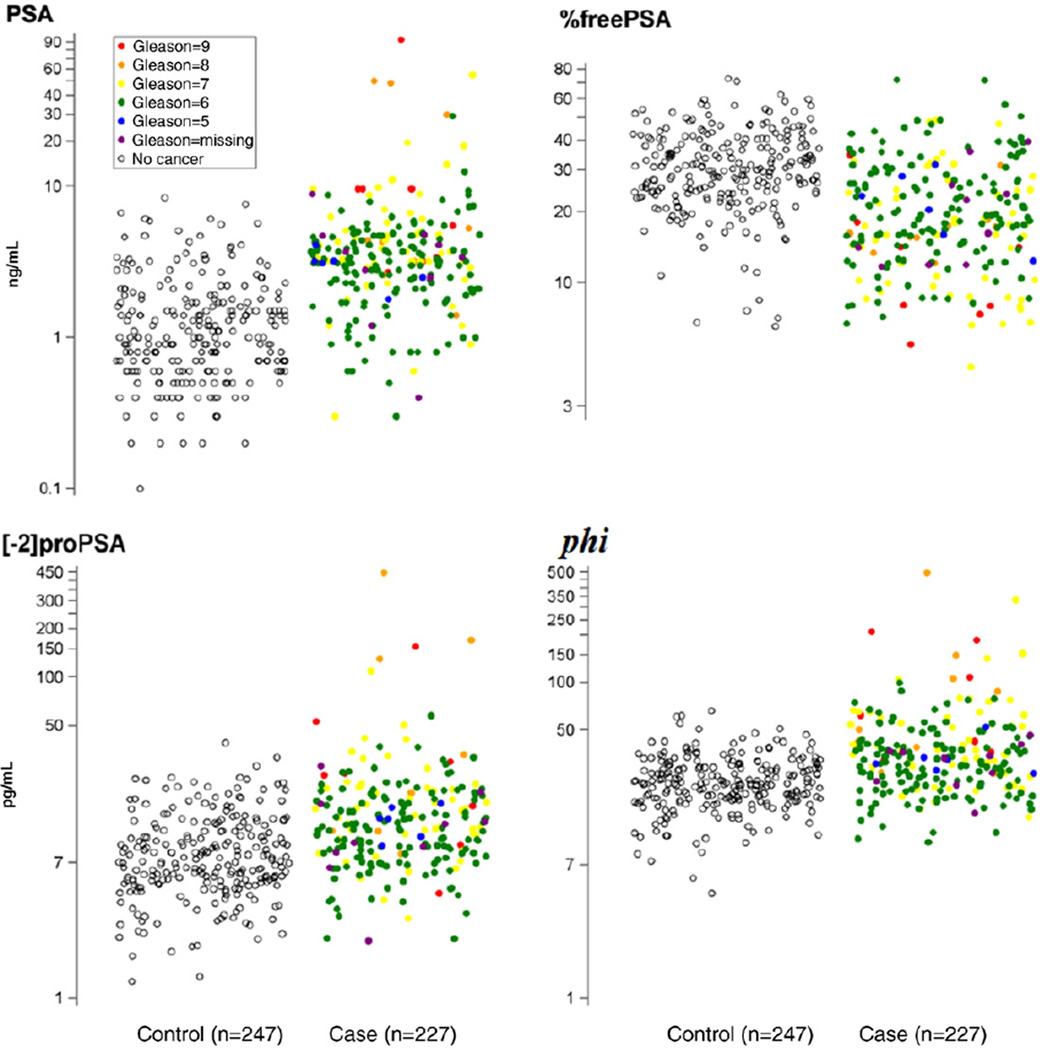
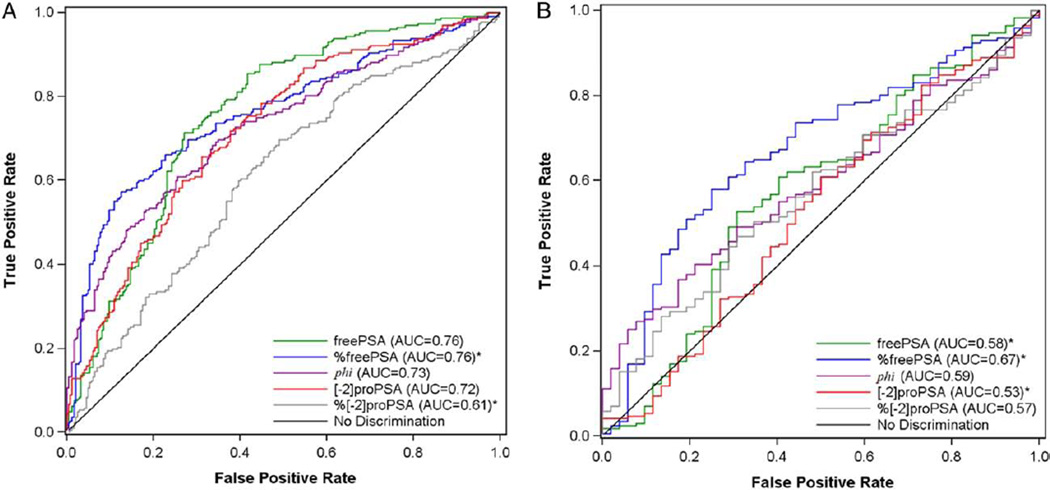
Results: The AUCs (95% CI) were 0.76 (0.71, 0.8) for free prostate specific antigen, 0.72 (0.67, 0.76) for [-2]proenzyme prostate specific antigen, 0.76 (0.72, 0.8) for %free prostate specific antigen, 0.61 (0.56, 0.66) for %[-2]proenzyme prostate specific antigen, 0.73 (0.68, 0.77) for prostate health index, 0.53 (0.48, 0.58) for Dickkopf-1 and 0.53 (0.48, 0.59) for neuroendocrine marker. In the 2 to 10 ng/ml prostate specific antigen range the AUCs (95% CI) were 0.58 (0.49, 0.67) for free prostate specific antigen, 0.53 (0.44, 0.62) for [-2]proenzyme prostate specific antigen, 0.67 (0.59, 0.75) for %free prostate specific antigen, 0.57 (0.49, 0.65) for %[-2]proenzyme prostate specific antigen and 0.59 (0.51, 0.67) for phi. Only %free prostate specific antigen retained independent predictive value compared to the traditional risk factors.
Conclusions: Free prostate specific antigen retained independent diagnostic usefulness for prostate cancers detected through prostate specific antigen and digital rectal examination screening. Prostate specific antigen isoforms are highly correlated with prostate specific antigen. Future research is needed to identify new markers associated with prostate cancer through different mechanisms.
Copyright © 2011 American Urological Association Education and Research, Inc. Published by Elsevier Inc. All rights reserved.
Figures
Comment in
-
Re: Prospective evaluation of operating characteristics of prostate cancer detection biomarkers.Eur Urol. 2011 Jul;60(1):177-8. doi: 10.1016/j.eururo.2011.04.014. Eur Urol. 2011. PMID: 21640692 No abstract available.
-
Re: Prospective evaluation of operating characteristics of prostate cancer detection biomarkers: Y. Liang, D. P. Ankerst, N. S. Ketchum, B. Ercole, G. Shah, J. D. Shaughnessy, Jr., R. J. Leach and I. M. Thompson J Urol 2011; 185: 104-110.J Urol. 2011 Nov;186(5):2131-2; author reply 2132. doi: 10.1016/j.juro.2011.07.015. Epub 2011 Sep 25. J Urol. 2011. PMID: 21945513 No abstract available.
References
-
- Wolf AM, Wender RC, Etzioni RB, et al. American Cancer Society guideline for the early detection of prostate cancer: update 2010. CA Cancer J Clin. 2010;60:70. - PubMed
-
- Tian E, Zhan F, Walker R, et al. The role of the Wnt-signaling antagonist DKK1 in the development of osteolytic lesions in multiple myeloma. N Engl J Med. 2003;349:2483. - PubMed
-
- Shah GV, Srivastava AK, Iczkowski K. Neuroendocrine marker: a novel, reliable early stage marker for prostate cancer; Presented at the 100th annual meeting of the American Association for Cancer Research; April 18–22, 2009; Denver, Colorado. abstract 4826.
-
- Thompson IM, Ankerst DP, Chi C, et al. The operating characteristics of prostate-specific antigen in a population with initial PSA of 3.0 ng/ml or lower. JAMA. 2005;294:66. - PubMed
-
- Lachenbruch PA. On the sample size for studies based upon McNemar’s test. Stat Med. 1992;11:1521. - PubMed
Publication types
MeSH terms
Substances
Grants and funding
LinkOut - more resources
Full Text Sources
Medical
