


Does rituximab increase the incidence of infectious complications? A narrative review
- PMID: 21074471
- PMCID: PMC8053444
- DOI: 10.1016/j.ijid.2010.03.025
Does rituximab increase the incidence of infectious complications? A narrative review
Abstract
Background: Rituximab has increasingly been used for the treatment of hematological malignancies and autoimmune diseases, and its efficacy and safety are well established. Although clinical trials have shown conflicting results regarding the association of rituximab with infections, an increased incidence of infections has recently been reported in patients with lymphomas being treated with rituximab. However, clinical experience regarding the association of rituximab with different types of infection is lacking and this association has not been established in patients with rheumatoid arthritis.
Methods: All previous studies included in our literature review were found using a PubMed, EMBASE, and Cochrane database search of the English-language medical literature applying the terms 'rituximab', 'monoclonal antibodies', 'infections', 'infectious complications', and combinations of these terms. In addition, the references cited in these articles were examined to identify additional reports.
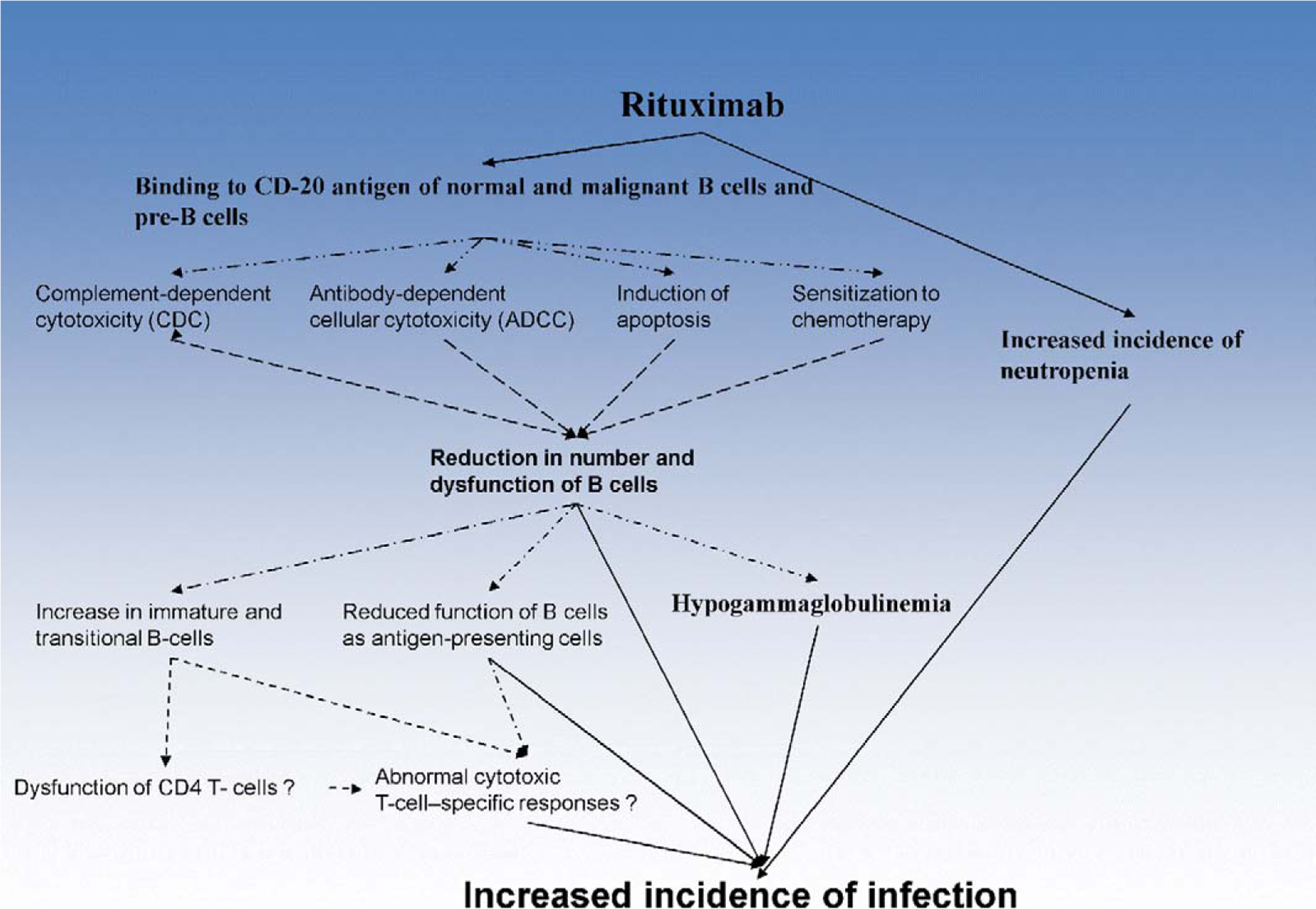
Results: We performed separate analyses of data regarding the association of rituximab with infection in (1) patients with hematological malignancies, (2) patients with autoimmune disorders, and (3) transplant patients. Recent data show that rituximab maintenance therapy significantly increases the risk of both infection and neutropenia in patients with lymphoma or other hematological malignancies. On the other hand, data available to date do not indicate an increased risk of infections when using rituximab compared with concurrent control treatments in patients with rheumatoid arthritis. However, there is a lack of sufficient long-term data to allow such a statement to be definitively made, and caution regarding infections should continue to be exercised, especially in patients who have received repeated courses of rituximab, are receiving other immunosuppressants concurrently, and in those whose immunoglobulin levels have fallen below the normal range. Few data are available concerning the risk of organ transplant recipients developing infections following rituximab therapy. Data from case reports, case series, and retrospective studies correlate rituximab use with the development of a variety of infections in transplant patients.
Conclusions: Further studies are needed to clarify the association of rituximab with infection. Physicians and patients should be educated about the association of rituximab with infectious complications. Monitoring of absolute neutrophil count and immunoglobulin levels and the identification of high-risk groups for the development of infectious complications, with timely vaccination of these groups, are clearly needed.
Copyright © 2010 International Society for Infectious Diseases. Published by Elsevier Ltd. All rights reserved.
Conflict of interest statement
Conflict of interest statement
The authors have no conflict of interest to declare.
Figures
References
-
- US Food and Drug Administration. FDA alert: rituximab (marketed as Rituxan). Available at: http://www.fda.gov/Drugs/DrugSafety/Postmarket-DrugSafetyInformationforP... (accessed August 1, 2009).
-
- Coiffier B Treatment of non-Hodgkin’s lymphoma: a look over the past decade. Clin Lymphoma Myeloma 2006;7(Suppl 1):S7–13. - PubMed
-
- Czuczman MS, Weaver R, Alkuzweny B, Berlfein J, Grillo-Lopez AJ. Prolonged clinical and molecular remission in patients with low-grade or follicular non-Hodgkin’s lymphoma treated with rituximab plus CHOP chemotherapy: 9-year follow-up. J Clin Oncol 2004;22:4711–6. - PubMed
-
- Dass S, Vital EM, Emery P. Rituximab: novel B-cell depletion therapy for the treatment of rheumatoid arthritis. Expert Opin Pharmacother 2006;7:2559–70. - PubMed
-
- Aksoy S, Harputluoglu H, Kilickap S, Dede DS, Dizdar O, Altundag K, Barista I. Rituximab-related viral infections in lymphoma patients. Leuk Lymphoma 2007;48:1307–12. - PubMed
Publication types
MeSH terms
Substances
Grants and funding
LinkOut - more resources
Full Text Sources
Other Literature Sources
Medical
