


Durable palliation of breast cancer chest wall recurrence with radiation therapy, hyperthermia, and chemotherapy
- PMID: 21074876
- PMCID: PMC3278216
- DOI: 10.1016/j.radonc.2010.10.020
Durable palliation of breast cancer chest wall recurrence with radiation therapy, hyperthermia, and chemotherapy
Abstract
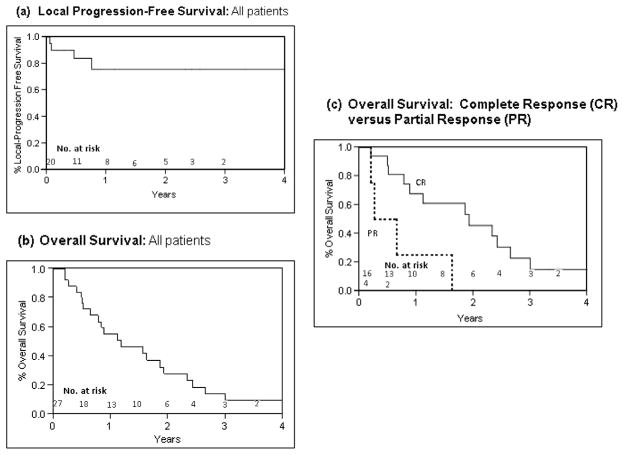
Background and purpose: Chest wall recurrences of breast cancer are a therapeutic challenge and durable local control is difficult to achieve. Our objective was to determine the local progression free survival (LPFS) and toxicity of thermochemoradiotherapy (ThChRT) for chest wall recurrence.
Methods: Twenty-seven patients received ThChRT for chest wall failure from 2/1995 to 6/2007 and make up this retrospective series. All received concurrent superficial hyperthermia twice weekly (median 8 sessions), chemotherapy (capecitabine in 21, vinorelbine in 2, and paclitaxel in 4), and radiation (median 45 Gy). Patients were followed up every 1.5-3 months and responses were graded with RECIST criteria and toxicities with the NCI CTC v4.0.
Results: Twenty-three (85%) patients were previously irradiated (median 60.4 Gy) and 22 (81%) patients received prior chemotherapy. Median follow-up was 11 months. Complete response (CR) was achieved in 16/20 (80%) of patients with follow-up data, and 1 year LPFS was 76%. Overall survival was 23 months for patients with CR, and 5.4 months in patients achieving a partial response (PR) (p=0.01). Twenty-two patients experienced acute grade 1/2 treatment related toxicities, primarily moist desquamation. Two patients experienced 3rd degree burns; all resolved with conservative measures.
Conclusions: ThChRT offers durable palliation and prolonged LPFS with tolerable acute toxicity, especially if CR is achieved.
Copyright © 2010 Elsevier Ireland Ltd. All rights reserved.
Conflict of interest statement
E.L. Jones, M.D., Ph.D., on speaker’s bureau and consultant, BSD Medical; M.W. Dewhirst is a paid consultant and Chair of the Scientific Advisory Board of Celsion, Inc., and is recipient of research contracts from Varian Corporation and GlaxoSmithKline, Inc., M.W.D. and V.J. are recipients of grants from the National Institutes of Health; all other authors had none.
Durable palliation of breast cancer chest wall recurrence with radiation therapy, hyperthermia, and chemotherapy is an approved Duke University Protocol, #00003793.
Disclaimer: The views expressed in this article are those of the authors and do not necessarily reflect the official policy or position of the Department of the Navy, Department of Defense or the United States Government.
For CDR Edward F. Miles—I am a military service member. This work was prepared as part of my official duties. Title 17 U.S.C. 105 provides that ‘Copyright protection under this title is not available for any work of the United States Government.’ Title 17 U.S.C. 101 defines a United States Government work as a work prepared by a military service member or employee of the United States Government as part of that person’s official duties.
Figures
References
-
- Lee MC, Jagsi R. Postmastectomy radiation therapy: indications and controversies. Surg Clin North Am. 2007;87:511–26. xi. - PubMed
-
- Buchanan CL, Dorn PL, Fey J, et al. Locoregional recurrence after mastectomy: incidence and outcomes. J Am Coll Surg. 2006;203:469–74. - PubMed
-
- Overgaard M, Hansen PS, Overgaard J, et al. Postoperative radiotherapy in high-risk premenopausal women with breast cancer who receive adjuvant chemotherapy. Danish Breast Cancer Cooperative Group 82b Trial. N Engl J Med. 1997;337:949–55. - PubMed
-
- Overgaard M, Jensen MB, Overgaard J, et al. Postoperative radiotherapy in high-risk postmenopausal breast-cancer patients given adjuvant tamoxifen: Danish Breast Cancer Cooperative Group DBCG 82c randomised trial. Lancet. 1999;353:1641–8. - PubMed
-
- Ragaz J, Olivotto IA, Spinelli JJ, et al. Locoregional radiation therapy in patients with high-risk breast cancer receiving adjuvant chemotherapy: 20-year results of the British Columbia randomized trial. J Natl Cancer Inst. 2005;97:116–26. - PubMed
MeSH terms
Grants and funding
LinkOut - more resources
Full Text Sources
Medical
Research Materials
