


Tumor-targeted delivery of liposome-encapsulated doxorubicin by use of a peptide that selectively binds to irradiated tumors
- PMID: 21075152
- PMCID: PMC3044774
- DOI: 10.1016/j.jconrel.2010.11.006
Tumor-targeted delivery of liposome-encapsulated doxorubicin by use of a peptide that selectively binds to irradiated tumors
Abstract
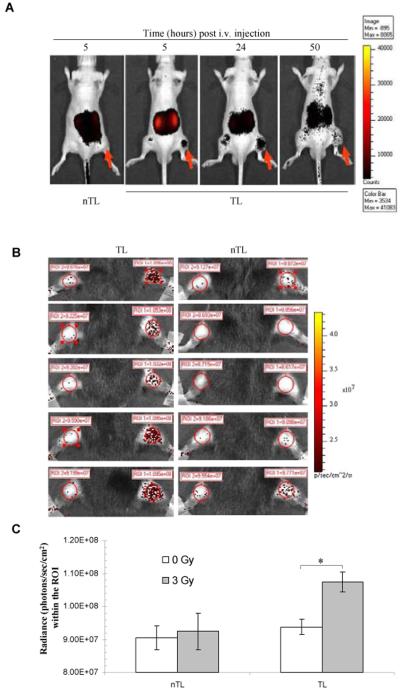
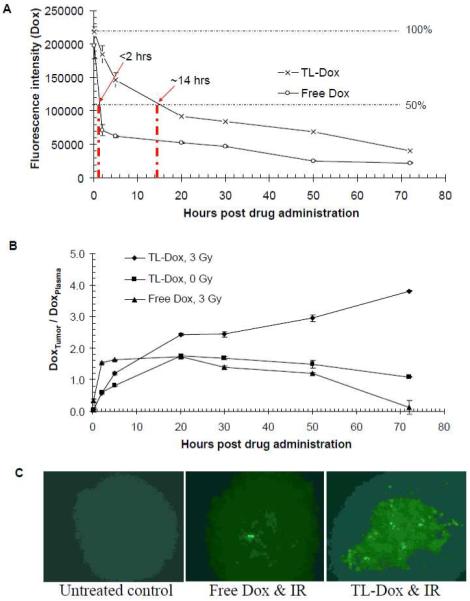
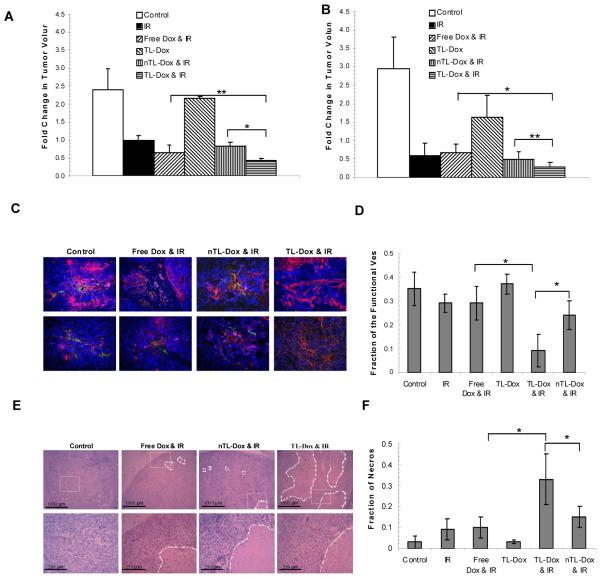
Tumor-targeted drug delivery improves anti-tumor efficacy and reduces systemic toxicity by limiting bioavailability of cytotoxic drugs to within tumors. Targeting reagents, such as peptides or antibodies recognizing molecular targets over-expressed within tumors, have been used to improve liposome-encapsulated drug accumulation within tumors and resulted in enhanced tumor growth control. In this report, we expand the scope of targeting reagents by showing that one peptide, HVGGSSV which was isolated from an in vivo screening of phage-displayed peptide library due to its selective binding within irradiated tumors, enabled highly selective tumor-targeted delivery of liposome-encapsulated doxorubicin and resulted in enhanced cytotoxicity within tumors. Targeting liposomes (TL) and non-targeting liposomes (nTL) were labeled with Alexa Fluor 750. Biodistribution of the liposomes within tumor-bearing mice was studied with near infrared (NIR) imaging. In the single dose pharmacokinetic study, the liposomal doxorubicin has an extended circulation half life as compared to the free doxorubicin. Targeting liposomes partitioned to the irradiated tumors and improved drug deposition and retention within tumors. The tumor-targeted delivery of doxorubicin improved tumor growth control as indicated with reduced tumor growth rate and tumor cell proliferation, enhanced tumor blood vessel destruction, and increased treatment-associated apoptosis and necrosis of tumor cells. Collectively, the results demonstrated the remarkable capability of the HVGGSSV peptide in radiation-guided drug delivery to tumors.
Copyright © 2010 Elsevier B.V. All rights reserved.
Figures


References
-
- Wagner TD, Yang GY. The Role of Chemotherapy and Radiation in the Treatment of Locally Advanced Non-Small Cell Lung Cancer (NSCLC) Current Drug Targets. 2010;11:67–73. - PubMed
-
- Pisters PW, Patel SR, Prieto VG, Thall PF, Lewis VO, Feig BW, Hunt KK, Yasko AW, Lin PP, Jacobson MG, Burgess MA, Pollock RE, Zagars GK, Benjamin RS, Ballo MT. Phase I trial of preoperative doxorubicin-based concurrent chemoradiation and surgical resection for localized extremity and body wall soft tissue sarcomas. J Clin Oncol. 2004;22:3375–3380. - PubMed
-
- Soper JT, Reisinger SA, Ashbury R, Jones E, Clarke-Pearson DL. Feasibility study of concurrent weekly cisplatin and whole abdominopelvic irradiation followed by doxorubicin/cisplatin chemotherapy for advanced stage endometrial carcinoma: a Gynecologic Oncology Group trial. Gynecologic oncology. 2004;95:95–100. - PubMed
-
- Madhankumar AB, Slagle-Webb B, Wang X, Yang QX, Antonetti DA, Miller PA, Sheehan JM, Connor JR. Efficacy of interleukin-13 receptor-targeted liposomal doxorubicin in the intracranial brain tumor model. Molecular cancer therapeutics. 2009;8:648–654. - PubMed
-
- Tuscano JM, Martin SM, Ma Y, Zamboni W, O’Donnell RT. Efficacy, biodistribution, and pharmacokinetics of CD22-targeted pegylated liposomal doxorubicin in a B-cell non-Hodgkin’s lymphoma xenograft mouse model. Clin Cancer Res. 2010;16:2760–2768. - PubMed
Publication types
MeSH terms
Substances
Grants and funding
LinkOut - more resources
Full Text Sources
Other Literature Sources
Medical
Miscellaneous
