. 2011 Jan;32(1):33-43.
doi: 10.1016/j.placenta.2010.10.010. Epub 2010 Nov 13.

Genome-wide expression profile of first trimester villous and extravillous human trophoblast cells

Affiliations

Genome-wide expression profile of first trimester villous and extravillous human trophoblast cells

R Apps et al. Placenta. 2011 Jan.

Abstract

We have examined the transcriptional changes associated with differentiation from villous to extravillous trophoblast using a whole genome microarray. Villous trophoblast (VT) is in contact with maternal blood and mediates nutrient exchange whereas extravillous trophoblast (EVT) invades the decidua and remodels uterine arteries. Using highly purified first trimester trophoblast we identified over 3000 transcripts that are differentially expressed. Many of these transcripts represent novel functions and pathways that show co-ordinated up-regulation in VT or EVT. In addition we identify new players in established functions such as migration, immune modulation and cytokine or angiogenic factor secretion by EVT. The transition from VT to EVT is also characterised by alterations in transcription factors such as STAT4 and IRF9, which may co-ordinate these changes. Transcripts encoding several members of the immunoglobulin-superfamily, which are normally expressed on leukocytes, were highly transcribed in EVT but not expressed as protein, indicating specific control of translation in EVT. Interactions of trophoblast with decidual leukocytes are involved in regulating EVT invasion. We show that decidual T-cells, macrophages and NK cells express the inhibitory collagen receptor LAIR-1 and that EVT secrete LAIR-2, which can block this interaction. This represents a new mechanism by which EVT can modulate leukocyte function in the decidua. Since LAIR-2 is detectable in the urine of pregnant, but not non-pregnant women, trophoblast-derived LAIR-2 may also have systemic effects during pregnancy.


Figures

Fig. 1
Fig. 1
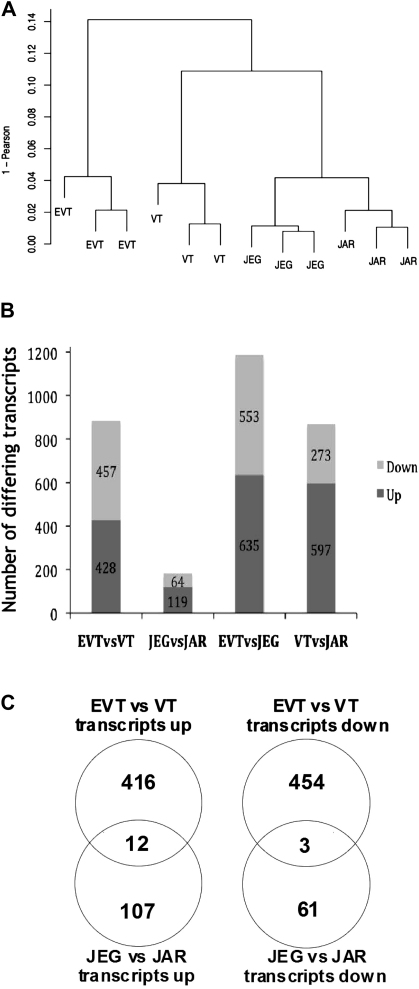
Comparison of gene expression profiles in primary EVT and VT with the choriocarcinoma cell lines JEG-3 and JAR. Unsupervised hierarchical clustering of the four cell types was performed using transcripts identified as showing variable expression across all samples (A). Organisation and length of the dendrogram branches reflect the degree of similarity between samples. (B). Identification of specific transcripts which differ significantly in expression (q < 0.01) by at least 4-fold up or down between cell types. 885 transcripts differ between EVT and VT by these criteria, compared with only 183 between JEG and JAR. 1188 transcripts differ between EVT and JEG and 870 between VT and JAR respectively. (C). The differences in expression between EVT and VT cells are not the same as the differences between JEG and JAR. For example, of the 457 transcripts at least 4-fold lower in EVT compared with VT, only 3 of these transcripts are also lower in JEG vs JAR.
Fig. 2
Fig. 2
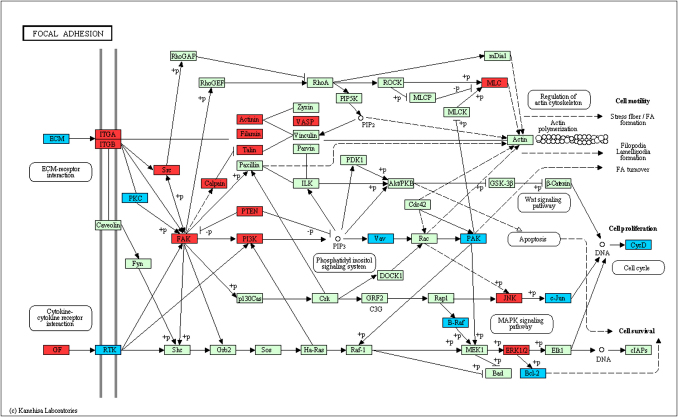
The Focal Adhesion Kinase (FAK) KEGG pathway has a significant number of transcripts up-regulated in EVT vs VT (p < 0.01). Individual transcripts significantly (q < 0.01) up-regulated in EVT are coloured red, transcripts that are signficantly lower in EVT compared to VT are coloured blue. Green indicates no significant change.
Fig. 3
Fig. 3
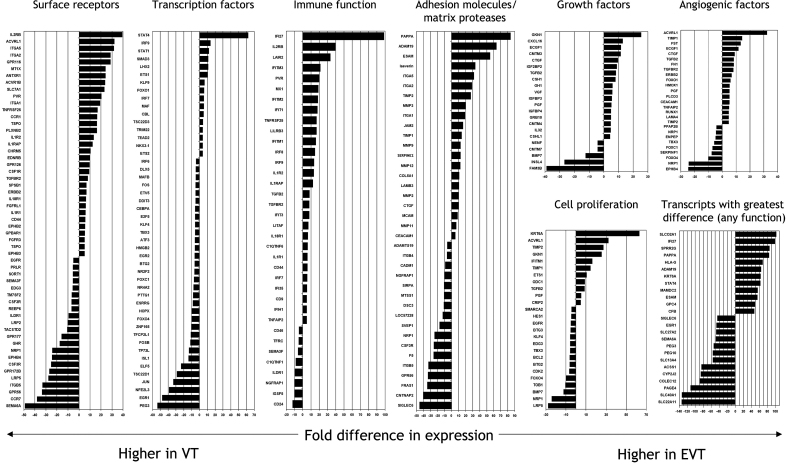
Genes differentially expressed between EVT and VT. A mean hybridization signal is used for each transcript, with all differences significant at q < 0.01. Only selected genes are shown here, for a complete list see Suppl Table 3. Genes were classified into functional categories based on Gene Ontology annotations.
Fig. 4
Fig. 4
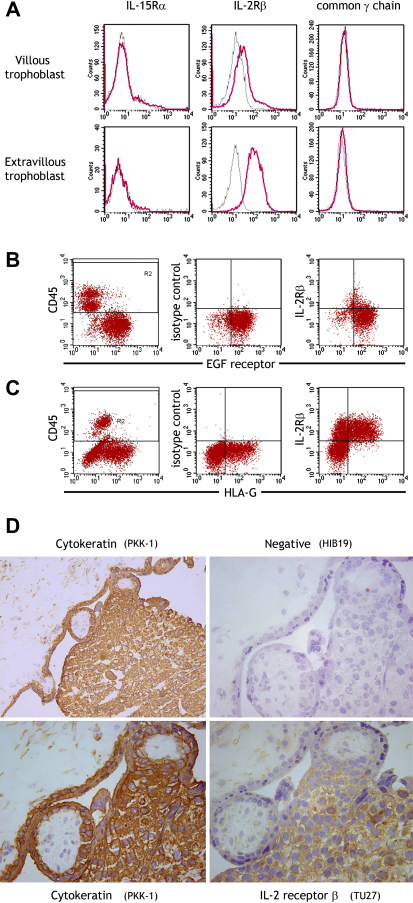
The IL-2 receptor β subunit is up-regulated on trophoblast cells as they differentiate from villous to extravillous phenotype. Upregulation of IL-2Rβ expression was validated by flow cytometry (A–C) and immunohistochemistry (D). Preparations of placental cells from normal first trimester pregnancies were gated on scatter, leukocytes excluded by CD45 labelling (gate R2) and subunits of the IL-15 receptor complex stained on villous (EGF-R+) or extravillous (HLA-G+) trophoblast cells (A). Dot plots are shown of IL-2Rβ subunit staining villous (B) and extravillous trophoblast (C). Shown here are cells from the same placenta which is representative of 3 pregnancies analysed. The IL-2Rβ was also localised histologically in sections of implantation site from the first trimester (D). The low power plan stained with cytokeratin shows villous mesenchyme (top left) and a column of EVT (bottom right) developing from placental villi (centre). Higher power pictures show strong IL-2Rβ staining detected on extravillous trophoblast migrating away from the villi, whereas staining was negligible on villous trophoblast and villous mesenchymal cells.
Fig. 5
Fig. 5
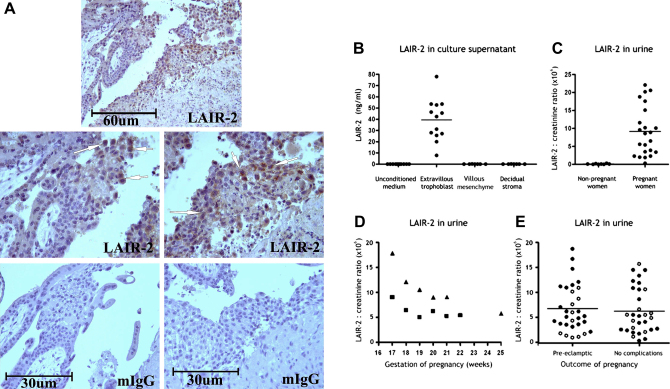
Extravillous trophoblast cells secrete LAIR-2. In histological staining of a first trimester implantation site extravillous trophoblast (arrowed) differentiating from a placental villus stain for LAIR-2 but not isotype control mAb (A). This secreted LAIR-2 can be detected by ELISA. LAIR-2 is detected in culture supernatant of extravillous trophoblast but not other placental or decidual cells from the implantation site of normal first trimester pregnancies (B). LAIR-2 in the urine of 23 pregnant women between 25 and 45 weeks gestation, but not non-pregnant women (C). Analysis of urine from two women throughout gestation shows LAIR-2 levels are highest before 20 weeks (D). No significant difference was found in urine LAIR-2 levels collected at 10–16 weeks gestation, from women who subsequently developed pre-eclampsia or who had pregnancies without complications (Mann–Whitney U test) (E). Filled circles are 14–16 week samples, open circles were collected at 10 weeks. There was no significant difference between samples from different timepoints, so the data was combined.
Fig. 6
Fig. 6
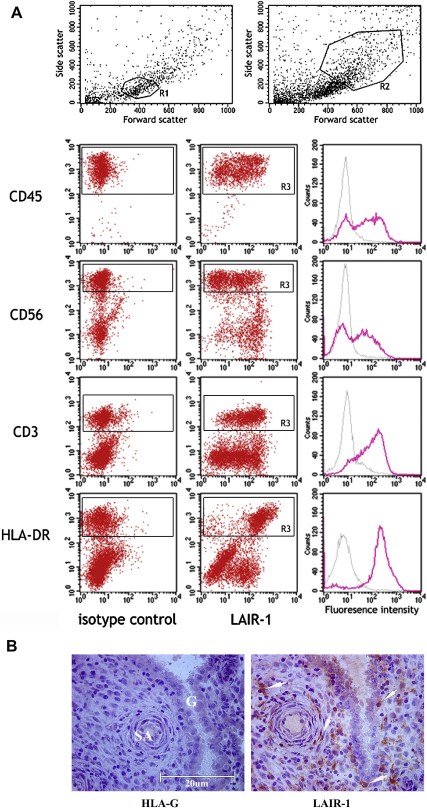
LAIR-1 expression in the decidua. Decidual leukocytes isolated from first trimester pregnancies were analysed by surface flow cytometry (A). The scatter gate R1 was used for CD45, CD56 and CD3 positive cells and R2 for HLA-DR+ myelomonocytic cells. Histograms show isotype control and LAIR-1 mAb staining to the leukocyte population discriminated (R3). Staining is representative of decidual leukocytes from 3 independent individuals. Histological staining of decidua adjacent to a first trimester implantation site is shown (B). No staining with an HLA-G mAb indicates the absence of extravillous trophoblast in this area. Immunoreactivity corresponding to LAIR-1 can be seen on maternal cells adjacent to arteries and glands or scattered throughout the decidua (right), consistent with LAIR-1 expression by maternal leukocytes. SA, spiral artery; G, uterine gland.

References

    1. Moffett A., Loke C. Immunology of placentation in eutherian mammals. Nat Rev Immunol. 2006 Aug;6(8):584–594. - PubMed
    1. Moffett-King A. Natural killer cells and pregnancy. Nat Rev Immunol. 2002 Sep;2(9):656–663. - PubMed
    1. Genbacev O., Zhou Y., Ludlow J.W., Fisher S.J. Regulation of human placental development by oxygen tension. Science. 1997 Sep 12;277(5332):1669–1672. - PubMed
    1. Hanna J., Goldman-Wohl D., Hamani Y., Avraham I., Greenfield C., Natanson-Yaron S. Decidual NK cells regulate key developmental processes at the human fetal-maternal interface. Nat Med. 2006 Sep;12(9):1065–1074. - PubMed
    1. Hiby S.E., Walker J.J., O’shaughnessy K.M., Redman C.W., Carrington M., Trowsdale J. Combinations of maternal KIR and fetal HLA-C genes influence the risk of preeclampsia and reproductive success. J Exp Med. 2004 Oct 18;200(8):957–965. - PMC - PubMed

Publication types

MeSH terms