


Assessing white matter integrity as a function of abstinence duration in former cocaine-dependent individuals
- PMID: 21075564
- PMCID: PMC3062648
- DOI: 10.1016/j.drugalcdep.2010.10.001
Assessing white matter integrity as a function of abstinence duration in former cocaine-dependent individuals
Abstract
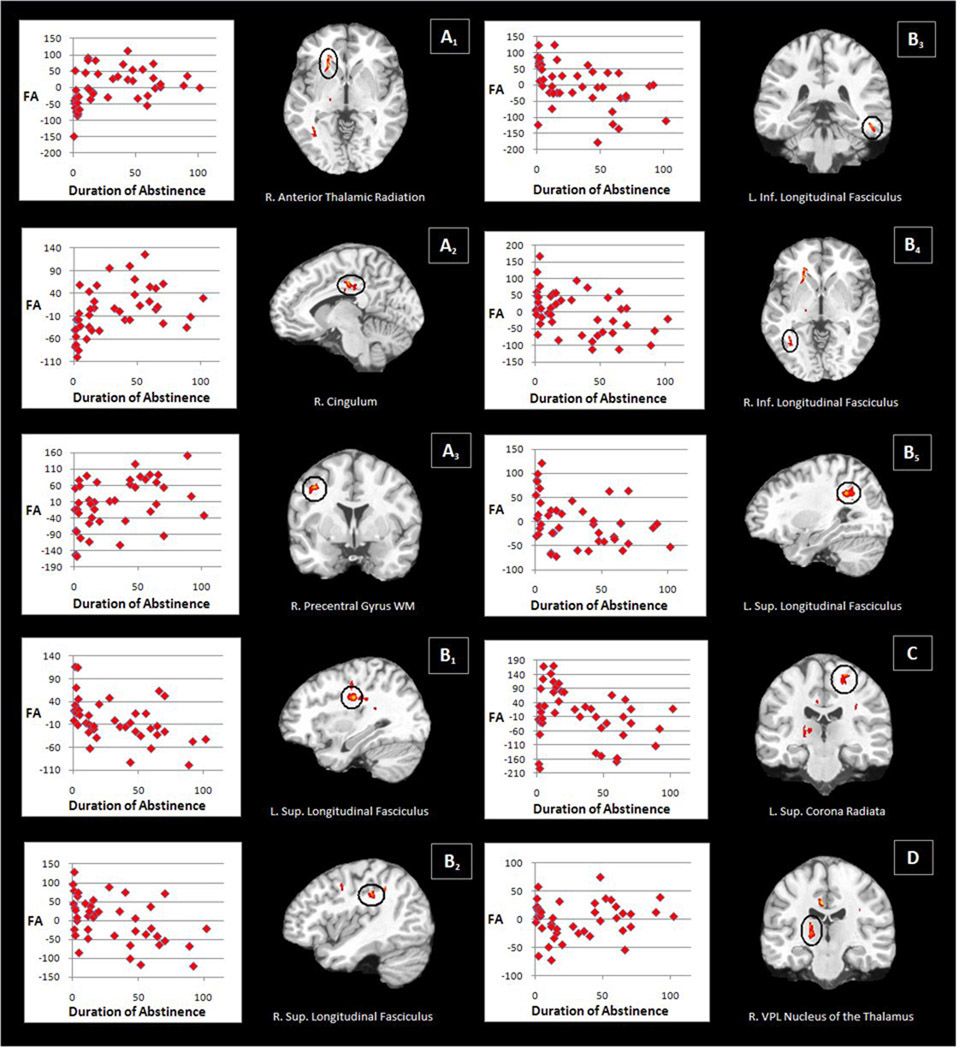
Current cocaine-dependent users show reductions in white matter (WM) integrity, especially in cortical regions associated with cognitive control that have been associated with inhibitory dysfunction. A key question is whether these white matter differences are present following abstinence from drug use. To address this, WM integrity was examined using diffusion tensor imaging (DTI) obtained on 43 cocaine abstinent patients (abstinence duration ranged between five days and 102 weeks) and 43 non-using controls. Additionally, a cross-sectional comparison separated the patients into three groups (short-term, mid-term and long-term) based upon duration of cocaine abstinence. The 43 cocaine abstinent patients showed lower fractional anisotropy (FA) in the left anterior callosal fibers, left genu of the corpus callosum, right superior longitudinal fasciculus, right callosal fibers and the superior corona radiata bilaterally when compared against non-using controls. Higher FA in the cocaine abstinent patients was observed in the splenium of the corpus callosum and right superior longitudinal fasciculus. Differences between the cocaine abstinent groups were observed bilaterally in the inferior longitudinal fasciculus, right anterior thalamic radiation, right ventral posterolateral nucleus of the thalamus, left superior corona radiata, superior longitudinal fasciculus bilaterally, right cingulum and the WM of the right precentral gyrus. The results identified WM differences between cocaine abstinent patients and controls as well as distinct differences between abstinent subgroups. The findings suggest that specific white matter differences persist throughout abstinence while other, spatially distinct, differences discriminate as a function of abstinence duration. These differences may, therefore, represent brain changes that mark recovery from addiction.
Copyright © 2010 Elsevier Ireland Ltd. All rights reserved.
Figures

References
-
- Ardekani BA, Braun M, Hutton BF, Kanno I, Iida H. A fully automatic multimodality image registration algorithm. J. Comput. Assist. Tomogr. 1995;19:615–623. - PubMed
-
- Aronica E, van Vliet EA, Mayboroda OA, Troost D, da Silva FH, Gorter JA. Upregulation of metabotropic gluatamate receptor subtype mGluR3 and mGluR5 in reactive astrocytes in a rat model of mesial temporal lobe epilepsy. Eur. J. Neurosci. 2000;12:2333–2344. - PubMed
-
- Bartolomeo P, Thiebaut de Schotten M, Doricchi F. Left unilateral neglect as a disconnection syndrome. Cerebral Cortex. 2007;17:2479–2490. - PubMed
Publication types
MeSH terms
Grants and funding
LinkOut - more resources
Full Text Sources
Medical
