


Impact of common mental disorders on sickness absence in an occupational cohort study
- PMID: 21075767
- PMCID: PMC3095482
- DOI: 10.1136/oem.2010.056994
Impact of common mental disorders on sickness absence in an occupational cohort study
Abstract
Objectives: Common mental disorders are associated with impaired functioning and sickness absence. We examine whether sub-clinical as well as clinical psychiatric morbidity predict long spells of sickness absence for both psychiatric and non-psychiatric illness. We also examine whether recent common mental disorders and those present on two occasions have a stronger association with sickness absence than less recent and single episodes of disorder.
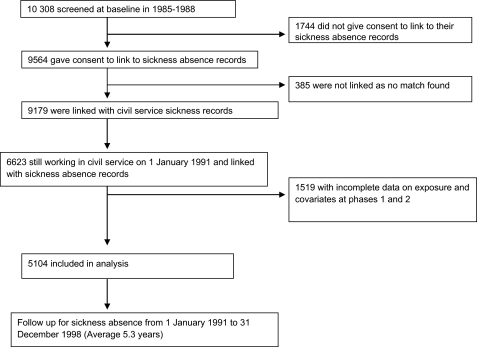
Methods: Common mental disorders measured by the General Health Questionnaire were linked with long spells of sickness absence in 5104 civil servants from the longitudinal Whitehall II Study. Negative binomial models were used to estimate rate ratios for long spells of sickness absence with and without a psychiatric diagnosis (mean follow-up 5.3 years).
Results: Clinical but not sub-threshold common mental disorders were associated with increased risk of long spells of psychiatric sickness absence for men, but not for women, after adjusting for covariates (rate ratios (RR) 1.67, 95% CI 1.13 to 2.46). Risk of psychiatric sickness absence was associated with recent common mental disorders (RR 2.08, 95% CI 1.29 to 3.35) and disorder present on two occasions (RR 1.65, 95% CI 0.98 to 2.71) for men only. Common mental disorders were not associated with increased risk of non-psychiatric sickness absence after adjustment for covariates.
Conclusions: Identification and treatment of common mental disorders may reduce the economic burden of long term psychiatric sickness absence. Our results suggest that public health and clinical services should focus on the identification of workers with elevated mental health symptoms. Studies are needed of the efficacy of early identification and management of mental health symptoms for the prevention of long spells of sickness absence.
Conflict of interest statement
References
-
- Kessler RC, Frank RG. The impact of psychiatric disorders on work loss days. Psychol Med 1997;27:861–73 - PubMed
-
- Sanderson K, Andrews G. Prevalence and severity of mental health-related disability and relationship to diagnosis. Psychiatr Serv 2002;53:80–6 - PubMed
-
- Surtees PG, Wainwright NW, Khaw KT, et al. Functional health status, chronic medical conditions and disorders of mood. Br J Psychiatry 2003;183:299–303 - PubMed
-
- Buist-Bouwman MA, De Graaf R, Vollebergh WA, et al. ESEMeD/MHEDEA 2000 Investigators Functional disability of mental disorders and comparison with physical disorders: a study among the general population of six European countries. Acta Psychiatr Scand 2006;113:492–500 - PubMed
Publication types
MeSH terms
Grants and funding
- R01 HL036310/HL/NHLBI NIH HHS/United States
- G19/35/MRC_/Medical Research Council/United Kingdom
- G0100222/MRC_/Medical Research Council/United Kingdom
- AG13196/AG/NIA NIH HHS/United States
- 121/5044/DH_/Department of Health/United Kingdom
- R37 AG013196/AG/NIA NIH HHS/United States
- HL36310/HL/NHLBI NIH HHS/United States
- R01 AG013196/AG/NIA NIH HHS/United States
- HS06516/HS/AHRQ HHS/United States
- RG/07/008/23674/BHF_/British Heart Foundation/United Kingdom
- G8802774/MRC_/Medical Research Council/United Kingdom
- G0902037/MRC_/Medical Research Council/United Kingdom
LinkOut - more resources
Full Text Sources
Medical
