. 2011 Jan;77(1):57-66.
doi: 10.1128/AEM.01603-10. Epub 2010 Nov 12.

Different contributions of HtrA protease and chaperone activities to Campylobacter jejuni stress tolerance and physiology

Affiliations

Different contributions of HtrA protease and chaperone activities to Campylobacter jejuni stress tolerance and physiology

Kristoffer T Baek et al. Appl Environ Microbiol. 2011 Jan.

Abstract

The microaerophilic bacterium Campylobacter jejuni is the most common cause of bacterial food-borne infections in the developed world. Tolerance to environmental stress relies on proteases and chaperones in the cell envelope, such as HtrA and SurA. HtrA displays both chaperone and protease activities, but little is known about how each of these activities contributes to stress tolerance in bacteria. In vitro experiments showed temperature-dependent protease and chaperone activities of C. jejuni HtrA. A C. jejuni mutant lacking only the protease activity of HtrA was used to show that the HtrA chaperone activity is sufficient for growth at high temperature or under oxidative stress, whereas the HtrA protease activity is essential only under conditions close to the growth limit for C. jejuni. However, the protease activity was required to prevent induction of the cytoplasmic heat shock response even under optimal growth conditions. Interestingly, the requirement of HtrA at high temperatures was found to depend on the oxygen level, and our data suggest that HtrA may protect oxidatively damaged proteins. Finally, protease activity stimulates HtrA production and oligomer formation, suggesting that a regulatory role depends on the protease activity of HtrA. Studying a microaerophilic organism encoding only two known periplasmic chaperones (HtrA and SurA) revealed an efficient HtrA chaperone activity and proposed multiple roles of the protease activity, increasing our understanding of HtrA in bacterial physiology.


Figures
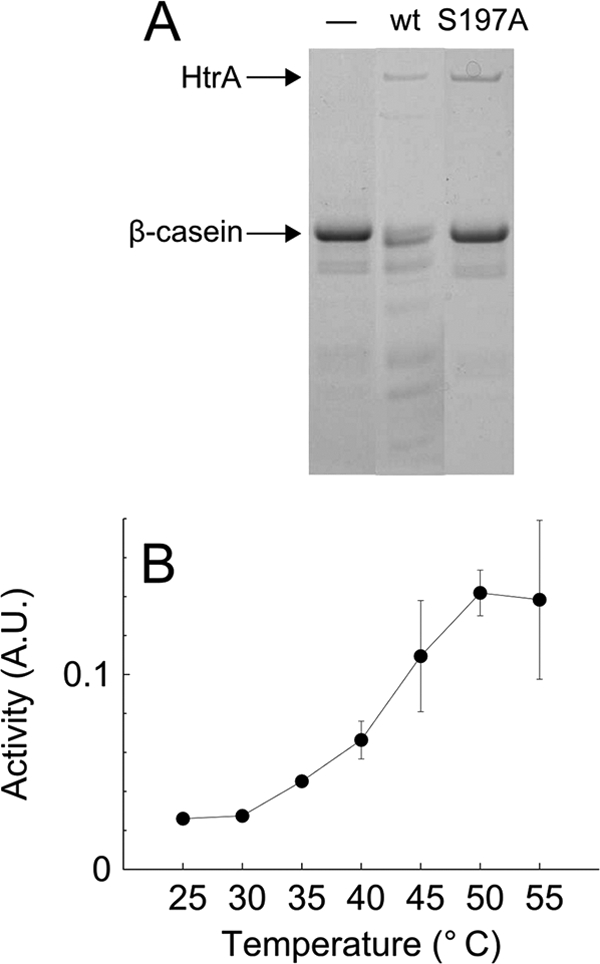
FIG. 1.
FIG. 1.
Protease activity of HtrA in vitro. Wild-type HtrA and HtrAS197A were expressed from plasmids pKB1012 and pKB1014, respectively, in E. coli and purified. (A) Degradation of β-casein at 37°C in the absence (−) or presence of wild-type HtrA or HtrAS197A. (B) Degradation of BODIPY-labeled β-casein at different temperatures in the presence of wild-type HtrA. The activity is the degradation rate measured fluorimetrically at 511 nm in triplicate. The averages from three independent measurements are shown. Error bars indicate the standard deviations. A.U., arbitrary units.
FIG. 2.
FIG. 2.
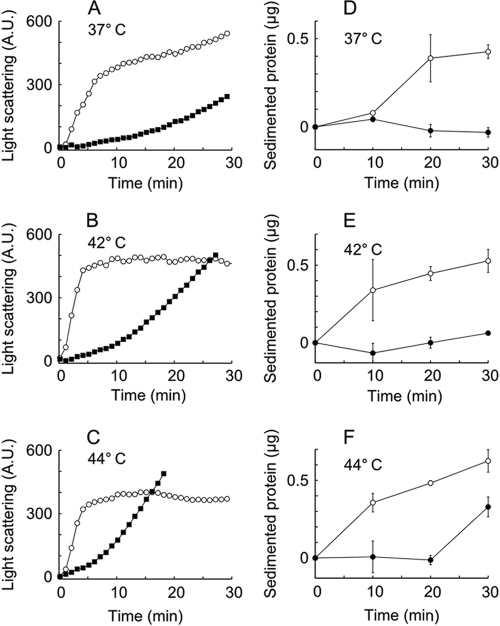
Chaperone activity of HtrA in vitro. HtrAS197A and lysozyme were mixed in a molar ratio of 1:2, and DTT was added at time zero. (A to C) Aggregation of denatured lysozyme in the presence (filled squares) or absence (open circles) of HtrAS197A, measured by light scattering at 300 nm. (D to F) Aggregation of denatured lysozyme in the presence (filled circles) or absence (open circles) of HtrAS197A, measured by sedimentation of insoluble aggregates at 21,000 × g for 10 min. Sedimented protein was quantified as described in Materials and Methods. The values shown are averages from two individual experiments, normalized to the value at time zero. Error bars indicate the standard deviations.
FIG. 3.
FIG. 3.
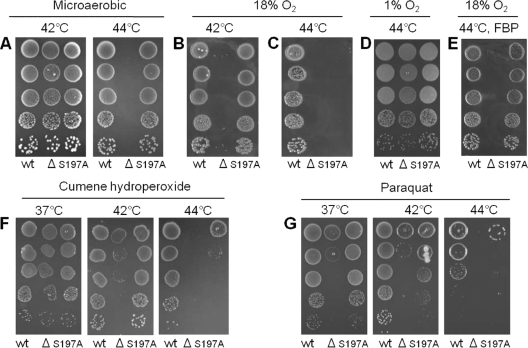
Effect of temperature and oxidative stress on growth of C. jejuni htrA mutants on solid medium. Serial dilutions (10−1 to 10−5) of C. jejuni NCTC11168 (wild type; wt), LB1281 (ΔhtrA mutant; Δ), and KB1025 [htrA(S197A) mutant; S197A] at an OD600 of 0.1 were spotted in 10-μl volumes on base II, 5% blood agar plates. The plates were incubated under microaerobic conditions (A, F, and G), in an 18% O2 atmosphere (candle jar) (B, C, and E), or in a 1% O2 atmosphere (D). Ferrous sulfate, sodium bisulfate, and pyruvate (FBP), cumene hydroperoxide, or paraquat was added as indicated.
FIG. 4.
FIG. 4.
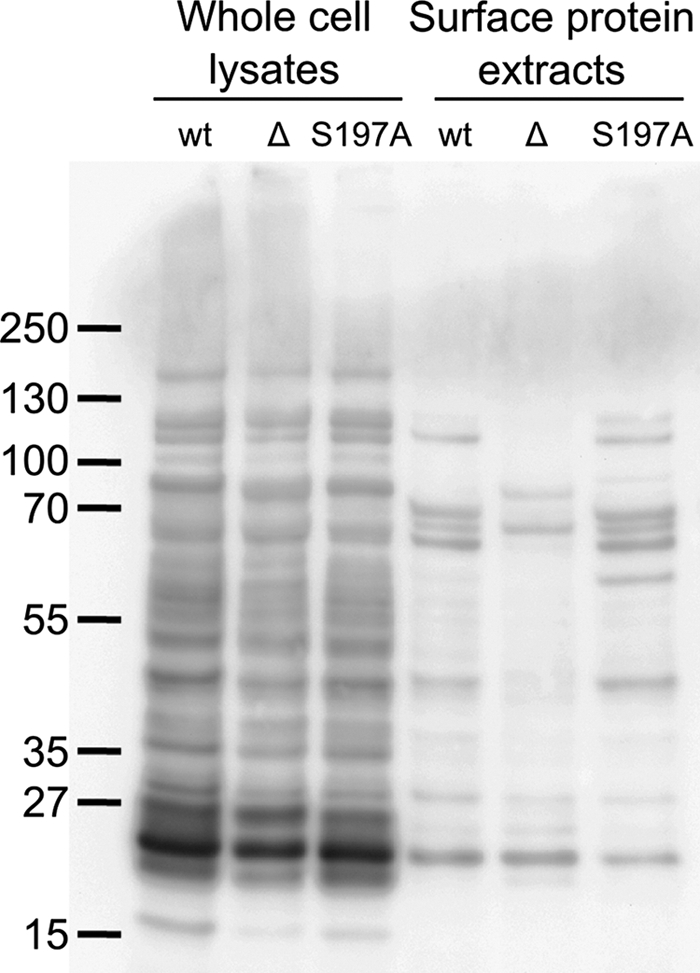
Protein carbonylation. C. jejuni NCTC11168 (wt), LB1281 (ΔhtrA mutant; Δ), and KB1025 [htrA(S197A) mutant; S197A] were grown microaerobically overnight at 42°C to stationary phase and then exposed to vigorous shaking for 1 h. Carbonylation of proteins in whole-cell lysates and surface protein extracts was determined as described in Materials and Methods. Equal amounts of protein were loaded in each lane for the lysates and surface extracts. The positions of molecular size standards are indicated on the left (in kilodaltons).
FIG. 5.
FIG. 5.
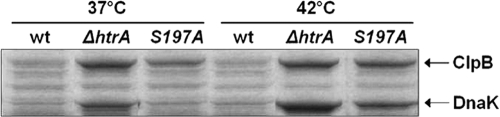
Effect of lack of HtrA protease activity on induction of cytoplasmic heat shock response. C. jejuni NCTC11168 (wt), LB1281 (ΔhtrA mutant; Δ), and KB1025 [htrA(S197A) mutant; S197A] were grown in BHI broth at the indicated temperatures in a microaerobic atmosphere. Extracted proteins were separated by SDS-PAGE and stained with Coomassie brilliant blue. ClpB and DnaK were identified previously (6).
FIG. 6.
FIG. 6.
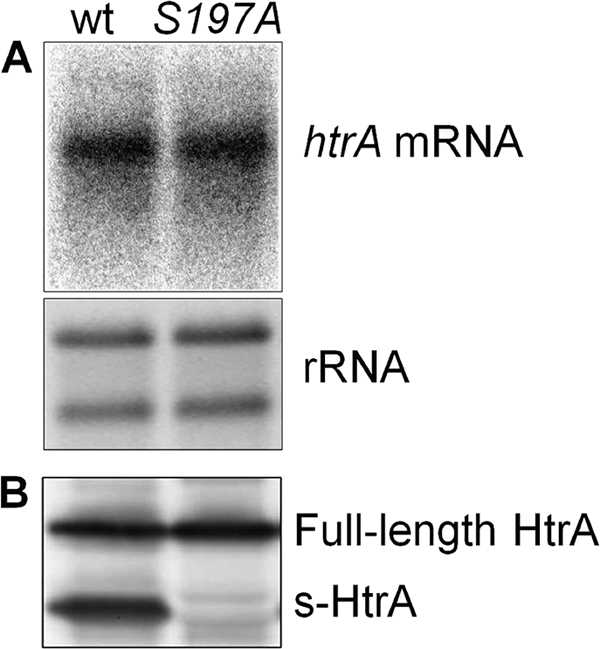
Effect of HtrA protease activity on HtrA content and htrA expression. (A) htrA mRNA in exponential-phase-growing C. jejuni NCTC11168 (wt) and KB1025 [htrA(S197A) mutant; S197A] cultures, detected by Northern blotting with an htrA-specific DNA probe. (B) Full-length and short HtrA (s-HtrA) in exponential-phase-growing C. jejuni NCTC11168 (wt) and KB1025 [htrA(S197A) mutant; S197A], detected by immunoblotting with an HtrA antibody.
FIG. 7.
FIG. 7.
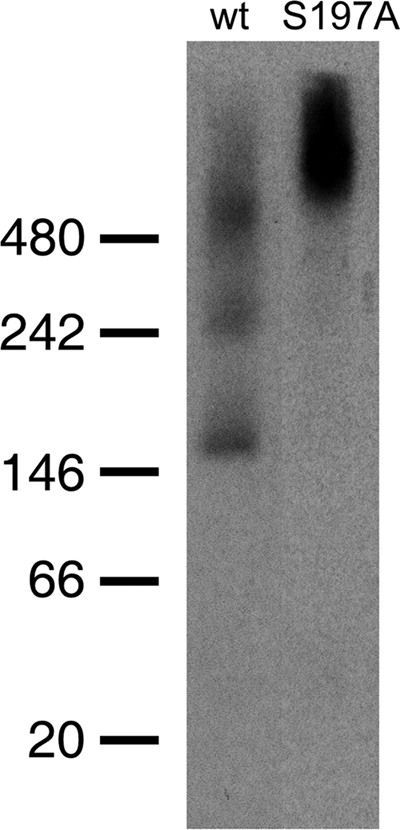
Visualization of HtrA oligomers in exponential-phase-growing C. jejuni NCTC11168 (wt) and KB1025 [htrA(S197A); S197A] by blue native PAGE followed by immunoblotting with HtrA antibody. The positions of molecular size standards (NativeMark; Invitrogen) are indicated on the left (in kilodaltons).

References

    1. Allos, B. M. 2001. Campylobacter jejuni infections: update on emerging issues and trends. Clin. Infect. Dis. 32:1201-1206. - PubMed
    1. Arie, J. P., N. Sassoon, and J. M. Betton. 2001. Chaperone function of FkpA, a heat shock prolyl isomerase, in the periplasm of Escherichia coli. Mol. Microbiol. 39:199-210. - PubMed
    1. Asakura, H., M. Yamasaki, S. Yamamoto, and S. Igimi. 2007. Deletion of peb4 gene impairs cell adhesion and biofilm formation in Campylobacter jejuni. FEMS Microbiol. Lett. 275:278-285. - PubMed
    1. Atack, J. M., and D. J. Kelly. 2009. Oxidative stress in Campylobacter jejuni: responses, resistance and regulation. Future Microbiol. 4:677-690. - PubMed
    1. Bolton, F. J., and D. Coates. 1983. A study of the oxygen and carbon dioxide requirements of thermophilic campylobacters. J. Clin. Pathol. 36:829-834. - PMC - PubMed

Publication types

MeSH terms

LinkOut - more resources