Randomized Controlled Trial
. 2011 Jan;258(1):59-72.
doi: 10.1148/radiol.10100454. Epub 2010 Nov 12.

Breast cancer: comparative effectiveness of positron emission mammography and MR imaging in presurgical planning for the ipsilateral breast

Affiliations
Randomized Controlled Trial

Breast cancer: comparative effectiveness of positron emission mammography and MR imaging in presurgical planning for the ipsilateral breast

Wendie A Berg et al. Radiology. 2011 Jan.

Abstract

Purpose: To determine the performance of positron emission mammography (PEM), as compared with magnetic resonance (MR) imaging, including the effect on surgical management, in ipsilateral breasts with cancer.

Materials and methods: Four hundred seventy-two women with newly diagnosed breast cancer who were offered breast-conserving surgery consented from September 2006 to November 2008 to participate in a multicenter institutional review board-approved, HIPAA-compliant protocol. Participants underwent contrast material-enhanced MR imaging and fluorine 18 fluorodeoxyglucose PEM in randomized order; resultant images were interpreted independently. Added biopsies and changes in surgical procedure for the ipsilateral breast were correlated with histopathologic findings. Performance characteristics were compared by using the McNemar test and generalized estimating equations.

Results: Three hundred eighty-eight women (median age, 58 years; age range, 26-93 years; median estimated tumor size, 1.5 cm) completed the study. Additional cancers were found in 82 (21%) women (82 ipsilateral breasts; median tumor size, 0.7 cm). Twenty-eight (34%) of the 82 breasts were identified with both PEM and MR imaging; 21 (26%) breasts, with MR imaging only; 14 (17%) breasts, with PEM only; and seven (8.5%) breasts, with mammography and ultrasonography. Twelve (15%) cases of additional cancer were missed at all imaging examinations. Integration of PEM and MR imaging increased cancer detection-to 61 (74%) of 82 breasts versus 49 (60%) of 82 breasts identified with MR imaging alone (P < .001). Of 306 breasts without additional cancer, 279 (91.2%) were correctly assessed with PEM compared with 264 (86.3%) that were correctly assessed with MR imaging (P = .03). The positive predictive value of biopsy prompted by PEM findings (47 [66%] of 71 cases) was higher than that of biopsy prompted by MR findings (61 [53%] of 116 cases) (P = .016). Of 116 additional cancers, 61 (53%) were depicted by MR imaging and 47 (41%) were depicted by PEM (P = .043). Fifty-six (14%) of the 388 women required mastectomy: 40 (71%) of these women were identified with MR imaging, and 20 (36%) were identified with PEM (P < .001). Eleven (2.8%) women underwent unnecessary mastectomy, which was prompted by only MR findings in five women, by only PEM findings in one, and by PEM and MR findings in five. Thirty-three (8.5%) women required wider excision: 24 (73%) of these women were identified with MR imaging, and 22 (67%) were identified with PEM.

Conclusion: PEM and MR imaging had comparable breast-level sensitivity, although MR imaging had greater lesion-level sensitivity and more accurately depicted the need for mastectomy. PEM had greater specificity at the breast and lesion levels. Eighty-nine (23%) participants required more extensive surgery: 61 (69%) of these women were identified with MR imaging, and 41 (46%) were identified with PEM (P = .003). Fourteen (3.6%) women had tumors seen only at PEM.


Figures

Figure a:
Figure a:
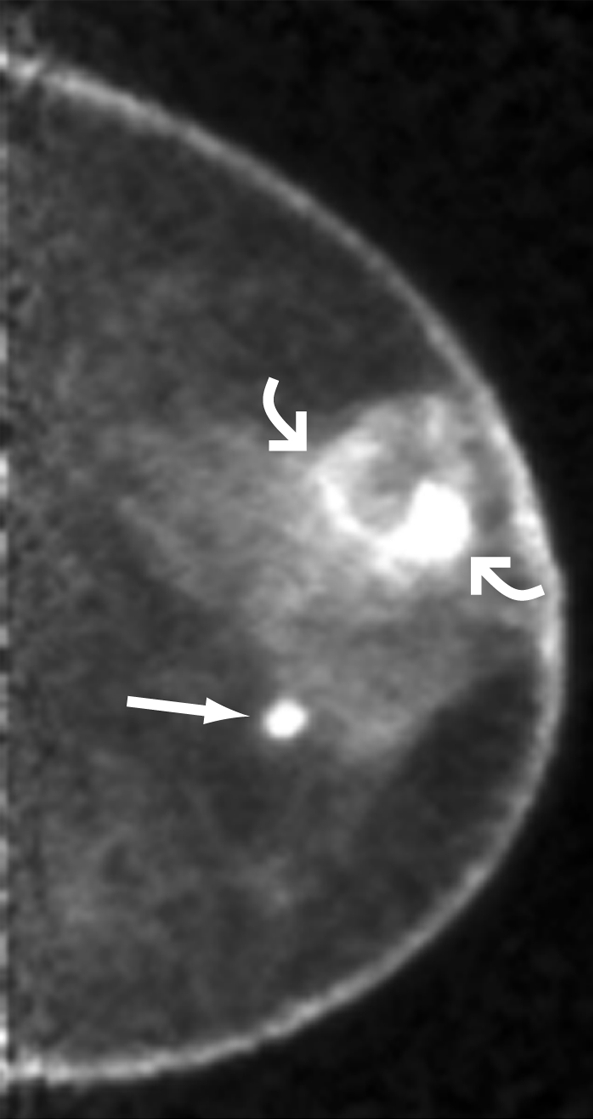
Images obtained in 68-year-old woman who previously underwent right mastectomy for cancer and was noted to have lump in left breast. (a) Lump was shown to correspond to 2.8-cm indistinctly marginated mass (triangular marker) on craniocaudal mammogram. US-guided core-needle biopsy revealed grade III IDC. (b) Craniocaudal and (c) mediolateral oblique PEM images (5.6-mm section thickness) obtained beginning 70 minutes after intravenous injection of 10.4 mCi (384.8 MBq) of FDG show intense rim uptake in known cancer (curved arrows). Approximately 5 cm medial and inferior to this region, intense FDG uptake was noted in second, 1-cm mass (straight arrow). (d) Axial maximum intensity projection of left breast subtraction of precontrast images from three-dimensional spoiled gradient-echo T1-weighted MR images obtained 90 seconds after intravenous injection of 0.1 mmol of gadoversetamide (OptiMARK; Mallinckrodt, St Louis, Mo) per kilogram of body weight also shows rim enhancement in known malignancy (curved arrows) and intense enhancement in second, 1-cm mass (long straight arrow) in lower inner region of breast. Metastatic axillary nodes were suspected at MR imaging. The patient opted for direct mastectomy; histopathologic analysis confirmed multicentric grade III IDC, the largest of which was 3.0 cm. The second mass was confirmed to be 1.2-cm grade III IDC with a less than 5% DCIS component. A third 0.7-cm grade III IDC (straight short arrow) noted in the immediate retroareolar region was difficult to distinguish from normal nipple enhancement but visible on both PEM and MR images. Two of five sentinel nodes showed metastatic disease. Both PEM and MR imaging correctly depicted multicentric disease that was not seen at mammography.
Figure b:
Figure b:
Images obtained in 68-year-old woman who previously underwent right mastectomy for cancer and was noted to have lump in left breast. (a) Lump was shown to correspond to 2.8-cm indistinctly marginated mass (triangular marker) on craniocaudal mammogram. US-guided core-needle biopsy revealed grade III IDC. (b) Craniocaudal and (c) mediolateral oblique PEM images (5.6-mm section thickness) obtained beginning 70 minutes after intravenous injection of 10.4 mCi (384.8 MBq) of FDG show intense rim uptake in known cancer (curved arrows). Approximately 5 cm medial and inferior to this region, intense FDG uptake was noted in second, 1-cm mass (straight arrow). (d) Axial maximum intensity projection of left breast subtraction of precontrast images from three-dimensional spoiled gradient-echo T1-weighted MR images obtained 90 seconds after intravenous injection of 0.1 mmol of gadoversetamide (OptiMARK; Mallinckrodt, St Louis, Mo) per kilogram of body weight also shows rim enhancement in known malignancy (curved arrows) and intense enhancement in second, 1-cm mass (long straight arrow) in lower inner region of breast. Metastatic axillary nodes were suspected at MR imaging. The patient opted for direct mastectomy; histopathologic analysis confirmed multicentric grade III IDC, the largest of which was 3.0 cm. The second mass was confirmed to be 1.2-cm grade III IDC with a less than 5% DCIS component. A third 0.7-cm grade III IDC (straight short arrow) noted in the immediate retroareolar region was difficult to distinguish from normal nipple enhancement but visible on both PEM and MR images. Two of five sentinel nodes showed metastatic disease. Both PEM and MR imaging correctly depicted multicentric disease that was not seen at mammography.
Figure c:
Figure c:
Images obtained in 68-year-old woman who previously underwent right mastectomy for cancer and was noted to have lump in left breast. (a) Lump was shown to correspond to 2.8-cm indistinctly marginated mass (triangular marker) on craniocaudal mammogram. US-guided core-needle biopsy revealed grade III IDC. (b) Craniocaudal and (c) mediolateral oblique PEM images (5.6-mm section thickness) obtained beginning 70 minutes after intravenous injection of 10.4 mCi (384.8 MBq) of FDG show intense rim uptake in known cancer (curved arrows). Approximately 5 cm medial and inferior to this region, intense FDG uptake was noted in second, 1-cm mass (straight arrow). (d) Axial maximum intensity projection of left breast subtraction of precontrast images from three-dimensional spoiled gradient-echo T1-weighted MR images obtained 90 seconds after intravenous injection of 0.1 mmol of gadoversetamide (OptiMARK; Mallinckrodt, St Louis, Mo) per kilogram of body weight also shows rim enhancement in known malignancy (curved arrows) and intense enhancement in second, 1-cm mass (long straight arrow) in lower inner region of breast. Metastatic axillary nodes were suspected at MR imaging. The patient opted for direct mastectomy; histopathologic analysis confirmed multicentric grade III IDC, the largest of which was 3.0 cm. The second mass was confirmed to be 1.2-cm grade III IDC with a less than 5% DCIS component. A third 0.7-cm grade III IDC (straight short arrow) noted in the immediate retroareolar region was difficult to distinguish from normal nipple enhancement but visible on both PEM and MR images. Two of five sentinel nodes showed metastatic disease. Both PEM and MR imaging correctly depicted multicentric disease that was not seen at mammography.
Figure d:
Figure d:
Images obtained in 68-year-old woman who previously underwent right mastectomy for cancer and was noted to have lump in left breast. (a) Lump was shown to correspond to 2.8-cm indistinctly marginated mass (triangular marker) on craniocaudal mammogram. US-guided core-needle biopsy revealed grade III IDC. (b) Craniocaudal and (c) mediolateral oblique PEM images (5.6-mm section thickness) obtained beginning 70 minutes after intravenous injection of 10.4 mCi (384.8 MBq) of FDG show intense rim uptake in known cancer (curved arrows). Approximately 5 cm medial and inferior to this region, intense FDG uptake was noted in second, 1-cm mass (straight arrow). (d) Axial maximum intensity projection of left breast subtraction of precontrast images from three-dimensional spoiled gradient-echo T1-weighted MR images obtained 90 seconds after intravenous injection of 0.1 mmol of gadoversetamide (OptiMARK; Mallinckrodt, St Louis, Mo) per kilogram of body weight also shows rim enhancement in known malignancy (curved arrows) and intense enhancement in second, 1-cm mass (long straight arrow) in lower inner region of breast. Metastatic axillary nodes were suspected at MR imaging. The patient opted for direct mastectomy; histopathologic analysis confirmed multicentric grade III IDC, the largest of which was 3.0 cm. The second mass was confirmed to be 1.2-cm grade III IDC with a less than 5% DCIS component. A third 0.7-cm grade III IDC (straight short arrow) noted in the immediate retroareolar region was difficult to distinguish from normal nipple enhancement but visible on both PEM and MR images. Two of five sentinel nodes showed metastatic disease. Both PEM and MR imaging correctly depicted multicentric disease that was not seen at mammography.

References

    1. Clarke M, Collins R, Darby S, et al. Effects of radiotherapy and of differences in the extent of surgery for early breast cancer on local recurrence and 15-year survival: an overview of the randomised trials. Lancet 2005;366(9503):2087–2106 - PubMed
    1. Berg WA, Gutierrez L, NessAiver MS, et al. Diagnostic accuracy of mammography, clinical examination, US, and MR imaging in preoperative assessment of breast cancer. Radiology 2004;233(3):830–849 - PubMed
    1. Fischer U, Kopka L, Grabbe E. Breast carcinoma: effect of preoperative contrast-enhanced MR imaging on the therapeutic approach. Radiology 1999;213(3):881–888 - PubMed
    1. Holland R, Veling SH, Mravunac M, Hendriks JH. Histologic multifocality of Tis, T1-2 breast carcinomas: implications for clinical trials of breast-conserving surgery. Cancer 1985;56(5):979–990 - PubMed
    1. Houssami N, Ciatto S, Macaskill P, et al. Accuracy and surgical impact of magnetic resonance imaging in breast cancer staging: systematic review and meta-analysis in detection of multifocal and multicentric cancer. J Clin Oncol 2008;26(19):3248–3258 - PubMed

Publication types

Substances