


Role of PPARα and Its Agonist in Renal Diseases
- PMID: 21076544
- PMCID: PMC2976496
- DOI: 10.1155/2010/345098
Role of PPARα and Its Agonist in Renal Diseases
Abstract
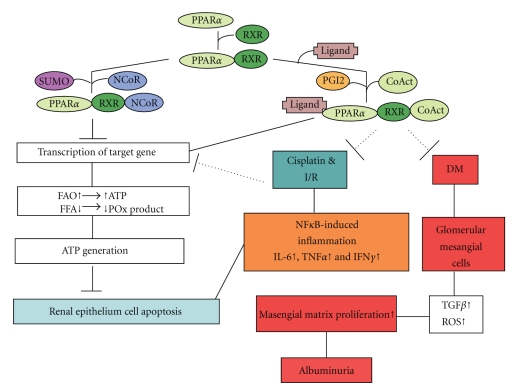
Peroxisome proliferator-activated receptor (PPAR)-α, a member of a large nuclear receptor superfamily, plays a major role in the regulation of lipid metabolism. Recently, PPARα activation has been shown to confer additional benefits on endothelial function, kidney function, and anti-inflammation, suggesting that PPARα agonists may be good candidates for treating acute renal failure. In clinical application, PPAR-α activators, such as hypolipidemic drugs in fibric acid class, were proven to have therapeutic effects on metabolic syndrome and cardiovascular disease. This paper focuses on signaling pathways, ligand selectivity, and physio-pathological roles of PPARα in kidney diseases and the therapeutic utility of PPARα modulators in the treatment of diabetes and inflammation-induced nephropathy. Implication of new and more potent PPAR-α activators could provide important insights into the overall benefits of activating PPAR-α clinically for the treatment of dyslipidemia and the prevention of diabetic or inflammation-induced nephropathy in the future.
Figures
References
-
- Berger JP, Akiyama TE, Meinke PT. PPARs: therapeutic targets for metabolic disease. Trends in Pharmacological Sciences. 2005;26(5):244–251. - PubMed
-
- Fruchart JC, Staels B, Duriez P. The role of fibric acids in atherosclerosis. Current Atherosclerosis Reports. 2001;3(1):83–92. - PubMed
-
- Fajas L, Debril M-B, Auwerx J. Peroxisome proliferator-activated receptor-γ: from adipogenesis to carcinogenesis. Journal of Molecular Endocrinology. 2001;27(1):1–9. - PubMed
-
- Mukherjee R, Jow L, Noonan D, McDonnell DP. Human and rat peroxisome proliferator activated receptors (PPARs) demonstrate similar tissue distribution but different responsiveness to PPAR activators. Journal of Steroid Biochemistry and Molecular Biology. 1994;51(3-4):157–166. - PubMed
-
- Guan Y, Zhang Y, Davis L, Breyer MD. Expression of peroxisome proliferator-activated receptors in urinary tract of rabbits and humans. American Journal of Physiology. 1997;273(6, part 2):F1013–F1022. - PubMed
LinkOut - more resources
Full Text Sources
Other Literature Sources
